Browse by Type
Results for Item type : "Conference or Workshop Item"
|
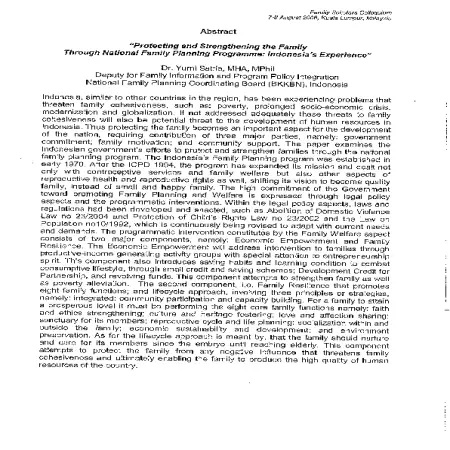
Protecting and strengthening the family through National Family Planning Programme: Indonesia's experience
Item Type: Conference or Workshop Item
Editor:
Year: 00/00/2006
Abstract: Indonesia, similar to other countries in the region, has been experiencing problems that threaten family cohesiveness, such as: poverty, prolonged socio-economic crisis, modernization and globalization. If not addressed adequately these threats to family cohesiveness will also be potential threat to the development of human resources in Indonesia. Thus protecting the family becomes an important aspects for the development of the nation, requiring contribution of three major parties, namely: government commitment; family motivation; and community support. The paper examines the Indonesian government's efforts to protect and strengthen families through the national family planning program. The Indonesia's family Planning program was established in early 1970. After the ICPD 1994, the program has expanded its mission and dealt not only with contraceptive services and family welfare but also other aspects of reproductive health and reproductive rights as well, shifting its vision to become quality family, instead of small and happy family. High commitment of the Government towards promoting Family Planning and Welfare is expressed through legal policy aspects and the programmatic interventions.
|
|
|
|
|
|
The development of antisocial behaviour in adolescence: child,family, peer and school influences
Item Type: Conference or Workshop Item
Editor:
Year: 00/00/2006
Abstract: This paper focuses on pathways to antisocial behaviour in adolescence, as well as resilience against antisocial behaviour, with particular attention being given to family influences on these pathways. Findings are presented from an ongoing, 23-year longitudinal study that has followed a large sample of Australian children from infancy to early adulthood thus far. Some of the important messages emerging from the three large reports completed between 2002 and 2005 are discussed, including: there is not one single pathway to antisocial behaviour, rather there are multiple pathways that can begin in childhood, adolescence, or early adulthood. Many children seem to embark on problematic pathways early in life, but there is considerable change at key transition points; the detection of sensitive periods of change can provide opportunities to intervene to help children move off problematic pathways; many at-risk children are resilient to the development of antisocial behaviour and we can learn from them what supports are needed; and finally, particular parenting styles can ameliorate or amplify the influence of child characteristics on antisocial behaviour.
|
|
|
|
|
|
Protecting and strengthening the family: challenges and opportunies
Item Type: Conference or Workshop Item
Editor:
Year: 00/00/2006
Abstract: Findings from the Malaysian Population and Family Survey 2004. Perceptions of relationships among family members found that as many as 98.5% of women said they had good family relationships comprising 99% Malays, 98% Chinese and 95% Indians. A total of 99% of men also stated that they have good family relationships, namely 99.2% Malays, 98.0% Chinese and 98.2% Indians. Meanwhile, 99.3% of women who did not have financial problems stated that they had good family relationships compared to 98.3% who had financial problems.
|
|
|
|
|
|
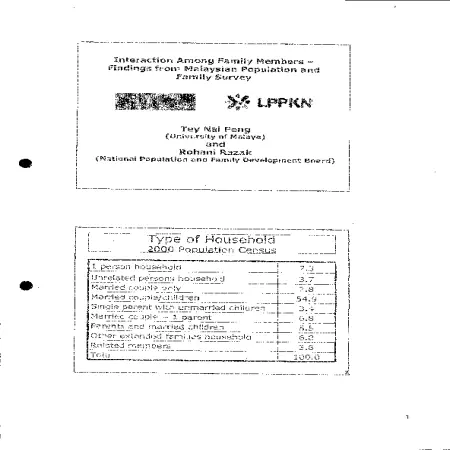
Interaction among family members: a Malaysian case study
Item Type: Conference or Workshop Item
Editor:
Year: 00/00/2006
Abstract: The perceived relationship among family members are 98.5% of women said that they have good family relationship while 99% of men said the same. Meanwhile, 99.3% of women who did not have financial difficulty stated that they have good family relationship compared to those who have financial difficulty represented by 98.3%.
|
|
|
|
|