Browse by Type
Results for Item type : "Newsletter"
|
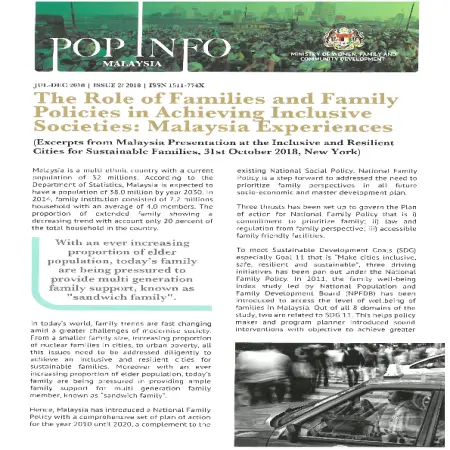
The role of families and family policies in achieving inclusive societies: Malaysia experiences
Item Type: Newsletter
Editor:
Year: 00/00/2018
Abstract: With an ever increasing proportion of elder population, today’s family are being pressured to provide multi generation family support, known as “sandwich family”. Hence, Malaysia has introduced a National Family Policy with a comprehensive set of plan of action for the year 2010 until 2020, a complement to the family well-being index. Next, community based intervention program called Family and Community Empowerment Program (FACE) and Family Impact Assessment (FIA) where an evaluation on the impact of family-related policies and program will be accessed.
|
|
|
|
|
|
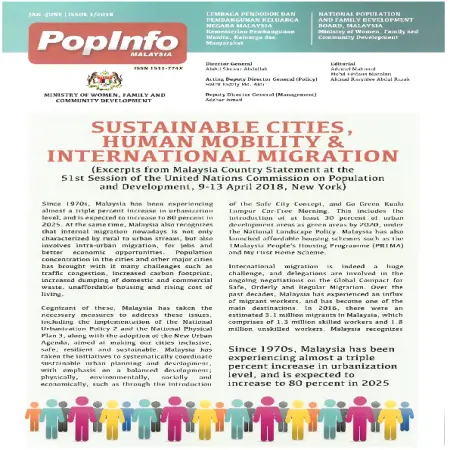
Sustainable cities, human mobility & international migration
Item Type: Newsletter
Editor:
Year: 00/00/2018
Abstract: Over the past decades, Malaysia has experienced and influx of migrant workers, and has become one of the main destinations. In 2016, there were an estimated 3.1 million migrants in Malaysia, which comprises of 1.3 million skilled workers and 1.8 million unskilled workers.
|
|
|
|
|
|
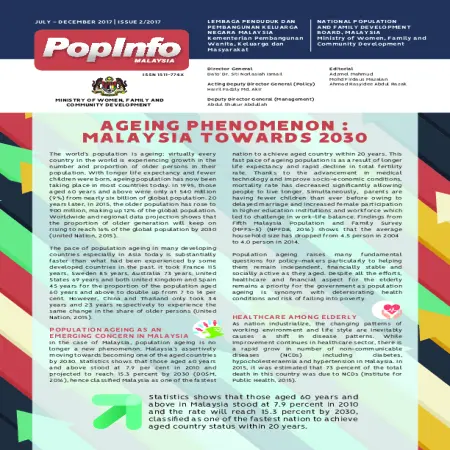
Ageing phenomenon: Malaysia towards 2030
Item Type: Newsletter
Editor:
Year: 00/00/2017
Abstract: Statistics shows that those aged 60 years and above in Malaysia stood at 7.9 % in 2010 and the rate will reach 15.3 % by 2030, classified as one of the fastest nation to achieve aged country status within 20 years. This fast pace of ageing population is as a result of longer life expectancy and rapid decline in total fertility rate.
|
|
|
|
|
|
Changing population age structures and sustainable development
Item Type: Newsletter
Editor:
Year: 00/00/2017
Abstract: Malaysia's demographic changes in structure, size and spatial distribution of families and household. These changes have created both opportunities and challenges for the Government in prescribing policies and designing initiatives to further foster the well-being as well as ensure sustainable development of current and future generations. Malaysia's population is projected to increase from 31.9 million in 2016 to 41.5 million in 2040. While the overall population of the country is projected to increase, the annual population growth rate is expected to decrease from 1.8 percent in 2010 to 0.8 percent in 2040.
|
|
|
|
|
|
Strengthening the demographic evidence base for the post-2015 development agenda
Item Type: Newsletter
Editor:
Year: 01/07/2016
Abstract: In Malaysia, the implementation of the post-2015 development agenda has obtained the highest political commitment at the national level and has continuously involved multi-stakeholders engagement under the 11th Malaysia development plans (2016-2020). Malaysia will also further improve the availability of online interactive databases and access to geo-referenced datasets disaggregated by relevant characteristics such as income, gender, age, ethnicity and disability, to ensure that no one is left behind.
|
|
|
|
|
|
Ensuring no one is left behind: the 2030 agenda for sustainable development
Item Type: Newsletter
Editor:
Year: 00/00/2016
Abstract: The 2030 Agenda for Sustainable Development, guided by the Sustainable Development Goals (SDGs) was adopted by all 193 UN Member States including Malaysia in September 2015. Through these 17 global goals and their 169 targets, Government have committed to eradicate poverty, fight inequalities, build peaceful, inclusive, and resilient societies, and secure the future of the planet and the well being of future generations over the next 15 years. The central objective of the Sustainable Development Goals is to leave no one behind.
|
|
|
|
|
|
Realizing the future we want: integrating population issues into sustainable development
Item Type: Newsletter
Editor:
Year: 00/00/2015
Abstract: Malaysia is closely monitoring the developments and discussion on the post-2015 development agenda. Malaysia believes that the post-2015 development agenda should integrate existing international commitments and outcomes of UN conferences and deliver on equality, social inclusion, decent work, and sustainable livelihoods.
|
|
|
|
|
|
Balancing the three dimensions of sustainable development: from integration to implementation
Item Type: Newsletter
Editor:
Year: 00/00/2015
Abstract: Malaysia has been able to transform from a low-income economy in the 1970s to a high middle-income economy today. Parallel to the economic achievement, Malaysia has also achieved commendable success in terms of social progress. These achievements are in line with Malaysia’s commitment to place the wellbeing of the people as the priority of its development efforts. As such, the government is committed to protect the environmental quality of life and caring for the planet, while harnessing economic value from the process.
|
|
|
|
|
|
Assessment of the status of implementation of the ICPD-POA
Item Type: Newsletter
Editor:
Year: 00/00/2014
Abstract: The International Conference on Population and Development (ICPD) held in Cairo in 1994 was a landmark in the population and development field. At this conference 179 countries, including Malaysia, adopted a 20-year program of action known as the Program of Action of the International Conference on Population and Development (ICPD-PoA). The overriding objective is to raise the quality of life and individual wellbeing and to promote human development by recognizing the complexity of the interrelationships between population and development. Malaysia has achieved most of the goals set in the ICPD-PoA. Key enabling factors such as political stability, efficient civil service, harmonious social environment, unity and strength in diversity, educated and trained workforce, abundant natural resources and effective partnership with stakeholders and NGOs contributed to the success.
|
|
|
|
|
|
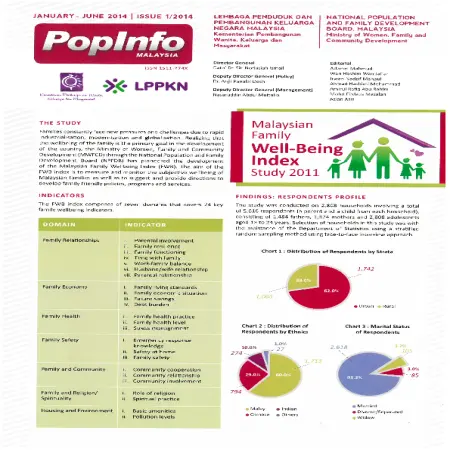
Malaysian family well-being index study 2011
Item Type: Newsletter
Editor:
Year: 00/00/2014
Abstract: Realizing that the wellbeing of the family is the primary goal in the development of the country, the Ministry of Women, Family and Community Development through the National Population and Family Development Board (NPFDB) has pioneered the development of the Malaysian Family Wellbeing Index (FWB). The aim of the FWB index is to measure and monitor the subjective wellbeing of Malaysian families as well as to suggest and provide directions to develop family friendly policies, programs and services. The study was conducted on 2,808 households involving of 5,616 respondents. Through this study, the Family Wellbeing Index (FWB) was recorded at 7.55 out of a maximum score of 10 indicating that Malaysian families have a relatively high level of wellbeing and are able to manage the challenges of development. Of the seven domains identified, the Family and Religion / Spirituality domain recorded the highest score of 8.25.
|
|
|
|
|