Browse by Type
Results for Item type : "Newsletter"
|
New trends in migration: demographic aspects
Item Type: Newsletter
Editor:
Year: 00/00/2013
Abstract: Industrialization has brought about rapid urbanization with about 7 in 10 Malaysians now residing in cities. Industrialization has also resulted in Malaysia being an attractive destination for migrants. Based on Migration and Remittances Factbook 2011 produced by World Bank, Malaysia was one of the top 30 countries in terms of number of immigrants flowing into the country in 2010. According to Census 2010, there were 2.3 million non-citizens residing in Malaysia. The majority of migrants are in the age group of ' high economic activity'. They are mainly employed in the manufacturing, agricultural and construction sectors. Employers prefer hiring foreign workers due to their willingness to work extra hours and for their relatively lower wages.
|
|
|
|
|
|
Ageing in Asia: the way forward
Item Type: Newsletter
Editor:
Year: 00/12/2012
Abstract: Ageing population is a universal phenomenon experienced by nearly all countries in the world at different rates. Malaysia, for example with a total population of 28.6 million in 2011, has experienced a steady rise in its older persons (those aged 60 years and above) from 6.3 % in 2000 to 7.7 % (or 2.2 million) in 2011. By 2020, it is estimated that the number of older persons in Malaysia will be 5.5 million and by 2030, older persons will constitute 15 % of the total population.
|
|
|
|
|
|
National experience in population matters: adolescents and youth
Item Type: Newsletter
Editor:
Year: 00/00/2012
Abstract: Adequate and accurate sexual and reproductive health information helps young people to make informed and responsible decisions. Howewer, cultural and religious sensitivities within the communities remain one of the major challenges in implementing reproductive health education for young people. Parents are still uncomfortable talking about reproductive health matters with their children ,leaving their children dependent upon information from their peers or other sources like the internet. The Government of Malaysia takes cognisance of the increasing importance of the sexual and reproductive health needs of adolescents and youth in Malaysia. Hence, the Government of Malaysia has put in place various policies and programmes to handle the sexual and reproductive health needs of the adolescents and youths. One of the main initiatives is the Healthy Programme without AIDS for Youth (PROSTAR). The Government of Malaysia also has established six youth-friendly adolescent centres known as kafe@TEEN to increase access to reproductive health information and services for young people aged 13 to 24 years.
|
|
|
|
|
|
National experience in population matters : fertility, reproductive health and development
Item Type: Newsletter
Editor:
Year: 00/01/2011
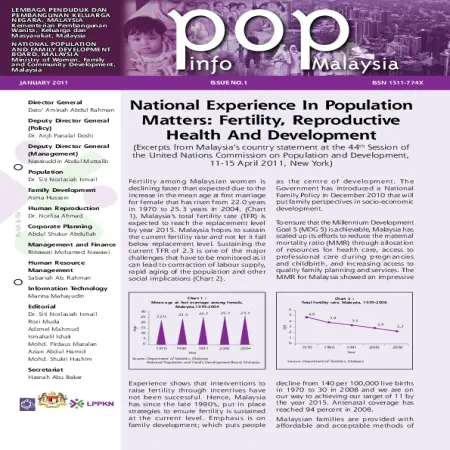
Abstract: Fertility among Malaysian women is declining faster than expected due to the increase in the mean age at first marriage for female that has risen from 22.0 years in 1970 to 25.3 years in 2004. Malaysia’s total fertility rate (TFR) is expected to reach the replacement level by year 2015. Malaysia hopes to sustain the current fertility rate and not let it fall below replacement level.
|
|
|
|
|
|
Achieving the ICPD-PoA and MDGs
Item Type: Newsletter
Editor:
Year: 00/07/2009
Abstract: Malaysia has achieved most of the goals set in the ICPD-PoA. Other development goals included in the MDGs are in the areas of poverty reduction, universal education, reductions in maternal and child mortality, gender equality and environmental sustainability.
|
|
|
|
|
|
Elderly population
Item Type: Newsletter
Editor:
Year: 00/01/2009
Abstract: The total population of the elderly (aged 60 and above) in Malaysia has reached to 2 million, that is 7 per cent out of the total of 27.6 million population. The proportion of the elderly is expected to exceed 10 per cent around the year 2025. Finding from the MPFS-4 focussed on living arrangements, elderly care, loneliness, community involvement, economic activities, sources of financial support and health status of the elderly. Data for this study was drawn from responses of a total of 1,866 elderly.
|
|
|
|
|
|
Population distribution, urbanisation, internal migration and development
Item Type: Newsletter
Editor:
Year: 00/07/2008
Abstract: Malaysia is currently experiencing an increase in population mobility mainly caused by industrialization and urbanization. Between 1970 and 2006, the proportion of population living in big cities such as Kuala Lumpur, Penang and Johor Bharu had doubled due to rapid urbanization mainly contributed by internal migration. This trend in internal migration has resulted in population redistribution due to an influx of people to the urban areas.
|
|
|
|
|
|
Population ageing
Item Type: Newsletter
Editor:
Year: 00/01/2008
Abstract: According to United Nation’s estimates, 21 percent of the population in the developed countries was aged 60 years or over in 2005. This proportion is projected to increase to 28 percent in 2025 and 32 per cent in 2050. In countries where economies are in transition, the average proportion of the population aged 60 years or over was estimated at only 8 percent in 2005 but is expected to reach 13 percent by 2025 and nearly 20 percent by 2050. Thus, the number of older persons in the developing countries will likely more than double between 2005 and 2025. This increase is much larger than in the developed countries compared to countries where the economies are in transition, where the number of older persons will grow by about 44 percent and 32 percent respectively during the same period.
|
|
|
|
|
|
The changing age structures of populations and their implications for development
Item Type: Newsletter
Editor:
Year: 00/07/2007
Abstract: The demographic transition in Malaysia is characterized by rapid declines in mortality and moderate declines in fertility. Rapid decline in mortality was due to the availability of modern medical and health facilities and the general improvement in socio-economic condition. While, steady decline in fertility due to the availability of family planning services and indirectly, due to the general improvement in the socio-economic conditions associated with development.
|
|
|
|
|
|
HIV/AIDS
Item Type: Newsletter
Editor:
Year: 00/01/2007
Abstract: Data from the Ministry of Health showed that by end of 1994 there were 3393 cases of HIV, 105 cases of AIDS and 80 cases of AIDS death. In Malaysia , the most common risk factor from HIV infection was exposure to contaminated drug injecting equipment.
|
|
|
|
|