Browse by Type
Results for Item type : "Newsletter"
|
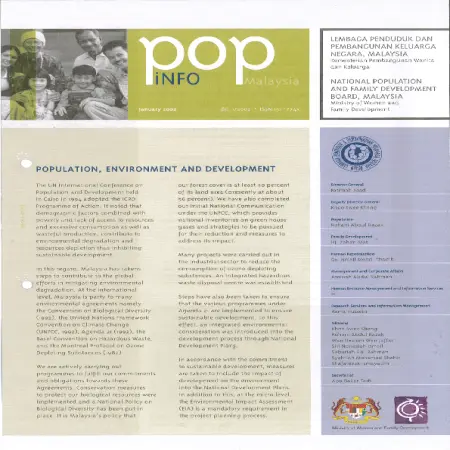
Population, environment and development
Item Type: Newsletter
Editor:
Year: 00/01/2002
Abstract: The Government has adopted a long-term strategy to carry out environmental education through a multi-disciplinary approach aimed at increasing awareness, understanding and love for environment. Towards this end, the National Population and Family Development Board (NPFDB) under the Ministry of Women and Family Development has developed two training modules. The modules are Population and Development while the other one is Population, Environment and Development.
|
|
|
|
|
|
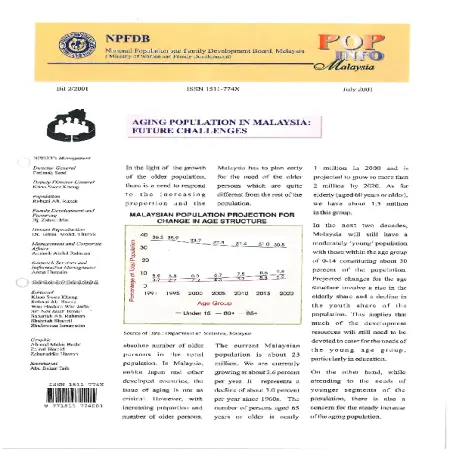
Aging population in Malaysia: future challenges
Item Type: Newsletter
Editor:
Year: 00/07/2001
Abstract: In the light of the growth of the older population, there is a need to respond to the increasing proportion and the absolute number of older persons in the total population. In Malaysia, unlike Japan and other developed countries, the issue of aging is not as critical. However, with increasing proportion and number of older persons, Malaysia has to plan early for the need of the older persons which are quite different from the rest of population.
|
|
|
|
|
|
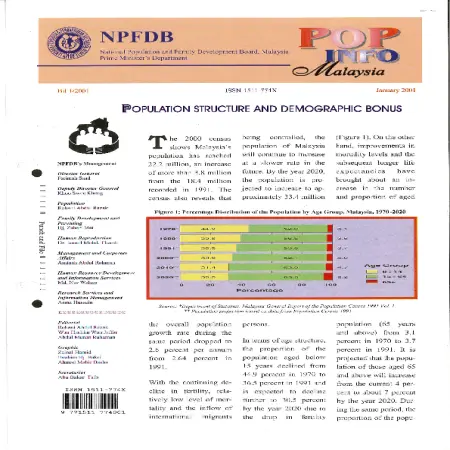
Population structure and demographic bonus
Item Type: Newsletter
Editor:
Year: 00/01/2001
Abstract: Malaysia, like several other countries in the region, will benefit from the demographic change whereby the proportion of working age group has been increasing from 52 percent in 1970 to 58 percent in 1995. Currently, this group constitutes about 60 % and assuming fertility continues to decline as projected, this proportion will continue to increase, and will reach almost 64 % by the year 2020.
|
|
|
|
|
|
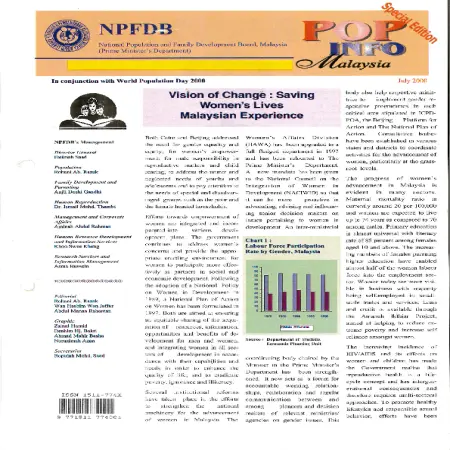
Vision of change: saving women's lives Malaysian experience
Item Type: Newsletter
Editor:
Year: 00/07/2000
Abstract: Efforts towards empowerment of women are integrated and incorporated into various development plans. The progress of women’s advancement in Malaysia is evident in many sectors. Maternal mortality ratio is currently around 20 per 100,000 and women are expected to live up to 74 years as compared to 70 among males. Primary education is almost universal with literacy rate of 85 per cent among females aged 10 and above. The increasing numbers of females pursuing higher education have enabled almost half of the women labour force into the employment sector. Women today are more visible in business with majority being self-employed in small scale trades and services.
|
|
|
|
|
|
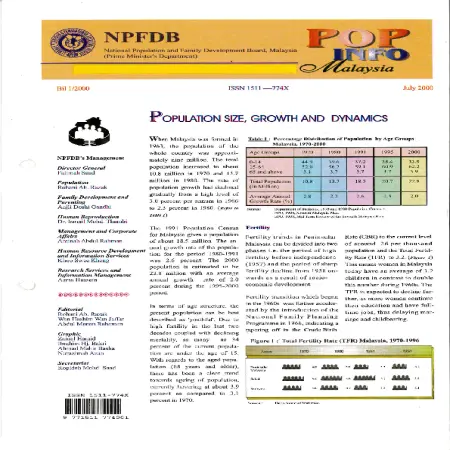
Population size, growth and dynamics
Item Type: Newsletter
Editor:
Year: 00/07/2000
Abstract: When Malaysia was formed in 1963, the population of the whole country was approximately 9 million. The total population increased to about 10.8 million in 1970 and 13.7 million in 1980. The rate of population growth had declined gradually from a high level of 3.0 per cent per annum in 1966 to 2.3 per cent in 1980. Besides, with the continuing decline in fertility, relatively low level of mortality and inflow of international migrants being controlled, the population of Malaysia will continue to increase at a slower rate in the future.
|
|
|
|
|