


PUBLICATIONS
2025 (1)
|
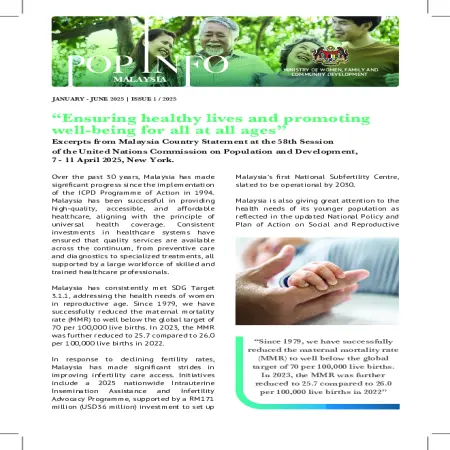
Ensuring healthy lives and promoting well-being for all at all ages
Item Type: Newsletter
Editor:
Year: 00/06/2025
Abstract: As Malaysia transitions to an aging society, the government is prioritizing the "Ageing Nation Agenda" within the 13th Malaysia Plan (RMK-13). This initiative is designed to create a robust social safety net for older persons, ensuring they live in an inclusive and supportive environment. To this end, the Government is developing the National Strategic Framework and Plan of Action for the Care Industry 2026-2030.
The National Agenda for a Healthy Malaysia (ANMS) is a key initiative to promote healthy lifestyles and create a health-conscious environment.
Our goal is to reduce the overall burden of diseases while promoting a culture of health and wellness within our communities.
|
|
|
|
|
2024 (3)
|
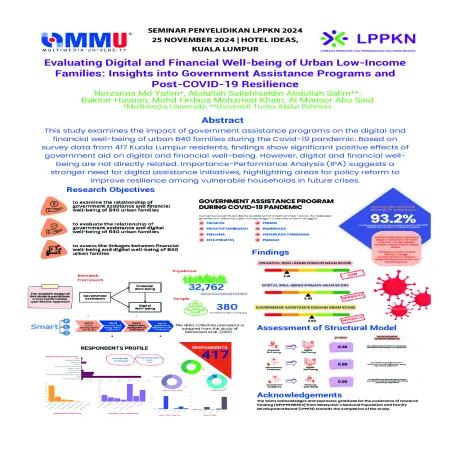
Evaluating digital and financial well-being of urban low-income families: insights into government assistance programs and post-COVID-19 resilience
Item Type: Scientific Poster
Editor:
Year: 00/11/2024
Abstract: This study examines the impact of government assistance programs on the digital and financial well-being of urban B40 families during the Covid-19 pandemic. Based on survey data from 417 Kuala Lumpur residents, findings show significant positive effects of government aid on digital and financial well-being. However, digital and financial well-being are not directly related. Importance-Performance Analysis (IPA) suggests a stronger need for digital assistance initiatives, highlighting areas for policy reform to improve resilience among vulnerable households in future crises.
|
|
|
|
|
|
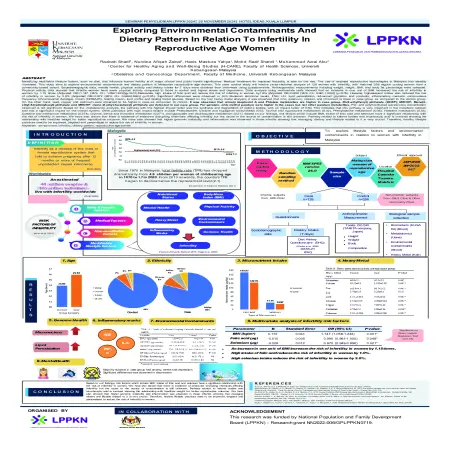
Exploring environmental contaminants and dietary pattern in relation to infertility in reproductive age women
Item Type: Scientific Poster
Editor:
Year: 00/11/2024
Abstract: Identifying modifiable lifestyle factors, such as diet, that influence human fertility is of major clinical and public health significance. Medical treatment for impaired fecundity is also on the rise. The use of assisted reproductive technologies in Malaysia has steadily increased. This study aims to explore environmental contaminants and dietary pattern in Malaysian reproductive age women. This case control study will involve cross-sectional analysis of 128 women with infertility, with matched 256 regular cycling women from a community-based cohort. Sociodemographic data, mental health, physical activity and dietary intake for 7 days were obtained from interviews using questionnaires. Anthropometric measurements including weight, height, BMI, and body fat percentage were collected. Physical activity data showed that infertile women have lower physical activity compared to those in control and higher stress and depression. Data analysis using multivariate tests showed that an increase in one unit of BMI increased the risk of infertility in women by 1.15 times [Adjusted OR=1.147 (95% CI= 1.059-1.243)])(p<0.01).Meanwhile, high intake of folic acid will reduce the risk of infertility in women by1.0% [Adjusted OR=0.990 (95% CI= 0.981-1.000)] (p<0.05). Likewise, highselenium intake also reduced the risk of infertility in women by 3.0% [Adjusted OR=0.972 (95% CI= 0.949-0.996)] (p<0.05). Significant differences were observed in Anti Mullerian Hormone levels, FSH, LH, lipid peroxidation, advanced glycation end products, inflammatory markers, micronucleus frequency (chromosomal damage), insulin (HOMA-IR), fasting insulin, lipid profile and fasting blood glucose. Based on the hair heavy metal analysis, it was observed that zinc, selenium, calcium and chromium is lower in case group as compared to the control group. On the other hand, lead, copper and cadmium were observed to be higher in case as compared to control. It was observed that urinary bisphenol A and Phtalate metabolites are higher in case group. Di-(2-ethylhexyl) phthalate (DHEP), MEHHP, Mono (2-ethyl-5-hydroxyhexyl) phthalate and MEOHP, mono (2-ethyl-5-oxohexyl) phthalate are detected in our case group. For paraben, only methyl paraben were higher in the cases but not other paraben metabolites. Per- and polyfluorinated substances) concentration observed is not significant. Based on the metabolomic analysis, the pathway with the highest impact factor was the synthesis and degradation of ketone bodies, with an impact factor of 0.60. This indicates that this pathway is very important in the metabolic network and has a significant impact on the overall system. Other pathways with high impact factors include Phenylalanine, tyrosine and tryptophan biosynthesis (0.5), Taurine and hypotaurine metabolism (0.42), Phenylalanine metabolism (0.35), Histidine metabolism (0.32), Cysteine and methionine metabolism (0.274), Glycine, serine and threonine metabolism (0.271), and glyoxylate and dicarboxylate metabolism (0.21). Based on our findings, risk factors which include BMI, intake of folic acid and selenium have a significant relationship with the risk of infertility in women. We have also shown that there is existence of endocrine disrupting chemicals affecting infertility but the cause or the source of contamination is still unknown. Pathway related to ketone bodies and tricarboxylic acid is involved showing the relationship with healthier weight for better reproductive outcome. We have also showed that higher genomic instability and inflammation was observed in those infertile showing that managing dietary and lifestyle related to it is very crucial. Therefore, healthy lifestyle practices need to be improved, targeted and personalized to reduce the risk of infertility in women.
|
|
|
|
|
|
Effect of Sexting Intervention Module (SIM) using prototype willingness to sext among undergraduate students.
Item Type: Conference or Workshop Item
Editor:
Year: 00/11/2024
Abstract: Sexting exchanging sexually explicit messages (texts, images, videos) via online. High sexting prevalence was used to rationalized the need for intervention. Implication of sexting are correlated with cyberbullying, sexual risk behavior, and mental health issues. Objectives of this research is to develop Sexting Intervention Module (SIM) using the Prototype Willingness Model, implement the intervention and evaluate the effectiveness of SIM on intention and willingness to sext among undergraduates in a public higher education institution in Melaka State. Research impact provide new evidence of effectiveness of Prototype Willingness Model (PWM) in reducing intention and willingness to sext. Previously PWM known to be effective in intervention that focus on prevention of smoking, alcohol drinking, sunless tanning, and sexual harassment. The effectiveness of PWM based intervention and animated videos supported future public health intervention toward digitalization of health education on sexting related topics among young adult. In community its increase awareness on sexting related issues and early prevention of negative implication of sexting.
|
|
|
|
|
2023 (3)
|
Emosi dan kesihatan mental ibu bapa di fasa endemik covid-19: hasil penemuan kajian tinjauan pendapat umum LPPKN di Negeri Terengganu
Item Type: Book Section
Editor:
Year: 00/12/2023
Abstract: Post Covid-19 had an impact on family institutions mainly in terms of preparation of family members especially parents in facing life post-pandemic Covid-19. This study aimed to identify the emotional and mental health levels of parents in the endemic phase of Covid-19 in Terengganu.
|
|
|
|
|
|
Employability skill model development for people with disability (PWD): A Mixed-Methods Approach
Item Type: Book Section
Editor:
Year: 00/12/2023
Abstract: A disability of a human being does not define their identity and capabilities, the skillset does. Employability skills are one of the skills which are highly valued by employers and essential for effective workforce performance. The National Health and Morbidity Survey (NHMS) 2019 report stated that 11.1% of Malaysians above 18 years old who have disabilities in Malaysia are ready for working in industry. However, employers frequently disregard PWD chances due to 'red tape' and challenges in hiring PWDs to work in their company.
|
|
|
|
|
|
Enhancing Pregnancy Outcomes in Women with Polycystic Ovary Syndrome
Item Type: Research Report
Editor:
Year: 00/01/2023
Abstract: Polycystic ovary syndrome or known as polycystic ovarian syndrome (PCOS) is an endocrine disorder and one of the main causes of anovulatory infertility in women of reproductive age, which is 15 to 49 years (Balen et al., 2016). The main characteristics of women with PCOS are ovarian dysfunction, hyperandrogenism and polycystic ovaries (Balen and Michelmore., 2002). This syndrome is associated with metabolic syndromes such as obesity, insulin resistance, diabetes mellitus type 1 (Barthemess and Naz., 2014) and arteriosclerosis (Orio et al., 2004).
The general objective of this study is to identify the demographic characteristics, clinical and medical history, of PCOS sufferers as well as appropriate treatment methods among clients seeking fertility treatment at the LPPKN Subfertility Clinic.
This study is an experimental, case control study involving female clients who come to seek fertility treatment at the LPPKN Subfertility Clinic. The chosen location is LPPKN Headquarters, Kuala Lumpur. Every female client who attends needs to meet the patient selection criteria, namely a Malaysian couple, trying to conceive for more than a year and aged between 25 to 38 years old. Every patient who faces subfertility problem is divided into two groups, namely PCOS and no PCOS.
Patients who are eligible and agree to participate in the study have gone through at least five (5) series of appointments with medical officers and nurses. A total of 167 patients participated in this study with an average age of 30 years.
|
|
|
|
|
2022 (1)
|
Examining the wellbeing of families during the acute phase of covid-19
Item Type: Book Section
Editor:
Year: 00/00/2022
Abstract: The COVID-19 pandemic and the subsequent movement restriction order (MCO) imposed an acute threat to the well-being of families caused by the threats linked to the social disruption including financial insecurity, caregiving burden, and confinement-related stress (e.g., crowding, changes to the arrangement, and routine). Also, many people have needed help even if they were not infected. This paper investigates the wellbeing of families in Malaysia during the pandemic.
|
|
|
|
|
2021 (1)
|
Empowering single mothers through institutional support: lessons from single mothers in Sabah
Item Type: Article
Editor:
Year: 00/12/2021
Abstract: Life can be challenging for single mothers. They are viewed as the most vulnerable social groups in society who often lack educational attainment, skills and social networks; thus, limiting their opportunities to compete in the labour market. Consequently, single mothers struggle to achieve financial independence and to support the well-being of their family. To help single mothers build a better life, it is crucial to provide single mothers with solid institutional support programmes. This paper explores the extent to which the institutional support programmes designed for single mothers are in accordance with the needs and expectation of the single mothers in Sabah. The views obtained from the leaders of the single mother associations show that the support programmes are useful for single mothers; however, the programmes are still inadequate to lift them out of poverty. Suggestions for improvement of the institutional support programmes for single mothers are highlighted.
|
|
|
|
|

2020 (1)
|
Executive Summary: youth intervention study: best practices of youth intervention programmes in Malaysia
Item Type: Research Report
Editor:
Year: 01/07/2020
Abstract: In the decades, Malaysia has undergone rapid economic, social and cultural changes which impacted not only the daily lives of its people but also their worldview and values. This is particularly so for young people, as excessive exposure to information from the social media, internet and pornography had inevitably influence their lifestyle and behaviour. The socio-cultural changes are likely associated with an increased rates of non-marital sexual activity, increased rates of sex partner change and increased rates of sexually transmitted infections (STIs). In 2005, the Ministry of Women, Family and Community Development through NPFDB introduced the PEKERTI Programme to be implemented at KafeTEEN adolescents centres. The programme provides reproductive health services, counseling services and education and skill building to promote a healthy life and inculcate positive attitudes and moral values among young people.
|
|
|
|
|
2017 (1)
|
Effects of socio-demographic, lifestyle and environmental factors on semen quality of men attending the sub fertility clinic in National Population and Family Development Board
Item Type: Research Report
Editor:
Year: 02/01/2017
Abstract: Couples are considered infertile if they are unable to conceive after one year of regular unprotected sex. The impact of lifestyle and environment on human fertility may vary depending on aetiology, demographic characteristics, genetic variation and other factors. As used by previous researchers, semen parameters were used to measure male infertility. Therefore, a decrease in semen quality is considered as a major factor in male infertility (http://en.wikipedia.org/wiki/Semen_quality). Previous studies (Kidd et al.2001,Eskenazi et al.2003, de La Rochebrochard and Thonneau 2003) have found that older men tend to have lower semen quality than younger ones. Testicular hyperthermia (elevated temperature) also has been known to affect male fertility. Men who like taking hot baths or sit in a sedentary position for a long time are at risk of having infertility. The objectives of this study are to identify the relationship between socio-demographic profile, lifestyle and environmental factors and semen quality, and to identify risk factors of poor semen quality among men attending the National Population and Family Development Board's (NPFDB) Subfertility Clinic. This study was done in Andrology Laboratory, NPFDB. Five hundred men from couples having their first infertility consultation between September 2010 abd June 2011 were recruited. Each patient was required to register, deposit semen and fill in the quesstionnaire. Sperm concentration, morphology and motility from semen analysis were used to study the relationship between semen quality and independent variables. Reference limits used were 15 cells x 10'6/ml, 4% and 40 %, respectively (World Health Organization, 2010). For statistical analysis, descriptive statistic, t test and ANOVA were used; 0.05 alpha value was chosen. Results showed that one-third of the study population were between 26 to 30 years of age and another one third were aged between 31 to 35 years old; mean age was 33.2. majority were Malays (71.2%), resided in Selangor (64.3%) and professionals (41.6%). Semen quality showed a negative relationship (p<0.05) with age. Meanwhile, sperm motility varied significantly for different ethnic group. Chinese (57.75%) had the highest motile-sperm compared to Malays (53.44%) and Indians (46.60%). Among lifestyles variables, frequency of sexual intercourse had a posive relationship (p<0.05) with sperm motility, whilst sedentary position had negative relationship (p<0.05) with the latter. Regression analysis was used to predict the risk factors of poor semen quality. This study found that men above 30 years old were two times more likely to have low sperm motility than men in the twenties. Moreover, less frequent sexual activity between couples was more likely (p<0.05) to have abnormal sperm compared to those who had sexual intercourse more frequently. In conclusion, this study suggested that age over 30 years and infrequent sexual activity were the risk factors to lower semen quality. Even though not regarded as a risk factor, sedentary work position had a negative impact on sperm motility. These factors may affect male fertility and cause difficulty in conception. Public awareness through advocacy programs and talks on infertility and its risk factors should be carried out regularly. Public education should be carried out to advice men to practice a healthy lifestyle and work life balance. This study has shown encouraging results, and should be replicated in the general population in Malaysia
|
|
|
|
|
2016 (2)
|
Embedding the environment sustainability for the 2030 agenda in Malaysia
Item Type: Conference or Workshop Item
Editor:
Year: 00/00/2016
Abstract: The presentation will outline the rationale and overarching vision for embedding the environment in the SDGs. These are guided by four interlocking ideas: the environment is a prerequisite for socio-economic development; human health and wellbeing depends on good environmental quality; environment has intrinsic values; and finally, protecting the environment can be a new source of economic growth.
|
|
|
|
|
|
Ensuring no one is left behind: the 2030 agenda for sustainable development
Item Type: Newsletter
Editor:
Year: 00/00/2016
Abstract: The 2030 Agenda for Sustainable Development, guided by the Sustainable Development Goals (SDGs) was adopted by all 193 UN Member States including Malaysia in September 2015. Through these 17 global goals and their 169 targets, Government have committed to eradicate poverty, fight inequalities, build peaceful, inclusive, and resilient societies, and secure the future of the planet and the well being of future generations over the next 15 years. The central objective of the Sustainable Development Goals is to leave no one behind.
|
|
|
|
|
2013 (2)
|
Ethnicity and support for parents in Malaysia
Item Type: Article
Editor:
Year: 00/12/2013
Abstract: This study analyzed support as reported by adult women to parents and parents-in-law in a multi-ethnic setting. It examined ethnic diversity and other influencing factors in the provision of support. Data utilized came from the Women sample of the 2004 Malaysian Population and Family Survey and was filtered to include the three largest ethnic groups in Malaysia- Malays, Chinesse and Indians.
|
|
|
|
|

|
Emerging patterns of Indonesia's international population mobility
Item Type: Conference or Workshop Item
Editor:
Year: 00/00/2013
Abstract: This paper attempts to examine some new trends in Indonesia’s international migration, both out-migration from and in-migration to Indonesia. More and more Indonesians have moved to other countries to pursue higher education, job opportunities and to settle down. On the other hand, rapid economic growth and the large consumer market have attracted increasing number of foreigners to work and invest in Indonesia. International population mobility is becoming a more important demographic process, with profound ramifications on economic development in Indonesia and other countries, in ASEAN and beyond.
|
|
|
|
|
2012 (1)
|
Enhancing family institution towards addressing population ageing
Item Type: Conference or Workshop Item
Editor:
Year: 00/00/2012
Abstract: Malaysia will be aged by the year 2030. The objective of National Policy for Older Persons, 2011 is to enhance the respect for and self-worth of the elderly in family, society and nation at the same time to develop the potential of the elderly so that they remain active and productive in national development and to create opportunities for them to continue to live independently and to encourage the establishment and the provision of specific facilities to ensure the care and protection of the elderly. The areas of Plan of Action: Promotion and Advocacy, Lifelong Learning, Safety and Protection, Governance and Shared Reasonability, Involvement and Intergenerational Solidarity, Research and Development.
|
|
|
|
|
2009 (1)
|
Elderly population
Item Type: Newsletter
Editor:
Year: 00/01/2009
Abstract: The total population of the elderly (aged 60 and above) in Malaysia has reached to 2 million, that is 7 per cent out of the total of 27.6 million population. The proportion of the elderly is expected to exceed 10 per cent around the year 2025. Finding from the MPFS-4 focussed on living arrangements, elderly care, loneliness, community involvement, economic activities, sources of financial support and health status of the elderly. Data for this study was drawn from responses of a total of 1,866 elderly.
|
|
|
|
|
2006 (1)
|
Emerging role of daughters in the context of new challenges and opportunities of maintaining family system
Item Type: Conference or Workshop Item
Editor:
Year: 00/00/2006
Abstract: My paper is based upon a long term study of the role of educated working women in the maintenance and revitatlisation of the institution of family in India in the urban settings in the era of modernisation. The institution of family has been stressed due to the pressures of nuclearisation and/or downward mobility in urban India. It is more pronounced among the lower-middle and middle classes where the women belonging to these sections are making large scale entry into the spheres of modern education and age employment. It has affected the norms about marriage and family in many ways for women including increase in the age at marriage and remaining unmarried due to the imperatives of career of family responsibilities. But my study has resulted into the conclusion that there is increasing visibility of 'daughter supported families' where the working daughters are performing a) central, b) crucial, and c) useful role in maintenance of the family system inspite of their remaining unmarried. This is a significant change where failure of patrilineality is duly compensated by the constructive role of unmarried working daughters in the continuity of family system.
|
|
|
|
|
1998 (1)
|
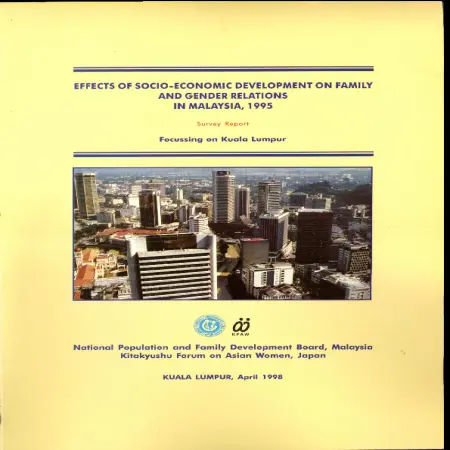
Effects of socio-economic development on family and gender relations in Malaysia, 1995: focussing on Kuala Lumpur
Item Type: Research Report
Editor:
Year: 00/04/1998
Abstract: This study attempts to inquire into the effects of socio economic development on families and gender relations in Malaysia societies living in urban areas, focusing on the capital city of Kuala Lumpur. These effects which the research attempts to study are found in the everyday lives of the Malaysian families such as family bonds, family satisfactions, identities, attitudes, norms, conjugal relations, parent and child relations and the family's support network. A total of 1,200 respondents consisting of males and females, aged 18 years and above living in and around Kuala Lumpur and within the Klang Valley had been selected for the survey.
|
|
|
|
|
1990 (1)
|
Effects of friends feminine wipes on sperm viability in-vitro
Item Type: Article
Editor:
Year: 00/12/1990
Abstract: Friend feminine wipes, disinfectant impregnanted fibre tissues meant for the maintenance of female hygiene, was evaluated for its effect on sperm viability in-vitro and found to be spermicidal. These feminine wipes are therefore not recommended for use at coitus in couples who are planning pregnancies. Although the wipes were found to have spermicidal properties they are not recommended for the purpose of contraception.
|
|
|
|
|
1987 (2)
|
Effect of centchroman on lipid metabolism in genital organs of female rhesus monkeys (macaca mulatta)
Item Type: Article
Editor:
Year: 00/06/1987
Abstract: Effect of Centchroman (3,4-trans-2, 2-dimenthyl-3-phenyl-4-p (B-pyrrolidinoethoxy)-phenyl-7-methoxy chroman)treatment at 1 and 2.5 mg/kg; for 3, 6 and 12 months on lipids constituents of uterus,cervix and vagina was studied. Centchroman did not cause any consistent pattern of alteration in lipid contents of uterus, cervix and vagina of female rhesus monkey. However, uterine phospholipids were decreased at both the doses and cervical and vaginal triglycerides increases at higher dose. The altered nature of responses in the genital organs may be due to manifestation of estrogenic-cum-antiestrogenic properties of centchroman.
|
|
|
|
|
|
Effect of norgestrel and testosterone on male rats
Item Type: Article
Editor:
Year: 00/06/1987
Abstract: Intramuscular administration of Norgestrel, an orally active progestogen, to male rats for 48 days interrupted spermatogenesis and also caused a temporary loss of libido. Testosterone therapy restored libido in progesterone treated rats but not the spermatogenic process. Consequent upon these findings, a new combination of Norgestrel and Testosterone, capable of inducing temporary sterility in male rats, has been evolved.
|
|
|
|
|
1980 (1)
 |
Ethnicity, attitude and fertility survey
Item Type: Research Report
Editor:
Year: 00/00/1980
Abstract: The objectives of this study is to provide information of ethnic differentials in fertility and associated cultural practices in Malaysia, to test hypotheses explaining the differentials or linking the differentials to cultural practices and social structure and to assess the role of the fertility differentials in perceptions of ethnic relations.
|
|
|
|