TOPICS
Results for Topics : "Population"
|
Bandar pintar inklusif warga emas: Bagaimana ketersediaan kita?
Item Type: Book Section
Editor:
Year: 01/07/2022
Abstract: The Third National Physical Plan projects that about 77% of Malaysia’s population will live in cities in 2020 and is expected to increase to 82% by 2030 and 87% by 2050. The elderly in Malaysia (those aged 60 and above) will increase from a total of 2,875 in 2015, to 5,196 million in 2030 and 9,593 in 2050. Malaysia as a developing country will experience an ageing population in the near future.
|
|
|
|
|
|
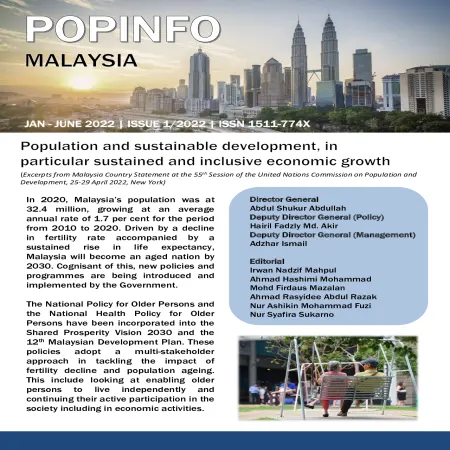
Population and sustainable development, in particular sustained and inclusive economic growth
Item Type: Newsletter
Editor:
Year: 00/05/2022
Abstract: In 2020, Malaysia's population was at 32.4 million, growing at an average annual rate of 1.7 per cent for the period from 2010 to 2020. Driven by a decline in fertility rate accompanied by a sustained rise in life expectancy. Malaysia will become an aged nation by 2030.
|
|
|
|
|
|
The 55th session of the Commission on Population and Development United Nations, New York, 25-29 April 2022
Item Type: Country Statement
Editor:
Year: 00/04/2022
Abstract: Malaysia’s socio-economic development has been significant in transforming our economy from a low income to an upper-middle-income status. We have achieved significant progress in eradicating poverty and narrowing inequalities. However, the COVID-19 crisis has resulted in vulnerable households falling into poverty and hardship.
|
|
|
|
|

|
The impact of ageing, population growth and fertility rate on economic growth: new evidence using dynamic heterogeneous panel
Item Type: Book Section
Editor:
Year: 00/00/2022
Abstract: Over the last century, a declining fertility and mortality rate have led to an ageing population. This trend was primarily found in Europe and North America prior to the past two decades, but it has since become widespread. Due to altered reproduction patterns and rising life expectancy, the ageing population will probably increase.
|
|
|
|
|
|
Preliminary investigation of cognitive abilities among B40 single mothers
Item Type: Book Section
Editor:
Year: 00/00/2022
Abstract: There have been a lot of socioeconomic research regarding the B40 income group in Malaysia but hardly any conducted among single mothers within the B40 population. Research that emphasizes on B40 group whereby RM4,850.00 is the maximum household income which represents 40 percent of Malaysians is intensely required in order to acquire the most appropriate strategies and policies that can improve their socioeconomic conditions.
|
|
|
|
|
|
Characteristics of digital resilience of children post covid-19 in the Malaysian context
Item Type: Book Section
Editor:
Year: 00/00/2022
Abstract: Over the past two decades, there has been a sharp increase in digital media usage among Malaysian children. The significant increase of online and screen time adds on to the issues of children online safety which has always posed a significant risk to parents, even before the pandemic. The opportunity given by parents to access gadgets and games has transformed the way children perceive, react, and adapt to the world change especially in the era of IR4.0. Thus, this study intends to examine the characteristics of digital resilience of children in the Malaysian context.
|
|
|
|
|
|
Academic performance and gender stereotypes among KUPTM students
Item Type: Article
Editor:
Year: 00/12/2021
Abstract: This study was aimed to find the gender differences in stereotypes. This study also seeks to identify the relationship between different levels of academic performance and stereotypes. A quantitative method was applied in this study and data was collected through the distribution of questionnaires among 230 respondents from Kolej University Poly-Tech MARA Kuala Lumpur (KUPTM KL). The result shows that there is no significant relationship between stereotypes and gender.
|
|
|
|
|

|
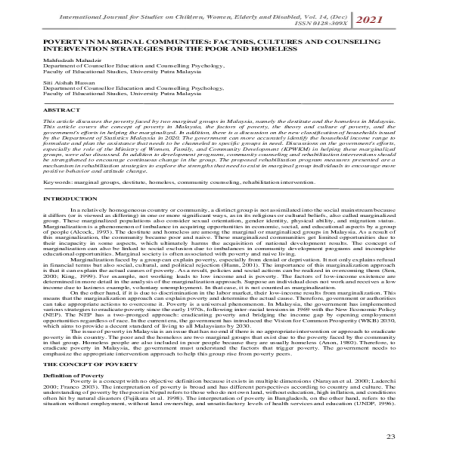
Poverty in marginal communities: factors, cultures and counseling intervention strategies for the poor and homeless
Item Type: Article
Editor:
Year: 00/12/2021
Abstract: This article discusses the poverty faced by two marginal groups in Malaysia, namely the destitute and the homeless in Malaysia. This article covers the concept of poverty in Malaysia, the factors of poverty, the theory and culture of poverty, and the government's efforts in helping the marginalized. In addition, there is a discussion on the new classification of households issued by the Department of Statistics Malaysia in 2020. The government can more accurately identify the household income range to formulate and plan the assistance that needs to be channeled to specific groups in need.
|
|
|
|
|