Browse by Subject
|
Penentuan pengaruh Psikostres terhadap kerosakan DNA dan ketakormalan residu sitoplasma sperma manusia
Item Type: Thesis
Editor:
Year: 00/00/2016
Abstract: Idiopathic infertility has been correlated with psychostress which can result in abnormality and declining semen quality in men. Nevertheless, direct relationship of semen quality and psychostress is still unclear. Hence, this study was conducted to evaluate the effect of psychostresson semen quality with emphasizing on sperm DNA damage and cytoplasm droplet abnormality. A total of 628 respondents were selected randomly among men aged between 25-45 years old were patient from LPPKN.
|
|
|
|
|


|
The 49th session of the Commission on Population and Development on agenda item 4: general debate on national experience in population matters: "strengthening the demographic evidence base for the post - 2015 development agenda", New York
Item Type: Country Statement
Editor:
Year: 00/00/2016
Abstract: The Department of Statistics Malaysia (DOSM) has been responsible for undertaking the Population and Housing Censuses of Malaysia every years since 1970. The Census remains the main source of data collection aimed at providing a comprehensive set of statistical
information about the population in the country in terms of its size and spatial distribution, its demographic, social and economic characteristics as well as housing stock at a specific time
reference. The census provides essential information not only for policy development and planning, but also for managing, monitoring and evaluating programs and activities across a broad spectrum of sectors. The 2010 Census round utilized improved ICT technologies and new approaches in the different phases of the census operation. The emerging technologies are transforming the way the Census is conducted in terms of operations management, quality assurance, data capture, mapping (GIS, GPS), data processing and storage. With the ever increasing individual privacy and accessibility of internet, the e-Census was introduced in 2010. An internet based questionnaire for data collection, was found to be more effective to capture respondents mainly in large urban areas and the gated communities.
|
|
|
|
|


|
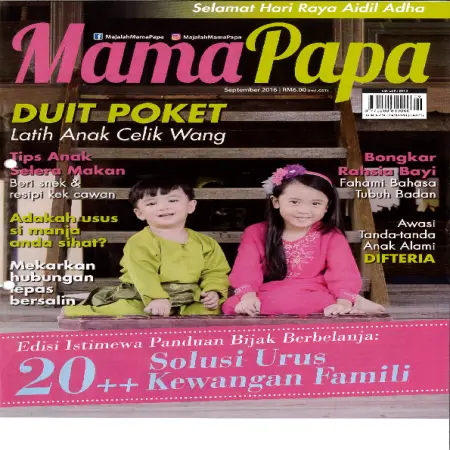
Memilih jantina bayi: bahagian 3
Item Type: Article
Editor:
Year: 00/00/2016
Abstract: The tendency to choose the sex of the baby by the couple on several factors has been discussed in the previous article (part 1 and part 2) while in this part 3 shares about other methods in science that are also said to be a factor to the determination of the sex of the baby. Among them are the "time" technique together (intercourse time), pre-implantation genetic diagnosis technique (PGD/PGS) to determine the quality of the embryo and the technique of 'prenatal sex identification' where through this technique, the sex of the baby in the womb is determined by taking blood samples from the mother and DNA tests were performed on the samples.
|
|
|
|
|
|
Gender equality and women empowerment
Item Type: Conference or Workshop Item
Editor:
Year: 00/00/2016
Abstract: The term gender equality is usually seen as synonymous with women’s empowerment. In Malaysia, the task of promoting gender equality as a vision and mission of the country’s development project has been shouldered by the Ministry of Women, Family and Community Development (henceforth KPWKM). Throughout the year, KPWKM has been focusing on empowering women in all areas of life, particularly in politics and economy. The formulation of the National Policy on Women and its ensuing Action Plan is the epitome of this effort. In addition, Gender Mainstreaming has been employed, albeit rather flighty, as KPWKM’s strategy to achieve gender equality. However, in contemporary Malaysian context, the link between gender equality and women’s empowerment has turned into a stigma that belies the importance of this development mission. This paper presentation seeks to address one of the reasons, that is, the dissemination of information about gender equality and women’s empowerment. I argue that the inconsistency and lack of strategy in the Ministry’s effort to strategically promote gender equality and women’s empowerment is a course for concern.
|
|
|
|
|
|
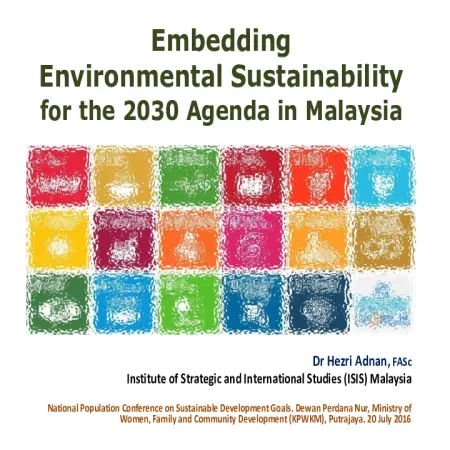
Embedding the environment sustainability for the 2030 agenda in Malaysia
Item Type: Conference or Workshop Item
Editor:
Year: 00/00/2016
Abstract: The presentation will outline the rationale and overarching vision for embedding the environment in the SDGs. These are guided by four interlocking ideas: the environment is a prerequisite for socio-economic development; human health and wellbeing depends on good environmental quality; environment has intrinsic values; and finally, protecting the environment can be a new source of economic growth.
|
|
|
|
|