Browse by Subject
|
Strategi kelangsungan hidup pekerja asing warga Indonesia dan implikasi sosial akibat kehadiran mereka di Sabah
Item Type: Conference or Workshop Item
Editor:
Year: 00/00/2012
Abstract: Sabah's direction focuses on the development of 3 main sectors such as agriculture, tourism and manufacturing to drive the economy. As an agro -economy -based state, the 2010 census recorded 30 per cent of the total workforce engaged in the agricultural sector. As locals are not interested in seizing employment opportunities in the 3D -based agriculture and plantation sector (Difficult, Dirty & Dangerous), job vacancies are filled mainly by Indonesian workers as shown in data obtained from Temporary Work Visit Passes (TWVP). Certainly, their presence has social implications for the state of Sabah which housed 27.7 percent of the foreign population in 2010. Therefore, a micro study needs to be conducted to understand and analyze this situation. A joint study was conducted with NPFDB, in which a total of 896 respondents consisting of Indonesian workers from the plantation, manufacturing, construction, services and informal sectors were interviewed in a survey in the Tawau Division in 2010. In addition, primary data were also collected from interviews. Conducted among legal and illegal employees as well as based on the researcher’s observations. Interviews with government officials directly involved with the management and recruitment of foreign workers were also conducted. Secondary data were obtained from various government agencies in Sabah such as the Immigration Department, Manpower Department, Statistics Department, Health Department and Education Department. This study successfully identified 5 survival strategies that are often used by Indonesian workers to ensure the success of their migration, namely family networking, choice of residence, cultural adaptation and assimilation, economic survival and involvement in social and political institutions. Of course, the implementation of this strategy has a social impact on the local people. Important findings of this study show that most Indonesian workers come to Sabah with family members. Certainly the presence of spouses and children has huge implications for social facilities especially health and education. Therefore, there must be integration between the entry of foreign workers with Sabah's development planning, especially if the dependence on foreign labor continues until Sabah achieves the status of a technology - intensive economy in the future.
|
|
|
|
|
|
Kontraseptif kecemasan: kesedaran dan penggunaannya
Item Type: Conference or Workshop Item
Editor:
Year: 00/00/2012
Abstract: Emergency contraceptive (EC) is one of the methods of contraception used after unprotected sex. With proper use, this method of emergency contraception can help reduce the problems of unplanned or unwanted pregnancies that have been frequent in recent times. The objective of this study was to identify women’s awareness of emergency contraceptive methods and their level of use. The research method involved the distribution of questionnaires to 1000 women, aged 15 to 49 years, who attended programs organized by NPFDB. Data collection and analysis was carried out using SPSS 11.5 software. The chi -square test was used to study the relationship between the sociodemographics of the respondents and the variables studied. The coverage of the study consisted of 84% Malay women, and was followed by Indians (9%) and Chinese (6%). The majority of respondents (43%) were in the range of 25 to 34 years, with a mean age of 33 years. Contraceptive use among respondents was found to be 26.3%, of which 98% were married women. The study found that women’s awareness of EC and its level of use was low, being only 29% and 3.9%, respectively. The chi -square test results showed that the level of awareness of EC increased with age (p <0.05). In addition, more highly educated women were found to have heard of EC (p <0.05) compared to low levels. Most EC users are from the married group. Nearly 70% of women who are using contraceptives are found to have used EC. Among women who have never used EC, only 21% are interested in using it in the future. However, the majority (70%) support this service provided at NPFDB. The lack of exposure on EC results in the number of women interested in using it being low. Therefore, NPFDB and related parties need to enhance promotional activities, advocacy and learning of emergency contraceptive methods, in addition to other methods, so that the community knows about it and can use it during emergencies.
|
|
|
|
|


|
Population aging in China: features, challenges & strategies
Item Type: Conference or Workshop Item
Editor:
Year: 00/00/2012
Abstract: Global response to population aging is confronted by a series of severe challenges, for example retirement and medical/caring costs adds to fiscal burdens, population aging withers the labor force, development and aging problems intermingle as growth of the aged population mostly takes place in developing countries and poverty of the aged remains an acute problem. All these issues may only be addressed when national governments all over the world take the needs of the aged into full consideration in developing their social policies, establish specific strategies for responding to population aging and incorporate such strategies into long-term national development frameworks. Population aging also reflects the progress and achievement that the human society has made in extending life expectancy, improving mother and child health and helping women realize family planning. Seniors are more than just beneficiaries of social welfare. As producers, consumers, spreaders of traditional cultures, care-takers of children in their families and communities, seniors also play positive irreplaceable roles. A shared goal for us all therefore is to regard aging as an achievement, respond to age-related issues with a positive, optimistic and rational altitude, view skills, experiences and resources of the elderly as capital of the social development course, incorporate aging into our development agendas, promote positive aging and thereby construct a sharing society regardless of age.
|
|
|
|
|
|
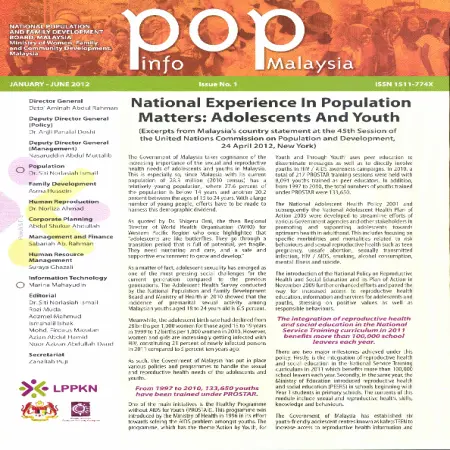
National experience in population matters: adolescents and youth
Item Type: Newsletter
Editor:
Year: 00/00/2012
Abstract: Adequate and accurate sexual and reproductive health information helps young people to make informed and responsible decisions. Howewer, cultural and religious sensitivities within the communities remain one of the major challenges in implementing reproductive health education for young people. Parents are still uncomfortable talking about reproductive health matters with their children ,leaving their children dependent upon information from their peers or other sources like the internet. The Government of Malaysia takes cognisance of the increasing importance of the sexual and reproductive health needs of adolescents and youth in Malaysia. Hence, the Government of Malaysia has put in place various policies and programmes to handle the sexual and reproductive health needs of the adolescents and youths. One of the main initiatives is the Healthy Programme without AIDS for Youth (PROSTAR). The Government of Malaysia also has established six youth-friendly adolescent centres known as kafe@TEEN to increase access to reproductive health information and services for young people aged 13 to 24 years.
|
|
|
|
|
|
The prevalence of work-family conflict among mothers in Peninsular Malaysia
Item Type: Article
Editor:
Year: 00/11/2011
Abstract: Achieving work-family balance is dependent on managing the conflict between work and family roles. This study focuses on the prevalence of work-family conflict among mothers in Peninsular Malaysia. The objective of this study is to examine the relationship between perceived work-family conflict and socio-demographic and family characteristics of the mothers. Data were obtained from 801 currently working mothers (with at least having one child) who were between 15 and 49 years old in Peninsular Malaysia interviewed in the Fourth Malaysian Population and Family Survey (MPFS-4), 2004. The result of this study showed that ethnicity, age and employment are the main factors contributing to the prevalence of work-family conflict. However, there is no significant relationship between the prevalence of conflict and the studied family characteristics, namely, number of children, childcare arrangement and presence of children aged 7 to 24 years.
|
|
|
|
|

|
Indonesian labour migration to Sabah: causes and implications
Item Type: Conference or Workshop Item
Editor:
Year: 01/07/2011
Abstract: There is increasing interest among policymakers and researchers in the relationship between migration and development in low and middle income countries (United Nations, 2006). However, there remains a lack of empirical evidence on the impact of migration on economies of origin and destination, especially in Asia and Africa. This paper reports on one of the most substantial global migration corridors (World Bank, 2011) – that linking Indonesia and Malaysia. In 2009 it is estimated that migrants in Malaysia numbered 2 million, around a half of whom were Indonesians. It is based predominantly on a substantial survey of Indonesian labour migrants working in the East Malaysian state of Sabah undertaken in 2010. The paper begins with a brief discussion of contemporary thinking on the relationship between migration and development as a basis for examining the situation in Sabah. Some key features of the movement between Indonesia and Malaysia, especially that directed to Sabah, are then discussed. The economic contribution of Indonesian migrant workers is first examined in Sabah and then in the home areas of the Indonesian migrant workers. The paper then discusses the policy implications of these findings, especially in the Malaysian context.
|
|
|
|
|

|
The 44th session of the Commission on Population and Development on agenda item 4: general debate on national experience in population matters: fertility, reproductive health and development, 11th April, 2011
Item Type: Country Statement
Editor:
Year: 11/04/2011
Abstract: Fertility among Malaysian women is declining faster than expected due to the increase in the average age at first marriage for women that has risen from 24.7 years in 1991 to 25.3 in 2004. Malaysia's total fertility rate (TFR) is expected to reach the replacement level by year 2015. With more and more women participating in the labour force and prioritising career development, this has also led to many highly educated women choosing to marry late or not to marry at all.
Malaysia hopes to sustain the current fertility rate and not let it fall below replacement level. Sustaining the current TFR of 2.3 is one of the major challenges that has to be monitored as it can lead to contraction of labour supply, rapid aging of the population and other social implications.
|
|
|
|
|
|
National Family Policy
Item Type: Act & Policy
Editor:
Year: 00/03/2011
Abstract: Malaysia is one of the few countries that has an explicit policy on family. The National Family Policy (NFP) was launched on 19 March 2011. It advocates the concept of family wellbeing based on family values such as caring, honesty, justice and equity regardless of status, gender and age. At the macro level, the policy will be the catalyst to urge all stakeholders to take into account the family perspective in all their planning, strategy formulation or development efforts, either through their commitment, formulation or review of policies and laws that are not family friendly to ensure that programmes, services and family friendly facilities are accessible.
|
|
|
|
|
|
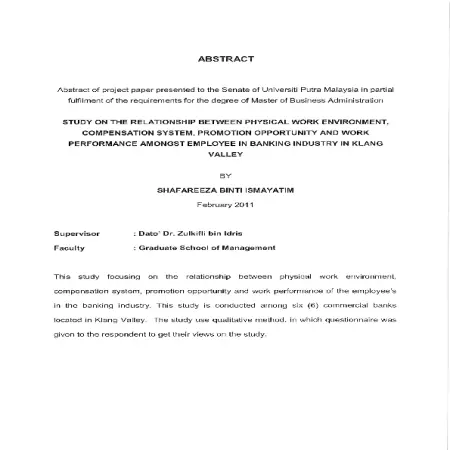
Study on the relationship between physical work environment, compensation system, promotion opportunity and work performance amongst employee in banking industry in Klang Valley
Item Type: Thesis
Editor:
Year: 01/02/2011
Abstract: This study focusing on the relationship between physical work environment, compensation system, promotion opportunity and work performance of the employee's in the banking industry. This study is conducted among six (6) commercial banks located in Klang Valley. The study use qualitative method, in which questionnaire was given to the respondent to get their views on the study. As for this study, the six selected banks and employees were chosen using the simple random sampling method. A total of 150 questionnaires were distributed to the employees and 120 questionnaires were returned and usable for further analysis. This study used Statistical Package for Social Science (SPSS) version 18.0 to analyze the data. The study found that physical working environment, compensation system and promotion opportunity have a positive relationship with the employee's work performance. All of the elements had only a low level significance relationship with work performance. However, from the three elements, promotion opportunity was the highest significance level of relationship, followed by the physical work environment and lastly the compensation system. This means that employee's work performance thus not much affected by the physical work environment, compensation system and promotion opportunity that organization have provided or introduced.
|
|
|
|
|