Browse by Subject
|
Malaysia makin menua dan masa depan sumber manusia
Item Type: Conference or Workshop Item
Editor:
Year: 00/08/2025
Abstract: Malaysia is heading towards an aging country where by 2030, 5.8 million of Malaysia's total population will be aged 60 and above. The total fertility rate is also decreasing. Various initiatives from the government need to be planned and implemented to face the aging era.
|
|
|
|
|
|
Breast Cancer Screening Via Mammography in Johor under Women Cancer Reproductive Awareness (WCARE) Campaign
Item Type: Conference or Workshop Item
Editor:
Year: 00/08/2025
Abstract: Breast cancer is the most commonly diagnosed cancer among women in Malaysia with increasing observed in both urban and semi urban population. Johor has the highest incidence of breast cancer in Malaysia with 6,564 cases reported between 2012 and 2016 most detected at late stages. Mammography is the most effective method for early detection of breast cancer, particularly among women aged 40 years and above. In Johor mammography service are available through government hospital, private centers, National Cancer Council Malaysia (MAKNA) and Klinik Nur Sejahtera under the National Population and Family Development Board (NPFDB)
|
|
|
|
|
|
Bujang lewat usia: meneroka dinamika perkahwinan lewat dalam kalangan wanita dan lelaki Malaysia
Item Type: Conference or Workshop Item
Editor:
Year: 00/08/2025
Abstract: Family institutions indeed play an important role in ensuring stability in society. However, nowadays many individuals choose to marry late. In this study, social and psychological factors have been identified as the main contributing factors to late marriage among women and men. This change has both positive and negative effects on their lifestyles, and late marriage has emerged as a significant issue for population growth even though it has some positive impacts.
|
|
|
|
|
|
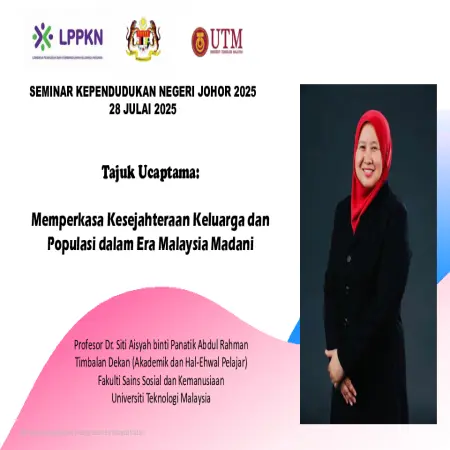
Memperkasa kesejahteraan keluarga dan populasi dalam era Malaysia Madani
Item Type: Conference or Workshop Item
Editor:
Year: 00/08/2025
Abstract: Family well-being encompasses the balance of physical, emotional, social, and spiritual aspects as well as environmental support. It creates a harmonious and happy atmosphere within the family. Statistics indicate that prosperous families improve the quality of life. It also contributes to the social stability of the country. The concept of Malaysia Madani emphasizes inclusive development based on noble values and social well-being. It is in line with Islamic principles that prioritize the welfare of the people and national harmony.
|
|
|
|
|
|
Situasi kemiskinan dan peranan Kerajaan dalam menanganinya
Item Type: Conference or Workshop Item
Editor:
Year: 00/08/2025
Abstract: Malaysia's poverty statistics show a total of 295,706 households, consisting of 295,256 poor households and 450 hardcore poor households. The government plays a role in terms of policy formulation, provision of aid, social protection, job offerings, income improvement, education/human capital, and infrastructure/housing. Sejahtera MADANI is one of the initiatives for public welfare.
|
|
|
|
|
|
Jenayah Kewangan: ancaman kepada warga emas
Item Type: Conference or Workshop Item
Editor:
Year: 00/08/2025
Abstract: Every hour an elderly person in Malaysia becomes a victim of financial fraud. From January to August 2024, there were 21,535 online fraud cases involving 1,916 victims or 8.9% elderly people. Financial crime is not just a loss of money but also dignity and peace of mind.
|
|
|
|
|
|
Fenomena penuaan penduduk di Malaysia
Item Type: Conference or Workshop Item
Editor:
Year: 00/08/2025
Abstract: The rapid decline in fertility rates accelerates the country's aging process. The country is potentially facing population shrinkage by 2072. The country is expected to reach the status of an "Aged Nation" by 2030. The rapid aging process will become a challenge if the country's income is insufficient. The country will experience a contraction in the labor force. High productivity needs to be the main driver of the country's economic growth after 2027. Interventions to stop the decline in fertility rates need to be implemented.
|
|
|
|
|
|
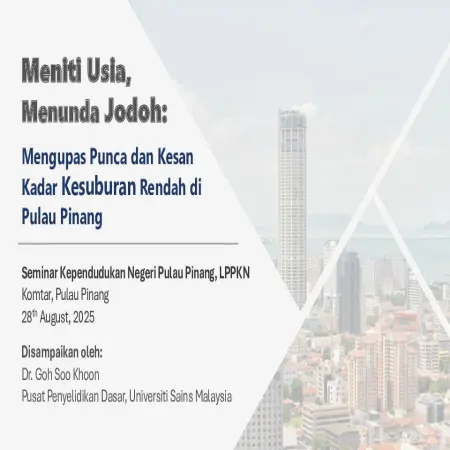
Meniti usia, menunda jodoh: mengupas punca dan kesan kadar kesuburan rendah di Pulau Pinang
Item Type: Conference or Workshop Item
Editor:
Year: 00/08/2025
Abstract: Penang is currently facing persistently low fertility rates as well as rapid population aging. The main factor identified is the low marriage rate, especially among non-Muslims. Policy suggestions to address the low marriage rate include exposing the public to the importance of having more than two children; implementing affordable housing schemes specifically for young couples and newlyweds; and fostering the value of marriage through awareness and educational programs, educating young people about the benefits of marriage, as well as addressing misconceptions about marriage.
|
|
|
|
|
|
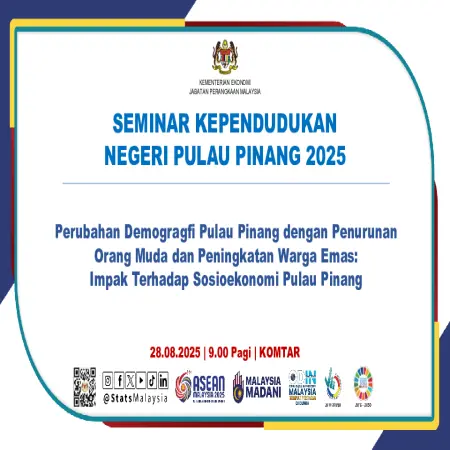
Perubahan demografi Pulau Pinang dengan penurunan orang muda dan peningkatan warga emas: impak terhadap sosioekonomi Pulau Pinang
Item Type: Conference or Workshop Item
Editor:
Year: 00/08/2025
Abstract: Population aging is a global phenomenon in which the number of elderly people contributes to a large part of the total population of a country. This scenario will occur when the birth rate decreases, the mortality rate stabilizes in line with advancements in healthcare services, and consequently, the life expectancy of the population in a country increases. Globally, we have reached an aging society where the growth of the elderly population exceeds that of the working-age population. An aging population impacts the reduction of productive labor; changes in the economic structure; increased government financial expenditure; pressure on the healthcare system; changes in social and demographic structures; and the preservation of culture and traditions.
|
|
|
|
|
|
Perkhidmatan subfertiliti LPPKN
Item Type: Conference or Workshop Item
Editor:
Year: 00/08/2025
Abstract: LPPKN provides subfertility services to raise awareness and education on fertility and reproductive health; empower access to fertility treatments and reproductive health services; organize community engagement programs and support services focused on fertility issues and family well-being; establishment of the National Subfertility Center and others. The subfertility treatments provided are Intrauterine Insemination (IUI) and In Vitro Fertilisation (IVF)
|
|
|
|
|