Browse by Subject
|
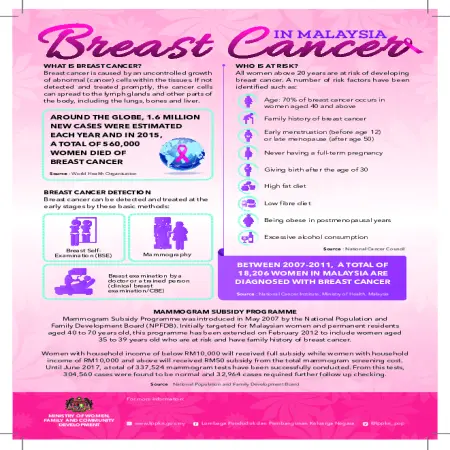
Breast cancer in Malaysia
Item Type: Infographic
Editor:
Year: 00/10/2017
Abstract: The infographic shows the statistic of breast cancer in Malaysia. Breast cancer is caused by an uncontrolled growth of abnormal (cancer) cells within the tissues. If not detected and treated promptly, the cancer cells can spread to the lymph-glands and other parts of the body, including the lungs, bones and liver.
|
|
|
|
|
|
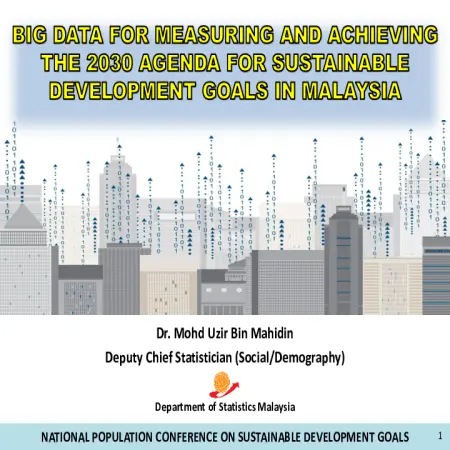
Big data for measuring and achieving the 2030 agenda for sustainable development goals in Malaysia
Item Type: Conference or Workshop Item
Editor:
Year: 00/00/2016
Abstract: The Sustainable Development Goals (SDGs) have set 17 goals and 169 related targets to be achieved by 2030. In line to support SDGs indicators, Big Data plays a pivotal role to achieve the aspiration by providing real time information and evidence-based decision making through the predictive analytics. Thus, Big Data Analytics (BDA) has become a top priority for Malaysia’s government and one of the key pillars for national ICT development under the 11th Malaysia Plan. In becoming a leading statistical agency internationally by 2020, DOSM has taken efforts to utilise big data to improvise outcome and produce a more comprehensive and quality services. DOSM is vital to ensure the statistical products and services are able to fulfil users’ expectations. In tandem with DOSM's Transformation Plan 2015-2020 and aiming to make the most of the fast-growing volume of digital data, DOSM has initiated the implementation of Big Data Analytics under the project of StatsBDA. This presentation aims to highlight DOSM’s experiences in constructing official statistics by using big data which is aligned to the 2030 Agenda for SDGs. In addition, we will also share on the issues and challenges faced by DOSM pertinent to utilising the Big Data.
|
|
|
|
|
|
Bijak berbelanja, keluarga bahagia
Item Type: Article
Editor:
Year: 00/09/2015
Abstract: Building a family requires knowledge of proper financial management. Both before and after marriage, financial problems will always linger in our minds, especially when family members are increasing. Seven (7) quick guides on family financial management using SmartBelanja Module for mutual benefit i.e. intention to save, have fixed and additional income, distribution of income money immediately for certain payments, make savings, always discuss with family members to avoid wastage and always pray that sustenance is always a blessing.
|
|
|
|
|

|
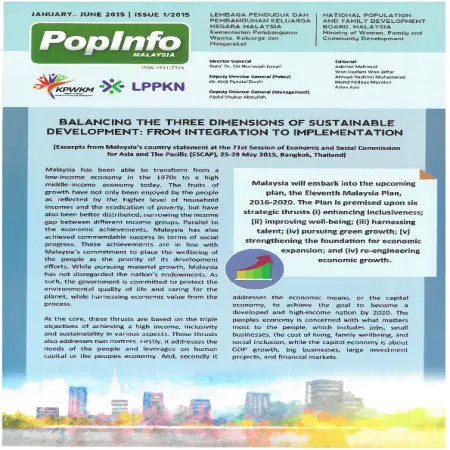
Balancing the three dimensions of sustainable development: from integration to implementation
Item Type: Newsletter
Editor:
Year: 00/00/2015
Abstract: Malaysia has been able to transform from a low-income economy in the 1970s to a high middle-income economy today. Parallel to the economic achievement, Malaysia has also achieved commendable success in terms of social progress. These achievements are in line with Malaysia’s commitment to place the wellbeing of the people as the priority of its development efforts. As such, the government is committed to protect the environmental quality of life and caring for the planet, while harnessing economic value from the process.
|
|
|
|
|
|
Bringing up mentally challenged children
Item Type: Article
Editor:
Year: 00/00/2014
Abstract: Children who are mentally challenged are often referred to as being intellectually disabled. It is characterized by below-average intelligence or mental ability (i.e. learning, reasoning, problem solving, etc.) and a lack of adaptive behaviour required for day-to-day living (i.e. interpersonal skills, self-esteem, ability to follow rules/obey laws).
Numerous factors can facilitate its onset, but more noticeably; genetic predisposition (i.e. Down Syndrome), complications during pregnancy or childbirth (substance abuse), injury (i.e. near drowning), trauma (i.e. severe parental neglect) or an infection (i.e. meningitis).
|
|
|
|
|

|
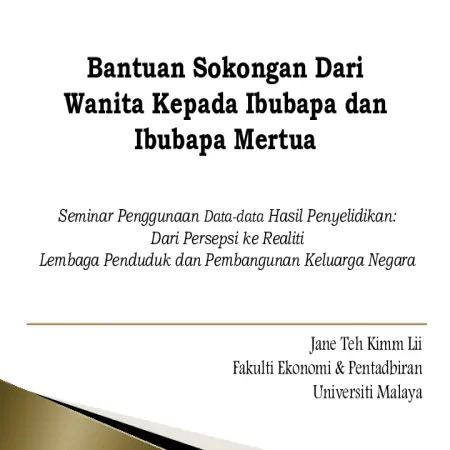
Bantuan sokongan dari wanita kepada ibubapa dan ibubapa mertua
Item Type: Conference or Workshop Item
Editor:
Year: 00/00/2012
Abstract: This study investigated ethnic diversity and other influencing factors among Malaysian women in Peninsular Malaysia in providing tangible support to their parents and parents-in-law. Data from the Women Sample of Malaysian Population and Family Survey (2004) was utilized. Tangible support was defined as either co-residing with parents (or in-laws), or financial/material transfers. Using logistic regression, we estimated the support to parents and parents-in-law separately. All possible pairwise interactions were tested using likelihood ratio test and Wald statistics, and significant interactions were added into each main effects model. Results revealed ethnic diversity in support. More offspring of women reduced support to parents only, while higher socioeconomic status of women increased support to both parents. Results also revealed that most divorcees co-resided with parents. Overall, most Malaysian women provide support to both sets of parents. Social policy should address opportunities for improving social mobility in women.
|
|
|
|
|