


Browse by Subject
|
Factors contributing to resilient attitude formation among excellent children from low SES single parent family
Item Type: Conference or Workshop Item
Editor:
Year: 00/00/2009
Abstract: The present study aims to identify the factors that contribute to resilient attitude formation among children who scored excellent results in UPSR. This study used a descriptive research design (Issac, 1995; Kerlinger, 1979). Samples were selected using purposive sampling since the study is only limited to single parent's family from low sosio-economic status (SES). Samples consisted of low SES single parents (mothers) from rural areas. This study was carried out in two phases; (i) structed interview with single parents (n=15) and (ii) handing out questionnaires and interviewing children (boys, n=6 and girls, n=9). The researcher has divided the interview into two types, namely the unstructured interview and the structured interview. Samples were interviewed and their stories were analyzed using the constant comparative method. Transcript data were coded and analyzed using the grounded theory approach (Strauss & Corbin, 1998). Recurring words, phrases and themes in the transcripts were coded commonalities and contradictions within and among the interviews were noted. While constantly comparing the data, themes and meanings were analyzed to develop theoretical, interpretations and implications of the data. After the data had been analyzed, results were compared with the literature to determine the degree to which the findings confirmed prior research.
|
|
|
|
|
|
Families exposed to poverty-asssociated and parent effectiveness service
Item Type: Conference or Workshop Item
Editor:
Year: 00/00/2009
Abstract: Economic problem ranks highest as a source of family stress among the poor families which are often addressed with functional coping activities such as borrowing money, getting extra job or overtime work. Frequently, loans are availed of from relatives, employer or co-employees, friend and "5-6" lenders. Oftentimes, earning children and close relatives offer support or are tapped in times of financial crisis. Likewise, there is a thin line interfacing economic problem with situational and relationship stressors such as spouse having vices of drinking alcohol, misunderstanding about house rules and differences in discipline children, spouse's in difference; children misbehaviour, work related pressures and wife's nagging and etc. by and large, these families exposed to proverty-associated risks still value family life and spirituality tend to permeate their response towards difficulties. Efforts at addressing the socio-economic conditions and other concomitant problems of these families should be seen within the family framework. In this context, Parent Effectiveness Service (PES) is being implemented by an NGO in six (6) poor villages in a rural area in the Philippines alongside with other service. The main reference for the conduct of parent effectiveness sessions is the Manual on Effective Parenting developed by Department of Social Welfare and Development (DSWD) and UNICEF Philippines. Each module was written with the end-in-view of what Filipino parents need to know to better preserve the family. Despite the slow implementation, there are promising signs thet PES can serve as a preventive program that builds and strengthen the families to transcend proverty-associated risks when facilitated by professional helpers, specifically the field social workers. Awareness and raising the consciousness of parents on their role in childs socialization and it's implication to upholding society's convictions, values systems and norms are necessary in achieving a wholesome family and community life. Moreover, it is also a venue to identify and assess family functioning that may need imperative and appropriate social work intervention. Thus, interventions for children and the youth, women and the elderly should be within the framework of a family orientation to ensure integration rather than fragmentation of program efforts.
|
|
|
|
|
|
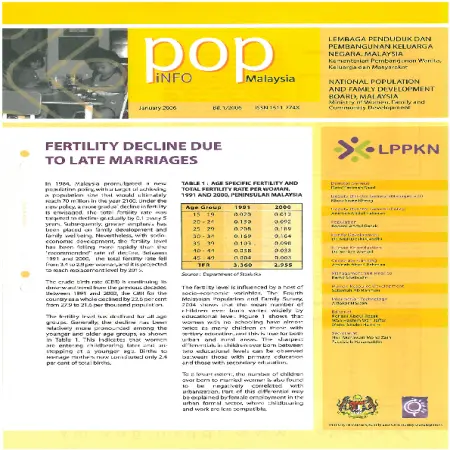
Fertility decline due to late marriages
Item Type: Newsletter
Editor:
Year: 00/01/2006
Abstract: Rising education, delayed and non-marriage will become more prevalent. Marriage postponement shortens childbearing span, and it will result in further fertility decline. Changes in marital structure have significant implications on the family system and the care of older persons. With rising age at marriage and consequently delayed childbearing , many retirees are still supporting children who are studying in institutions of higher learning.
|
|
|
|
|
|
Fertility transition in Asia in relation to family and population aging
Item Type: Conference or Workshop Item
Editor:
Year: 00/00/2006
Abstract: Declining fertility and increasing longevity have brought about remarkable shifts in the age structure of the population. Europe, Northern America and Australia/New Zealand initially experienced one of such inevitable demographic events, that is population aging. While the transition from the young-age population to the aging population occurred over a much longer period in the West, the speed of aging is much faster in low-fertility countries of Asia. This has now emerged as a new issue challenging many low-fertility countries in Asia, as it has implications for the family and caring for the older persons. This paper provides a general overview of the fertility transition in Asia and factors affecting the fertility decline. Focusing on low-fertility countries in Asia, the paper highlights the implications of low fertility on population aging. Various indicators of population aging, such as the changes in age structure, potential support ratio and feminization of the elderly population, are presented for a better understanding of the overall situation. Comparisons are made with Europe, Northern America and Australia/New Zealand to put forward the magnitude of the challenge. As the Asian region contains over 60 percents of the global population and has experienced a rapid decline in fertility, the absolute size of the older population is a major concern. While the overall population growth rate has been declining over time, the number of older persons is increasing at a rate at least twice as high. In addition to the increase in older persons, a gender disparity in the improvements in the life expectancy at birth is likely to be illiterate and living in poverty. Providing family support, health care and financial security are some of the contentious issues aging societies will face. There have been discussions concerning the possibility of increasing fertility in countries with below replacement fertility. It is, therefore, crucial for governments to plan for an aging society long before fertility reaches a very low level. Meanwhile, it is important for Asian countries to recognize the significance of aging problems and start formulating policies for the elderly given that it takes several decades for government old-age pension insurance schemes to mature and operate at full scale. It would be more difficult for families to care for their older members because families would be smaller, people would live longer and the migration of young adults would mean that families would fragment. the present trends present a major challenge to address the needs of families. It is, therefore, important to consider the present trends in designing social policies, put the family at the centre of any future social policy development and examine good national practices when designing a new approach to family policies.
|
|
|
|
|
|
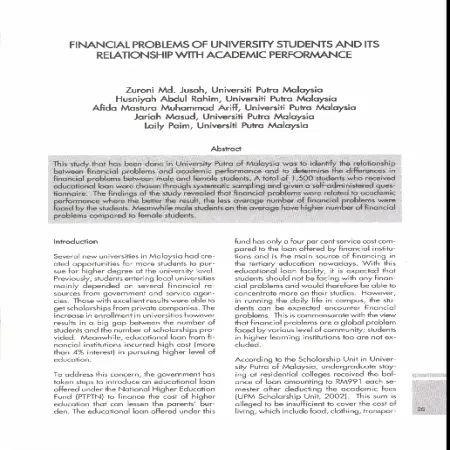
Financial problems of university students and its relationship with academic performance
Item Type: Article
Editor:
Year: 00/01/2004
Abstract: This study that has been done in University Putra of Malaysia was to identify the relationship between financial problems and academic performance and to determine the difference in financial problems between male and female students. A total of 1,500 students who received educational loan were chosen through systematic sampling and given a self-administered questionnaire. The findings of the study revealed that financial problems were related to academic performance where the better the result, the less average number of financial problems were faced by the students. Meanwhile male students on the average have higher number of financial problems compared to female students.
|
|
|
|
|
|
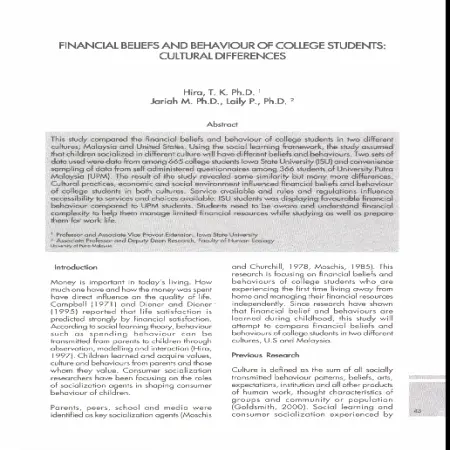
Financial beliefs and behaviour of college students: cultural differences
Item Type: Article
Editor:
Year: 00/01/2004
Abstract: This study compared the financial beliefs and behaviour of college students in two different cultures; Malaysia and United States. Using the social learning framework, the study assumed that children socialized in different culture will have different beliefs and behaviours. Two sets of data used were data from 665 college students Iowa State University (ISU)and convenience sampling of data from self administered questionnaires among 366 students of University Putra Malaysia (UPM). The result of the study revealed some similarity but many more differences. Cultural practices, economic and social environment influenced financial beliefs and behaviour of college students in both cultures. Service available and rules and regulations influence accessibility to services and choices available. ISU students was displaying favourable financial behaviour compared to UPM students. Students need to be aware and understand financial complexity to help them manage limited financial resources while studying as well as prepare them for work life.
|
|
|
|
|
 |
Family development module for Institutions of Higher Education
Item Type: Module
Editor:
Year: 01/12/2000
Abstract: The NPFDB has initiated a family development programme (MOPKITP) for students from Institutions of Higher Education. The Family Development Module will be offered through the co-curriculum programme. This Family Development Module Package is a combination of the NPFDB's existing modules, that is Permata Kasih, Youth Exploration, SMARTbelanja, SMARTSTART, Bahtera Kasih, Belaian Kasih, Mutiara Kasih and POP Community. The outcome of this collaborative effort with the Institutions of Higher Education will be a pool of student who are "trained facilitators". Hence the NPFDB will be able to use these students to further expand its family development programmes to the grassroots.
|
|
|
|
|
Female sterilization using filshie clip in private practice
Item Type: Article
Editor:
Year: 00/01/1983
Abstract: The findings of a trial clip female sterilization program in private practice in Malaysia is presented. The Filshie clips were successfully applied in 382 subjects. Complications encountered were minimal. Only one subject presented with an intrauterine pregnancy following sterilization (0.3 percent). The success rate was very high in the region of 99.7 percent. This study also strengthens the view that private practitioners can play a very important role in the delivery of family planning advice and services to the masses in developing countries.
|
|
|
|
|
|
|
Family and Health Survey in the Federal Territory and Petaling Jaya
Item Type: Research Report
Editor:
Year: 00/00/1977
Abstract: The main objectives of this study is to provide basic demographic data for the Federal Territory and Petaling Jaya, and to provide estimates of the family planning knowledge, attitude and practices and to identify measures to improve family planning services. The survey covered a total of 3,679 household in Federal Territory and Petaling Jaya.
|
|
|
|
|
|
Family planning acceptor survey
Item Type: Research Report
Editor:
Year: 00/00/1977
Abstract: The objective of this survey is to evaluate the on-going family planning programme and to identify factor that are helpful for the successful implementation of The National Programme in terms of better acceptance and continuity of contraception.This study covering a total of 3,750 family planning recipients who use the pill for years 1975,1976 and the first four months of 1977 and also some of those who make use of other modern methods. This study also involving 70 districts in peninsular Malaysia.
|
|
|
|