


Browse by Subject
|
Cabaran, kesejahteraan dan penglibatan ibu dalam keluarga : penemuan tinjauan pendapat umum bersempena Sambutan Hari Ibu 2024
Item Type: Scientific Poster
Editor:
Year: 00/07/2024
Abstract: In conjunction with the 2024 National Mother's Day celebration, the Ministry of Women, Family and Community Development (KPWKM) through the National Population and Family Development Board (LPPKN) has conducted an online public opinion poll from 12 to 31 May 2024. In addition to finding out the issues and the current challenge of motherhood in managing the family and raising children, the focus of this study is to find out the level of mental well-being of mothers, and to know the extent of the important role and involvement of a mother in family institutions. With the theme "Terima KASIH Ibu", a total of 3,988 respondents consisting of mothers of Malaysian citizens aged 18 and above who have children were involved in this survey. The results of this study are expected to be the basis for the implementation of appropriate intervention programs towards the strengthening of family institutions.
|
|
|
|
|

|
Cabaran, kesejahteraan dan penglibatan bapa dalam keluarga : penemuan tinjauan pendapat umum bersempena Sambutan Hari Bapa 2024
Item Type: Scientific Poster
Editor:
Year: 00/07/2024
Abstract: In conjunction with the 2024 National Father's Day Celebration, the Ministry of Women, Family and Community Development (MWFCD) through the National Population and Family Development Board (NPFDB) has conducted an online public opinion poll from 12 to 30 June 2024. In addition to finding out the issues and the current challenges of fatherhood in managing the family and raising children, the focus of this study is to find out the level of mental well-being of fathers, and to know the extent of the important role and involvement of a father in family institutions. With the theme "Terima KASIH Ayah", a total of 1,238 respondents consisting of fathers of Malaysian citizens aged 18 and above who have children were involved in this survey. The results of this study are expected to be the basis for the implementation of appropriate intervention programs towards the strengthening of family institutions.
|
|
|
|
|

|
Population redistribution and concentration in Malaysia, 1970-2020
Item Type: Scientific Poster
Editor:
Year: 00/07/2024
Abstract: Migration, population redistribution and development are closely interrelated. Uneven population growth and distribution are the results and causes of religion and urban-rural disparities in development. Population distribution has changed significantly since 1970. 22% of the national population resided in Selangor in 2020. Urbanization level increased from 28% in 1970 to 75% in 2020, making Malaysia the second most urbanized country in SEA. This study is based on census reports and UN databases.
|
|
|
|
|

|
Fifty years of population ageing in Selangor: 1970-2020
Item Type: Scientific Poster
Editor:
Year: 00/07/2024
Abstract: According to the 2020 Cencus, Selangor Darul Ehsan is the most populous States in Malaysia with total population of 6,994,423 persons and 1,836,410 households (average household size= 3.8 persons). With a total GDP of RM 326,805 million (RM 48,606 per capita), the relatively young State has a positive net migration rate although the absolute number of older persons has reached a staggering 714.4 thousand, or in other words, 21.4% of all older persons aged 60 years or over in Malaysia resides in Selangor.
|
|
|
|
|

|
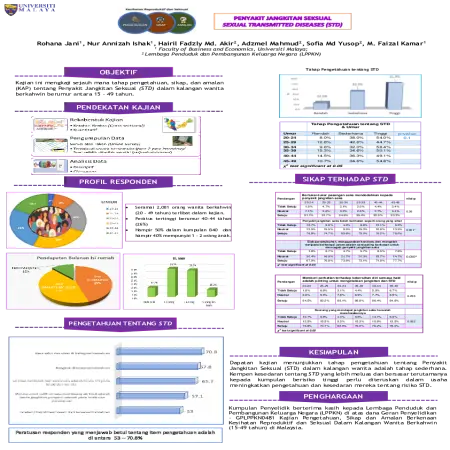
Penyakit Jangkitan Seksual= Sexual Transmitted Diseases (STD)
Item Type: Scientific Poster
Editor:
Year: 00/07/2024
Abstract: This study examines the extent of knowledge, attitudes, and practices (KAP) about Sexually Transmitted Diseases (STDs) among married women aged between 15-49 years. The findings of the study show that the level of knowledge about Sexually Transmitted Diseases (STDs) among women is moderate. Awareness campaigns about STDs that are more widespread and targeted especially at high-risk groups should be continued in an effort to increase their knowledge and awareness of the risks of STDs.
|
|
|
|
|
|
Project concept: a mixed method study of social psychological influences and affordability perception on fertility intentions in Malaysia
Item Type: Scientific Poster
Editor:
Year: 00/07/2024
Abstract: Malaysia, a culturally rich and economically strong Southeast Asian country, is experiencing a major demographic transition. In 1970, the Total Fertility Rate (TFR) was high at 4.9 children per woman, indicating a preference for larger families. By 2022, TFR has drastically reduced to 1.6 children per woman, below the replacement level of 2.1. Pronounced in urban areas especially Kuala Lumpur, with a TFR or just 1.2. The study aims to bridge gaps in understanding fertility intentions in urban Malaysia. Findings will inform public health policies and family planning programs, contributing to sustainable health systems.
|
|
|
|
|

|
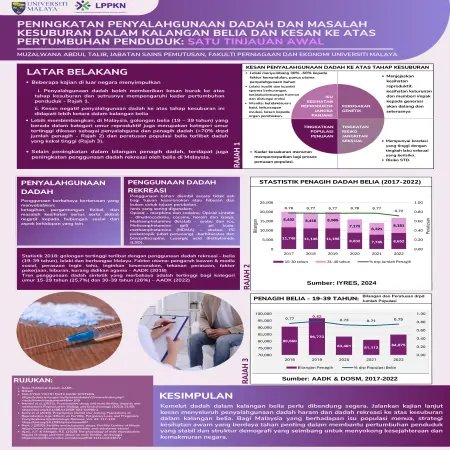
Peningkatan penyalahgunaan dadah dan masalah kesuburan dalam kalangan belia dan kesan ke atas pertumbuhan penduduk : satu tinjauan awal
Item Type: Scientific Poster
Editor:
Year: 00/07/2024
Abstract: Drug abuse can have an adverse effect on fertility levels and subsequently affect the rate of population growth. The negative effect of drug abuse on the level of fertility is found to be more significant among the youth. More worrying in Malaysia, the youth group (19-39 years) who are in the reproductive age category are also the highest age category detected as drug abusers and addicts (>70% of the total number of addicts) and the percentage of the youth population involved in drugs remains high.
|
|
|
|
|
|
Suara Keluarga, Masa Depan Negara: Kajian Penduduk dan Keluarga Malaysia Keenam (KPKM-6) 2024
Item Type: Video
Editor:
Year: 00/07/2024
Abstract: The Sixth Malaysian Population and Family Survey (MPFS-6) 2024 is the sixth study in a series of surveys conducted by the National Population and Family Development Board (NPFDB) since 1974. This study aims to provide up-to-date information and time-series data related to population, family, and reproductive health of the Malaysian population.
|
|
|
|
|

|
Video Promosi Kajian Penduduk dan Keluarga Malaysia Keenam (KPKM-6) 2024
Item Type: Video
Editor:
Year: 00/07/2024
Abstract: The Sixth Malaysian Population and Family Survey (MPFS-6) 2024 is the sixth study in a series of surveys conducted by the National Population and Family Development Board (NPFDB) since 1974. This study aims to provide up-to-date information and time-series data related to population, family, and reproductive health of the Malaysian population.
|
|
|
|
|

|
Assessing the status of implementation of the Programme of Action of the International Conference on Population and Development and its contribution to the follow-up and review of the 2030 Agenda for Sustainable Development during the decade of action and deliver for sustainable development
Item Type: Newsletter
Editor:
Year: 00/06/2024
Abstract: Despite facing numerous challenges, there is a significant progress has been made over the past 30 years since the implementation of the Programme of Action in Malaysia. This includes improvements such as increased life expectancies as well as better access to services and education on sexual and reproductive health.
|
|
|
|
|
