Browse by Subject
|
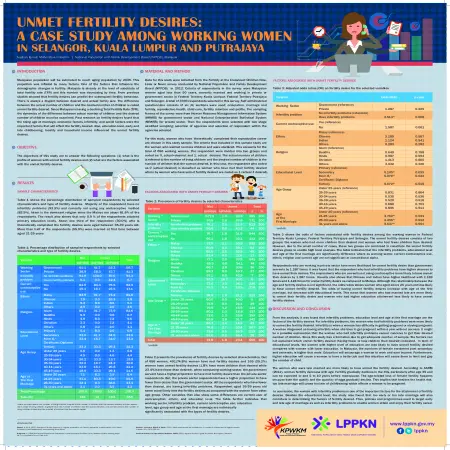
Unmet fertility desires: a case study among working women in Selangor, Kuala Lumpur and Putrajaya
Item Type: Scientific Poster
Editor:
Year: 00/00/2015
Abstract: Malaysia population will be estimated to reach aging population by 2035. This projection was inflated by many factors. One of the factors that influence the demographic changes is fertility. Malaysia is already at the level of substitute of total fertility rate (TFR) and this number was decreasing by time. From previous studies showed that fertility desires can predict the subsequent fertility behavior. There is always a disjoint between desired and actual family size. The difference between the actual number of children and the desired number of children is called unmet fertility desired. Since Malaysia is having a declining Total Fertility Rate (TFR), the dynamics of the difference between actual number of children and the desired number of children must be examined. Past research on fertility desires found that the rising age at marriage, economic factors, infertility, and social factors were the important factors that will affect the fertility desired. Also, education level, early and late childbearing, locality and household income influenced the unmet fertility desires.
|
|
|
|
|
|
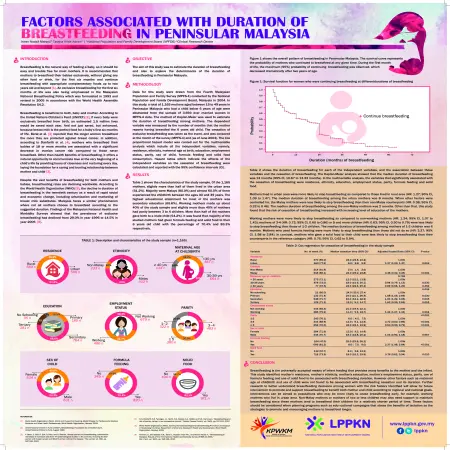
Factors associated with duration of breastfeeding in Peninsular Malaysia
Item Type: Scientific Poster
Editor:
Year: 00/00/2015
Abstract: Breastfeeding is the natural way of feeding a baby, so it should be easy and trouble free for most mothers. It is recommended that mothers to breastfeed their babies exclusively, without giving any other food or drink, for the first six months and continue breastfeeding with appropriate complementary foods up to two years old and beyond [1]. An exclusive breastfeeding for the first six months of life was also being emphasized in the Malaysian National Breastfeeding Policy which was formulated in 1993 and revised in 2005 in accordance with the World Health Assembly Resolution 54.2. Breastfeeding is beneficial to both, baby and mother. According to the United Nations Children’s Fund (UNICEF) [2], if every baby were exclusively breastfed from birth, an estimated 1.5 million lives would be saved each year. And not just saved, but enhanced, because breast milk is the perfect food for a baby’s first six months of life. Beral et al. [3] reported that the longer women breastfeed the more they are protected against breast cancer. In addition, according to Danforth et al. [4], mothers who breastfeed their babies of 18 or more months are associated with a significant decrease in ovarian cancer risk compared to those never breastfeed. Other than health benefits of breastfeeding, it offers a natural opportunity to communicate love at the very beginning of a child’s life by providing hours of closeness and nurturing every day, laying the foundation for a caring and trusting relationship between mother and child [2]. Despite the vast benefits of breastfeeding for both mothers and babies, breastfeeding rates are declining worldwide. According to the World Health Organization (WHO) [5], the decline in duration of breastfeeding in the twentieth century as a result of rapid social and economic change, including urbanization and marketing of breast milk substitutes. Malaysia faces a similar phenomenon where not all mothers choose to breastfeed according to the suggested duration. Findings of the Malaysian National Health and Morbidity Surveys showed that the prevalence of exclusive breastfeeding had declined from 29.0 % in year 1996 to 14.5 % in year 2006 [6]. Objective: The aim of this study was to estimate the duration of breastfeeding and also to explore the determinants of the duration of breastfeeding in Peninsular Malaysia.
|
|
|
|
|
|
Sosialisasi dan kawalan sosial dalam kehidupan remaja berisiko: kajian kes di projek Perumahan Rakyat (PPR) Sri Pahang, Bangsar dan Sri Pantai, Lembah Pantai, Kuala Lumpur
Item Type: Thesis
Editor:
Year: 00/00/2015
Abstract: This study focused on a group of adolescents categorized as adolescents at risk in the People's Housing Project (PPR) area in urban areas. Purpose of the study is to identify and understand the life patterns of at -risk adolescents includes their involvement in deviant behavior, the role of socialization agents and forms of social control in the lives of at -risk adolescents. This study uses design qualitative form using in -depth interview and observation methods did not participate. A total of 10 teenagers consisted of six boys and four women aged between 16 to 22 years from PPR Sri Pahang, Bangsar and PPR Sri Pantai, Lembah Pantai have been purposefully selected.
|
|
|
|
|


|
Gaya hidup wanita dan faktor risiko kanser payudara: satu kajian literatur
Item Type: Article
Editor:
Year: 00/00/2015
Abstract: Breast cancer is currently the most common cancer in women worldwide. It is said that there is no proven method of preventing cancer. However, studies have shown that there are some women’s lifestyle factors that have been scientifically shown to increase the risk of breast cancer. A review of the literature from the epidemiological, medical, and psychosocial disciplines strives to analyse factors that tend to increase the risk of developing breast cancer. Published material reviewed concerning the connection between breast cancer risk and lifestyle factors such as diet and physical activity. This review shows that several women’s
lifestyle factors have been regularly considered as risk factors for developing breast cancer. They include women who have not had children or women who had their first child at an older age, short duration of brestfeeding or not breastfeed at all, diet and nutrition, and psychological stress.
|
|
|
|
|

|
Adolescent perception on family well-being: the effect of family economic status, family functioning, and community support
Item Type: Conference or Workshop Item
Editor:
Year: 00/00/2015
Abstract: The objective of this presentation is to examine the difference of family well-being across several demographic information and to examine the relations between the family well-being in adolescents perceived family economic status, quality of family functioning, and community and neighbourhood support.
|
|
|
|
|
|
Highlights of family and social issues : Fifth Malaysian Population and Family Survey (MPFS 5-2014)
Item Type: Conference or Workshop Item
Editor:
Year: 00/00/2015
Abstract: This slide Highlights of Family and Social Issues from finding of the Fifth Malaysian Population and Family Survey (MPFS 5-2014).
|
|
|
|
|
|
Mammogram Screening Subsidy: Program in Malaysia
Item Type: Conference or Workshop Item
Editor:
Year: 00/00/2015
Abstract: In Malaysia, a woman has a 1:19 life time risk of developing breast cancer in her lifetime. Breast cancer contributes 32.3% of all female cancers. To reduce the incidence of breast cancer, the Government has embarked on the subsidised Mammogram Screening Program. This aims at promoting greater awareness and encouraging women to undergo mammogram screening for early detection of breast cancer. The objective of this subsidy is to promote greater awareness on breast cancer and the importance of breast examination.
|
|
|
|
|

|
Nuptiality, fertility and contraceptive use: preliminary findings from the 5th Malaysian Population and Family Survey (MPFS -5)
Item Type: Conference or Workshop Item
Editor:
Year: 00/00/2015
Abstract: The current marital trend status shows more than 90 % are currently married while the percentage of divorce or separation is increasing. Next, current marital status by age group in 2014 showed that 93.1 % is currently married and 5.3 % among women 20-24 are divorce or separated. This paper discuss about nuptiality, fertility and contraceptive use from preliminary finding of the Fifth Malaysian Population and Family Survey (MPFS-5) 2014.
|
|
|
|
|