Browse by Subject
|
Dasar dan Pelan Tindakan Kanak-Kanak Negara
Item Type: Act & Policy
Editor:
Year: 29/07/2009
Abstract: Children are a very important part of society, they are an asset for the country and the link for the country's development in the future. In 2008, there were 10.5 million (37.9%) children out of 27.7 million population. As such, the Government is very concern about the welfare and interests of children. In this regard, Malaysia has ratified the Convention on the Rights of the Child (CRC) on 17 February 1995. The Convention focuses on the welfare and lives of children that lead to aspects of survival, protection, development and participation. As a State Party to the CRC, Malaysia is very concerned and committed to the responsibility to ensure the safety and welfare of the children who are the heirs and future generation of the country. Interests of the child is clearly shown in the Statement of Vision 2020 in which the institution of the family and children is one of the focuses of priority in the country's efforts to achieve developed nation status in addition to creating a society that is fair and compassionate.
|
|
|
|
|

|
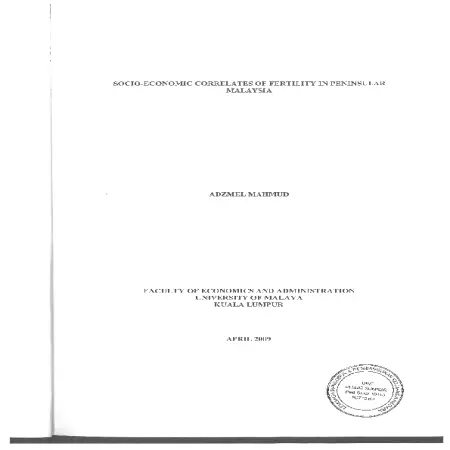
Socio-economic correlates of fertility in Peninsular Malaysia
Item Type: Thesis
Editor:
Year: 01/04/2009
Abstract: The main aim of this paper is to examine the fertility trends and differentials among Peninsular Malaysia women based on the 2004 Malaysian Population and Family Survey (MPFS-4) according to selected socio-economic variables which were found to have significant effect on number of children ever born. Findings from the study reveal that mean number of children ever born has dropped from 4.2 children in 1974 to 3.6 children in 1984, 3.4 children in 1994 and continued to decline to 3.1 in 2004. Fertility level is highest among Malays, who resides in rural areas, eastern region, lower educational level, women who had never worked, women whose husbands worked in agricultural sector and family income less than RM1000 a month. Socio-economic variables can only affect the fertility level through the intermediate variables such as postponement of marriage and use of contraception. There is an upward trend in age at first marriage from 17.6 years in 1974 to 22.0 years in 2004. Marriage postponement is more pronounced among highly educated Chinese women, followed by the Indians and the Malays. The contraceptive prevalence rate was highest among Chinese, followed by the Indians and the Malays. Ethnic differentials in number of children ever born are rather pronounced. In the multivariate context, after adjusting for age and age at first marriage, the differential in the mean number of children ever born among ethnic groups remain discernible. The socio¬economic variables have different effects on the fertility level of each ethnic group. 'Region' emerges as the most important predictor of Malay fertility, while 'work pattern' and 'family income' is the most important predictor of Chinese and Indian fertility respectively. Based on the present trend, it is highly likely that the fertility will reach replacement level by 2020, and the 70 million population target is unlikely to be achieved through natural increase. There is a need for the government to give some attention to the trend in delayed and non-marriage as this will determine to a large extent the future course of population growth in Malaysia.
|
|
|
|
|
|
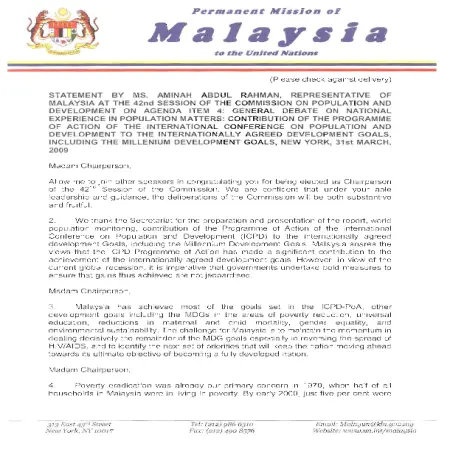
The 42nd session of the Commission on Population and Development on agenda item 4: general debate on national experience in population matters: contribution of the programme of action of the international conference on population and development to the internationally agreed development goals, including the millenium development goals, New York, 31st March, 2009
Item Type: Country Statement
Editor:
Year: 31/03/2009
Abstract: Malaysia has achieved most of the goals set in the ICPO-PoA, other
development goals including the MDGs in the areas of poverty reduction, universal education, reductions in maternal and child mortality, gender equality, and
environmental sustainability. The challenge for Malaysia is to maintain the momentum in
dealing decisively the remainder of the MOG goals especially in reversing the spread of
HIV/AIDS, and to identify the next set of priorities that will keep the nation moving ahead towards its ultimate objective of becoming a fully developed nation.
|
|
|
|
|
|
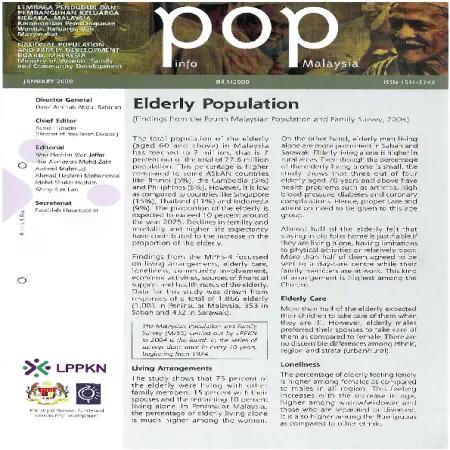
Elderly population
Item Type: Newsletter
Editor:
Year: 00/01/2009
Abstract: The total population of the elderly (aged 60 and above) in Malaysia has reached to 2 million, that is 7 per cent out of the total of 27.6 million population. The proportion of the elderly is expected to exceed 10 per cent around the year 2025. Finding from the MPFS-4 focussed on living arrangements, elderly care, loneliness, community involvement, economic activities, sources of financial support and health status of the elderly. Data for this study was drawn from responses of a total of 1,866 elderly.
|
|
|
|
|
|
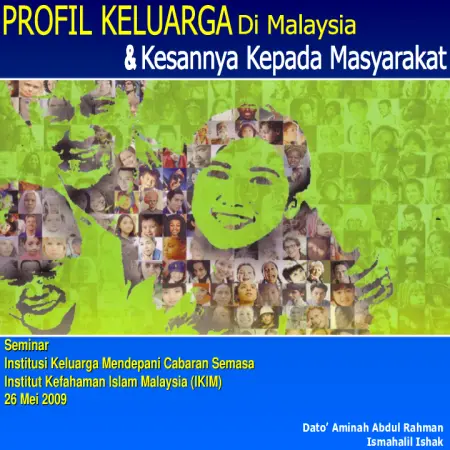
Profil keluarga di Malaysia & kesannya kepada masyarakat
Item Type: Conference or Workshop Item
Editor:
Year: 00/00/2009
Abstract: Family institution in Malaysia is facing many changes and challenges. Functional families and the role of institutions is crucial to the development of human capital formation, human and potential development of each family members and influence the development and well-being of the people. Formation patterns and family relationships as well as family lifestyle can be seen in the demographic trends in Malaysia. Formation and family structure that encountered evolution has influenced some aspects of family life. Now family institutions are required to be more resilient in dealing with the challenges of life such as child care, dual-career couples, financial management, parenting teens and responsibilities to elderly parents.
|
|
|
|
|
|
Penduduk dan keluarga: penemuan Kajian Penduduk dan Keluarga Keempat
Item Type: Conference or Workshop Item
Editor:
Year: 00/00/2009
Abstract: This paper discusses the important findings of the Fourth Population and Family Survey conducted by NPFDB in 2004. This study is the fourth in a series of Malaysian Population and Family Survey (MPFS) conducted every ten years since 1974. In 2004, this study was for the first time conducted simultaneously for the whole of Malaysia. In contrast to the previous MPFS, MPFS-4 interviewed households consisting of five (5) categories, (a) Women aged 15 to 49 years, (b) Husbands of married women, (c) Adolescents aged 13 to 24 years, (d) Citizens aged 50 years and above, and (e) single residents aged 25 to 49 years. This study aims to provide time series data related to demographic and socio-economic information in particular the relationship between population, family and human reproduction with development. The results of the study are used to evaluate the effectiveness of existing development programs and also used as input in the preparation of the Ninth Malaysia Plan (9MP). In this study data analysis was performed for the three areas separately. Among the important findings include: 1) Age structure of the population, 2) burden of dependents, 3) Delayed marriages, 4) Fertility, 5) Family planning, 6) Health practices, 7) Household composition, 8) Female labor force participation, 9) Child care, 10) The elderly, and 11) Adolescent social and sexual behavior.
|
|
|
|
|

|
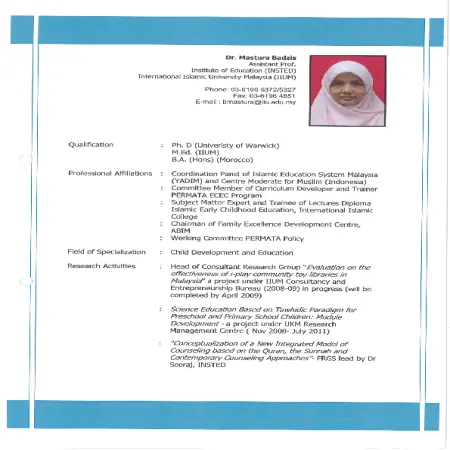
Families resilience and children and families of low income: maximizing opportunities through PERMATA ECEC Program
Item Type: Conference or Workshop Item
Editor:
Year: 00/00/2009
Abstract: PERMATA Early Childhood Education and Care (ECEC) Program in Malaysia was launched on the basis of evidence from research and practice which illustrates that early intervention through high quality program enhances children's social, emotional, spiritual, physical, and cognitive development. PERMATA is a child-focused, community integrated program with the overall goal of increasing school readiness in young children in low-income families, particularly in deprived areas. Despite its various learning outcomes, ECEC main underpinning goal is to produce generations of youth who are able to manage and regulate emotion, possess high EQ skill, and resillient in facing different challenges in life. Its long-term effect can be better understood as children develop into responsible citizens who will take a much more positive role in the society and are free of social ills that now seem to beset the country. This paper presents some strategies of best practices that have been applied in this program to foster and instill resilience in children mainly, increasing caring relationship, developing social competence, encouraging, self-help skills, create partnerships with family and community, and awareness of the existence and supremacy of God.
|
|
|
|
|
|
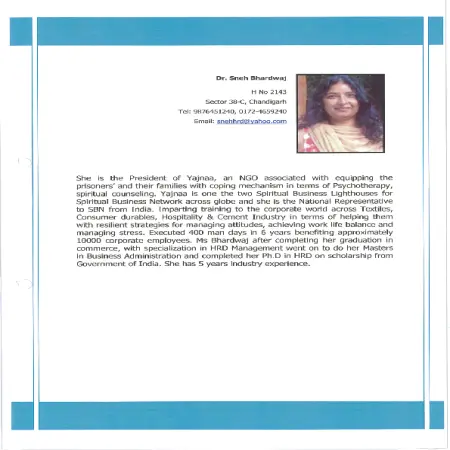
Resilient families coping with sudden demise husband: an exploratory and empirical study of 50 nuclear urban middle class families in North India
Item Type: Conference or Workshop Item
Editor:
Year: 00/00/2009
Abstract: The paper offers research based Resilient Indian Family Template' culled from the coping practices adopted by 50 Nuclear Urban Middle Class Families in North India in the eventuality of sudden loss of husband. Convenient random sampling technique of data collection was employed for choosing the 50 families in question. Further interview and narrative methodology was used to elicit information from the families. Sudden loss of husband was accompanied by emotional and health problems for the surviving spouse, acute feeling of loneliness, decreased standard of living for the family, increased moral support from close relatives, children especially grown ups showing more restraint and responsibility in their habits and one member (in most cases it was wife) taking up income generating activity. Coping practices adopted by these families helped them rebound from crisis.
|
|
|
|
|
|
Family functioning and child well-being amongst urban Malay single mother families: resilence despite challenges
Item Type: Conference or Workshop Item
Editor:
Year: 00/00/2009
Abstract: This study was designed to determine the contribution of risk and protective factors in predicting urban Malay single mother's family functioning and child well being. In addition, this study examine the moderating role of protective factors (risk x protective factor interaction) on the relationship between risk factors and family functioning and child well-being. Result highlight the role of protective factors in promoting better family functioning and child well-being and the extent to which protective factor buffer risk factors in the design of intervention aimed at strengthening family functioning and enhancing child well-being in urban Malay single mother families.
|
|
|
|
|