Advanced Search
|
Autonomy in household decision-making among Malaysia women
Item Type: Thesis
Editor:
Year: 00/06/2022
Abstract: The progress of Malaysian women has significantly improved since 1980, particularly in terms of educational achievement. However, women's labor force participation rate, level of women in decision-making at the household and industry levels, is still below that of men. These instances suggested that there were still obstacles to women's empowerment
in Malaysia, particularly in decision-making. Hence, this study aims to identify factors affecting women's autonomy in household decision-making among married women in Malaysia. Data on women's autonomy in household decision-making were obtained from Fifth Malaysian Population and Family Survey in 2014 and accounted for 2595 married women aged 15-59. Kishor's Conceptual Framework and Three-domains of Women's Empowerment were adopted as a research framework. The study framework consisted of ten exogenous factors and endogenous variables of women's autonomy in household decisions. The household decision-making was divided into eight domains: household expenses, buying a house, making assets, family savings, family holidays, children's discipline, children's education, and woman's career. Each household decision domain had responses of three levels of women's autonomy (not involved, joint and sole participation) and was analyzed individually using the Multinomial Logistics Regression method. The study provides evidence that women's characteristics can restrict the
autonomous power of women in a patriarchal society like Malaysia. All selected factors significantly impacted women's autonomy in at least one decision domain in the household. Women's education was the most substantial factor that positively influenced women's autonomy in all decisions in the household. In contrast, the spousal education gap and participation in the labor force could be a barrier to women's autonomy in the household. The family should be at the forefront of the empowering process as a woman's role in caring for the family's welfare is definite. Despite the continuous efforts to empower women, the study suggested that there is a need for a balance in shaping the positive patriarchal values among the communities, particularly among men. This can be achieved by promoting shared responsibility within a household, and this initiative has the same substantial weightage as a woman's education and economic status.
|
|
|
|
|

|
A process model for stakeholder engagement and management for the Rebung cancer early cancer diagnosis pilot project for an underserved urban population in Selangor, Malaysia
Item Type: Book Section
Editor:
Year: 00/00/2022
Abstract: A cancer control plan in Malaysia has been published since 2008, however, the stage at diagnosis for most cancers in Malaysia remains advanced, despite multiple efforts from many sectors. Situational awareness is critical in implementing projects, especially in the B40 in the community; REBUNG (Reducing Barriers in Cancer Early Diagnosis in Urban B40 Group) is a multi-sectoral complex intervention that studies a community and the processes to access early cancer diagnosis. Thus, this study aims to map out the stakeholders in implementing a cancer control program in a single-site urban poor pilot community in Taman Medan, Petaling Jaya.
|
|
|
|
|
|
Academic performance and gender stereotypes among KUPTM students
Item Type: Article
Editor:
Year: 00/12/2021
Abstract: This study was aimed to find the gender differences in stereotypes. This study also seeks to identify the relationship between different levels of academic performance and stereotypes. A quantitative method was applied in this study and data was collected through the distribution of questionnaires among 230 respondents from Kolej University Poly-Tech MARA Kuala Lumpur (KUPTM KL). The result shows that there is no significant relationship between stereotypes and gender.
|
|
|
|
|
|
Achievement of desired fertility in Malaysia and association with sociodemographic characteristics
Item Type: Scientific Poster
Editor:
Year: 00/00/2021
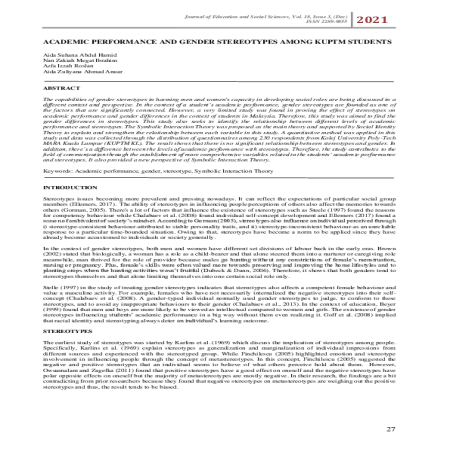
Abstract: This study aims to examine the patterns of desired fertility achievement and the differences according to socio - demographic characteristics among married women.
|
|
|
|
|
|
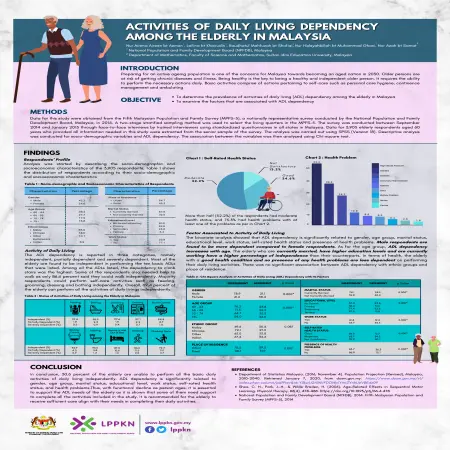
Activities of daily living dependency among the elderly in Malaysia
Item Type: Scientific Poster
Editor:
Year: 00/00/2021
Abstract: The objective of this study is to determine the prevalence of activities of daily living (ADL) dependency among the elderly in Malaysia and to examine the factors that are associated with ADL dependency.
|
|
|
|
|
|
A multimodal analysis of Malaysian contraceptive promotional materials
Item Type: Book Section
Editor:
Year: 00/00/2021
Abstract: Communicating about contraception is still a taboo subject for many Malaysians. This study focuses on the use of multimodal communication in providing information and promoting contraception to the Malaysian public. Employing Kress and Van Leeuwen’s visual grammar framework and linguistic genre analysis, the study unpacks the social-cultural practices represented in printed and digital promotional materials disseminated by Malaysia’s three main responsible agencies. These resources were published by the National Population and Family Development Board (NPFDB), the Ministry of Health (MOH) and the Federation of Reproductive Health Association of Malaysia (FRHAM).
|
|
|
|
|
|
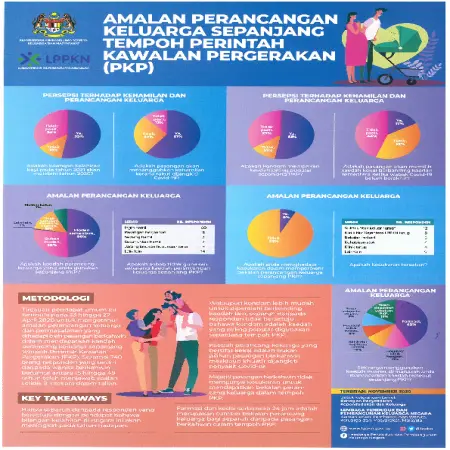
Amalan perancangan keluarga sepanjang tempoh perintah kawalan pergerakan
Item Type: Infographic
Editor:
Year: 00/12/2020
Abstract: A total of 740 respondents of married women aged 15 to 49 years were involved in this public opinion poll to find out family planning practices and problems faced by married couples in obtaining family planning methods during the period of Movement Control Order (MCO).
|
|
|
|
|
|
Analisis Situasi Kependudukan dan Kekeluargaan di Malaysia
Item Type: Conference or Workshop Item
Editor:
Year: 00/00/2019
Abstract: Population related program or policies have been introduced since 1966 and have gone through 3 series of studies. IN 1966, The National Family Planning Program was able to reduce the population growth rate from 3% per year to 2% (1985). On June 10 1966, LPKN was established under The National Family Planning Act No.42, 1966. The growth rate decreased to 2.8 in 1980. The 70 million population policy was announced in 1984 to reach 70 million population by 2100. This presentation slide describes the findings of the study of the analysis of the population and family situation in Malaysia, including the 7 main challenges of the population which include aspects of fertility, aging, labor force and productivity.
|
|
|
|
|