PUBLICATIONS
|
Kompilasi Hasil Geran Penyelidikan LPPKN 2025
Item Type: Research Report
Editor:
Year: 00/08/2026
Abstract: The implementation of the LPPKN Research Grant (GP LPPKN) 2025 emphasizes producing findings that are not only scientific but also practical and implementable. A total of 20 studies produced cover various critical issues, including the stability of marriage institutions, family well-being, fertility challenges, and the need for more effective social support systems. These findings provide a strong foundation for policymakers, program implementers, and strategic partners in planning interventions that are more focused, impactful, and results-oriented. Setting a clear research scope has allowed each study to directly contribute to policy improvements, program planning, and the development of more effective interventions.
|
|
|
|
|
|
Keibubapaan : ketakutan tertinggal (FOMO) atau ketenangan bebas (freedom glow)? satu kajian emosi dan psikologi dalam keputusan perkahwinan tanpa anak
Item Type: Conference or Workshop Item
Editor:
Year: 00/07/2026
Abstract: This study aims to identify typologies of reproductive decisions, examine the factors that influence the decision to live without children, compare levels of Parenting Fear of Missing Out (Parenting FOMO), Freedom Glow, and socio-cultural pressure according to reproductive decision typologies, as well as explore the emotional experiences of individuals living without children. Economic factors are the main factors influencing reproductive decisions, followed by career, autonomy, health, and life aspirations. The Childless by Condition group recorded higher levels of Parenting FOMO and socio-cultural pressure, while the Childfree by Choice group showed higher levels of Freedom Glow.
|
|
|
|
|
|
Kajian Awal Pemerkasaan dan Daya Tahan Usahawan Wanita di Perlis: Peranan Sokongan Komuniti dan Pembelajaran Berterusan Dalam Meningkatkan Kesejahteraan Sosioekonomi
Item Type: Conference or Workshop Item
Editor:
Year: 00/07/2026
Abstract: In June 2026, there were 3,996 women entrepreneurs under the SAHABAT Amanah Ikhtiar Malaysia (AIM) network in Perlis. Financing acts as a key catalyst for the socioeconomic chain of low-income groups. Studies summarize that the sustainability of women entrepreneurs is not just the result of individual effort or financial injections alone. Resilience is shaped by how actively the ecosystem (husband, children, community, institutions) manages and negotiates the work-family boundaries. When both domains are under pressure, it’s this invisible infrastructure that helps prevent a 'boundaryless' situation that would overwhelm entrepreneurs.
|
|
|
|
|
|
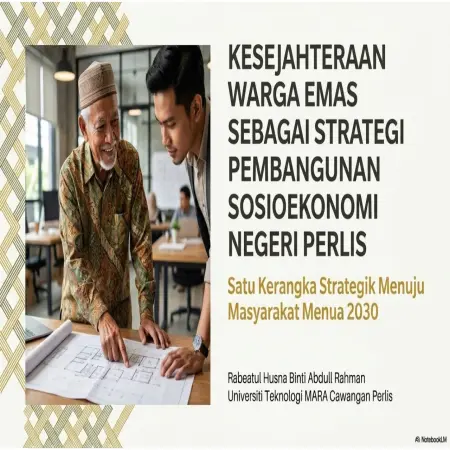
Kesejahteraan warga emas sebagai strategi pembangunan sosioekonomi Negeri Perlis
Item Type: Conference or Workshop Item
Editor:
Year: 00/07/2026
Abstract: There are 5 strategic frameworks for elderly welfare in Perlis, namely Strategy 1 - Strengthening the welfare ecosystem (strategic collaboration across sectors to build a strong social support network in Perlis); Strategy 2 - Developing an elderly-friendly environment (modifying the state's physical and social landscape to be inclusive, conducive, and safe for senior mobility); Strategy 3 - Empowering Senior Economic Participation (driving the state's 'Silver Economy' through labor sector flexibility and micro-business initiatives); Strategy 4 - Lifelong learning and digital inclusion (eliminating digital gaps and ensuring ongoing tech adaptation for independent seniors); and Strategy 5 - Strengthening evidence-based governance (policy making and program evaluations must be assessed empirically based on demographic data and real feedback).
|
|
|
|
|
|
Kepentingan Lelaki Qawwam dalam Menjamin Kesejahteraan Keluarga Muslim Era Digital
Item Type: Conference or Workshop Item
Editor:
Year: 00/07/2026
Abstract: The four dimensions of digital Qawwamah are spiritual leadership, digital protection, exemplary (qudwah) and holistic livelihood. The five household digital governance practices are the family media charter; screen-free zones and times; congregational worship; open digital dialogue; and alternative activities. Qiwamah is the pillar: sakinah, mawaddah, Rahmah is the roof. The digital age does not diminish the relevance of qiwamah but it multiplies it
|
|
|
|
|
|
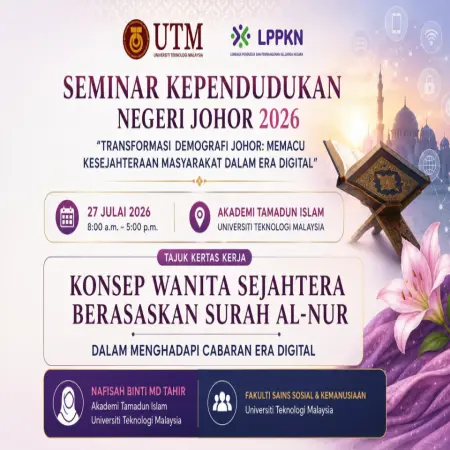
Konsep Wanita Sejahtera Berasaskan Surah Al-Nur Dalam Menghadapi Cabaran Era Digital.
Item Type: Conference or Workshop Item
Editor:
Year: 00/07/2026
Abstract: When women are well, the family institution becomes more harmonious and, in turn, contributes to the well-being of society and the nation. From an Islamic perspective, a woman's well-being is not only measured through physical, emotional, and social aspects but also includes spiritual, moral, intellectual development, as well as social responsibilities based on faith and adherence to Shariah. However, the rise of digital technology has changed the landscape of women's lives. Despite the various opportunities it offers, the digital era also brings new challenges that could affect the well-being of women, families, and society. The concept of women's well-being based on Surah Al-Nur should be translated into policies, educational modules, Islamic digital literacy, and women's empowerment programs by various stakeholders.
|
|
|
|
|
|
Keluarga Sebagai Mikrosistem Dalam Pembentukan Identiti Islam Remaja di Johor
Item Type: Conference or Workshop Item
Editor:
Year: 00/07/2026
Abstract: Changes in urban family lifestyles can reduce meaningful interactions between parents and teenagers. The use of devices and social media expands the sources of information and exposes teens to various values. Technology can make communication easier, but uncontrolled use can reduce face-to-face communication. Parents need to balance monitoring, trust, setting boundaries, and having dialogues with their teens. Empirical studies are needed to examine the relationship between family education and the Islamic identity of teenagers in Johor. Families need support from schools, communities, and relevant agencies to help shape teenagers who are principled, ethical, and capable of facing current challenges.
|
|
|
|
|
|
Knowledge, Attitude and Practices (KAP) related to cervical cancer screening among women Aged 18 years and above in Malaysia
Item Type: Scientific Poster
Editor:
Year: 16/05/2026
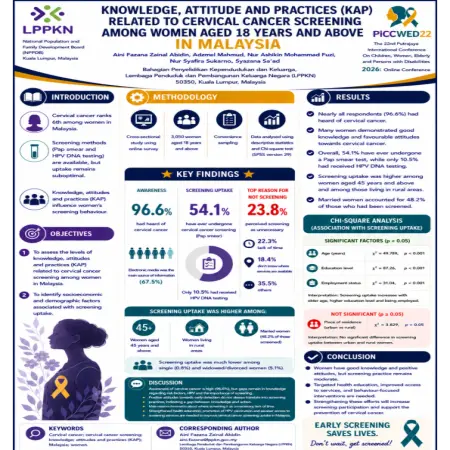
Abstract: Cervical cancer ranks 6th among women in Malaysia. Screening methods (Pap smear and HPV DNA testing) are available, but uptake remains suboptimal. Knowledge, attitudes and practices (KAP) influence women’s screening behaviour. Overall, 54.1% have ever undergone a pap smear test, while only 10.5% had received HPV DNA testing. Many women demonstrated good knowledge and favorable attitudes towards cervical cancer. Targeted health education, improved, access to services, and behaviour-focused interventions are needed.
|
|
|
|
|
|
Keterjaminan makanan sebagai teras strategi pengurangan kemiskinan di Malaysia
Item Type: Scientific Poster
Editor:
Year: 00/11/2025
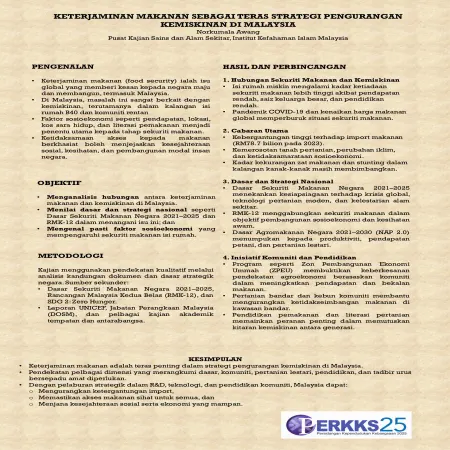
Abstract: Food security is a global issue that affects both developed and developing countries, including Malaysia. In Malaysia, this problem is closely linked to poverty, especially among B40 households and vulnerable communities. Socioeconomic factors such as income, location, cost of living, and nutritional literacy are key determinants of food security. Inequality in access to nutritious food can affect a country's social well-being, health, and human capital development. In conclusion, a multi-dimensional approach that encompasses policy, community, sustainable agriculture, education, and integrated governance is urgently needed. With strategic investments in R&D, technology, and community education, Malaysia can reduce import dependence; ensure access to healthy food for all; and generate sustainable social and economic well-being.
|
|
|
|
|
|
Kepelbagaian Identiti Seksual : pendekatan agama dan psikososial dalam membina keluarga sejahtera
Item Type: Conference or Workshop Item
Editor:
Year: 00/08/2025
Abstract: The issues of sexual identity and gender confusion need to be viewed wisely and in an integrated manner. The combination of religious and psychosocial approaches is the main key. A prosperous family is built on the foundation of religion, love, natural values, and continuous education.
|
|
|
|
|