TOPICS
|
Kajian Pengesanan Mikrodelesi Kromosom Y dalam kalangan klien Infertiliti di Lembaga Penduduk dan Pembangunan Keluarga Negara
Item Type: Research Report
Editor:
Year: 02/01/2017
Abstract: The study "Microdelesi of Y Chromosome among NPFDB Infertility Clients" conducted by the Biomedical Unit, NFPDB is to identify infertility factors from a genetic aspect. Study samples were obtained from infertility patients referred to the Cytogenetic Laboratory, NPFDB from 2003 to 2010. A total of 100 blood samples of clients diagnosed as azoospermia (48), severe oligoasthenoteratozoospermia (24), oligozoospermia (15), severe oligozoospermia (6), Klinefelter Syndrome (3) and idiopathy (4) were performed Chromosome Analysis Tests to identify any abnormalities of the number and structure on the chromosome and subsequently Molecular Testing is performed to detect the microdeletion of the Y chromosome. Majority of ethnic groups involved in the study are Malays, which is 74 people (74%) followed by Chinese; nine (9) people (9%), Indians; seven (7) people (7%) and other ethnicities from Sabah and Sarawak as many as 10 people (10%) in the age range of 23 to 46 years.The chromosome analysis test results for the 100 samples were normal which is, 46, XY, no abnormalities in the structure or number of chromosomes were found. Results was found that 15 samples (15%) underwent Y chromosome microdeletion at the AZF locus in molecular test. From 15 samples, 10 samples were azoospermia, three (3) severe oligoasthenoteratozoospermia samples and two (2) oligozoospermia samples. Each sample experienced deletion at different locus and there were samples that experienced multiple deletion which involved deletion of more than one factor locus (AZF).The most common AZF factors found to experience deletion were AZFc (73.33%) followed by AZFb (53.33%), AZFd (40%) and AZFa (13.33%). In conclusion, it was found that genetic factors are one of the causes of infertility problems among clients came for subfertility treatment. Looking at the importance of undergoing genetic screening testing at an early stage, it is recommended that this test be tested for men diagnosed with azoospermia and severe oligozoospermia at the Subfertility Clinic, NPFDB. The information obtained has prognostic value and influences the medical therapy chosen to assist in the clinical management of the client and his descendant in the future.
|
|
|
|
|
|
Kajian perbandingan penggunaan tiga jenis rawatan hormon FSH dalam kalangan pesakit subfertiliti yang menjalani prosedur permanian beradas di Lembaga Penduduk dan Pembangunan Keluarga Negara
Item Type: Research Report
Editor:
Year: 02/01/2017
Abstract: Since 1979, the National Population and Family Development Board (NPFDB) has been providing subfertility management services to the public especially middle-income group. In line with the rapid pace of the latest technology and research developments, there are various types of fertility drugs in the form of injections which had been used in subfertility treatment. The main function of this injection is to mature the follicles where the main hormone contained in this injection is the follicle stimulating hormone (Follicle Stimulating Hormone, FSH). In general, there are three types of FSH injections, which is a recombinant FSH (rFSH) that have 100 percent synthetic hormone, urinary FSH (uFSH) that derived from menopausal urine and highly purified urinary FSH (hp-uFSH) that also derived from menopausal urine but more pure state than uFSH. All three hormones have FSH’s activities but uFSH and hp-uFSH also have Luteinizing Hormone’s activity (LH). Thus, NPFDB has taken initiative to conduct a comparative study on the use of three types of FSH hormone treatment, namely Gonal F (rFSH), Folliova (uFSH) and Menopur (hp-uFSH), among subfertilitie’s patient who’s undergoing Intrauterine Insemination Technique (IUI). Among others, the three types of hormones were studied in terms of effevtivenee and cost burden. The study sample was from patients with unknown cause of subfertilitie’s problem and they visit NPFDB Subfertilitie’s Clinic, Headquarters, from June 2010 to May 2012. The sampling method was random. The patient and researcher do not know the treatment regimen to be initiated until a closed sample containing the treatment regimen code number is opened by the patient before starting treatment. Data were collected, recorded and anlyzed using Statistical Package for the Social Sciences (SPSS) software. Although originally a total of 90 female patients were targeted to be recruited into this study. 30 patients for each type of FSH hormone, but at the end of the study only 39 patients met all eligibility criteria and agreed to participate in this study. The result showed that average of the patients was 28.3 years and the majority were ethnic Malays (76.9%). Most of the patients had a household income between RM 5,000.00 and RM 10,000.00 (51.4%). The percentage of patients requiring more than three injections to procedure mature follicles was lowest for Folliova (41.7%), compared with Menopur (50.0%) and Gonal F (55.6%). Similarly in terms of the number of follicles produced, the Folliova regime (58.3%) produced more follicles (more than three follicles) than other regimes. A total of 16.7 percent of patients who took Menopur injections were confirmed pregnant, while no pregnany occurred among patients who took Folliova and Gonal F. In terms of cost, at the time of this study, the price of three 75IU injections was RM 334.20 for Gonal F, RM 187.20 for Folliova and RM 271.20 for Menopur. In conclusion, this study shows that, hp-uFSH (Menopur) gives the highest pregnancy rate compared to Gonal F and Folliova. Furthemore, the price of Menopur is moderate (affordable) for patients. Therefore, highly purified urinary FSH is a good gonadotropin choice for couples with unexplained subfertility undergoing an IUI procedure and it may be the main choice for patients who need a combination fertility pill stimulation regimen and gonadotropin injections. As a suggestion, such a study should be conducted with a larger sample size to obtain more significant results and be representative of actual population.
|
|
|
|
|
|
Ke arah memantapkan sistem sokongan keluarga di Malaysia: pendekatan holistik dalam penyelesaian pertikaian keluarga
Item Type: Conference or Workshop Item
Editor:
Year: 00/00/2017
Abstract: This topic gives an overview of the institutions that are dealing with family disputes in Malaysia. Generally, these institutions can be divided into judicial institutions and non-judicial institutions. Judicial institutions refer to the civil courts and Syariah courts. While non-judicial institutions refer to the other bodies that provide family services, including the Ministry of Women, Family and Community Development, LPPKN, Legal Aid Department, Malaysian Mediation Centre, religious institutions, private counsellors and NGOs. However, one of the downsides in the present system is lack of cooperation between judicial and non-judicial institutions that are dealing with family matters. In the meantime, resolution of legal disputes does not necessarily indicate that the disputes have been treated from the root. In order to promote holistic resolution of family disputes, family members need to be given further treatment outside of the courts, to tackle other non-legal issues, such as emotional and mental conflicts. The family support system can facilitate the individuals, particularly by giving social support and counselling. In fact, the family support institutions are able to deal with family conflicts at the early stage, thus reducing the number of cases that need to go for court trial. Family service centres that have been established in other countries such as Singapore and Australia indicated a high success rate in the resolution of family disputes. It is viewed that a cooperation between judicial and non-judicial institutions can provide a holistic approach to the resolution of family disputes. Therefore, it is suggested that a strong networking to be established between these institutions, so as to improve the referral function between them. At the same time, it is important to create awareness among the society regarding family services that are available and how these services can help them in handling their family disputes.
|
|
|
|
|
|
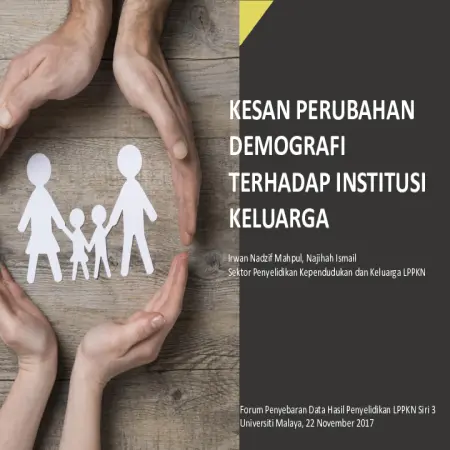
Kesan perubahan demografi terhadap institusi keluarga
Item Type: Conference or Workshop Item
Editor:
Year: 00/00/2017
Abstract: Since the 1980s, the fertility rate (TFR) has declined slowly from 4.0 to 2.0 children per woman in 2016. This means that every woman in the country at this point , on average, gives birth to 2 children in her lifetime. The rapid decline in fertility rate (TFR) has accelerated the aging process of the country. The TFR is likely to remain between 1.9 and 2.0 by 2020 and below 1.9 in the next decade. This presentation is about the impact of demographic change on family institutions.
|
|
|
|
|
|
Kajian bagi mengenalpasti faktor-faktor risiko kanser payudara yang berkaitan dengan gaya hidup dalam kalangan wanita melayu di Kuala Lumpur
Item Type: Thesis
Editor:
Year: 00/02/2016
Abstract: Breast cancer is the most common cancer that has affected women all over the world. The worldwide rates of breast cancer incidence and mortality show a drastic and alarming increase. Until today the cause of the disease has yet to be identified. However, evidences from extensive researches related to breast cancer found that there were several lifestyle factors and some biomedical factors of the women that are scientifically recognized to increase the risk for breast cancer. In Malaysia, recent data obtained from data obtained from the National Population and Family Development Board (NPFDB) shows the incidence rate of breast cancer among Malay women was
found to have increased drastically in the last 8 years. This study aimed to identify risk factors, especially those related to lifestyle that may increase the risk of breast cancer among Malay women in Kuala Lumpur. The study also examined the knowledge of breast cancer among informants. A total of twelve breast cancer survivors were
interviewed in depth to identify and explore aspects of past lifestyle and biomedical background that may likely to increase their risk of getting breast cancer. Results show that some lifestyle and biological risk factors seen likely to increase the risk of getting breast cancer; late age at first birth or has never given birth (nulliparity), has never
breastfed or short period of breastfed, obesity, physical inactivity, high frequency of red meat intake, less intake of vegetables and fruits, psychological stress, family history of breast cancer and radiation treatment to the chest or breast. The study also found that the majority of the informants had poor knowledge regarding breast cancer.
|
|
|
|
|


|
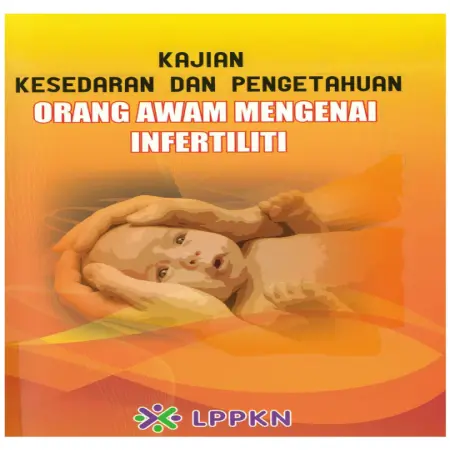
Kajian kesedaran dan pengetahuan orang awam mengenai infertiliti
Item Type: Research Report
Editor:
Year: 00/01/2014
Abstract: The study conducted by the Human Reproductive Division, National Population and Family Development Board aims to identify the extent of the public awareness and knowledge about infertility. The sampling method of the study is convenience sampling; involving the display of questionnaires on other websites are also provided. The completed questionnaires were collected, recorded and analyzed using SPSS software. The statistical analysis carried out is descriptive statistics and the Chi-square Test.
|
|
|
|
|
|
Kajian Penduduk dan Keluarga Malaysia Kelima (KPKM-5)
Item Type: Video
Editor:
Year: 00/00/2014
Abstract: Announcement of the implementation of the Malaysian Population and Family Survey 2014 (MPFS-5).The purpose of this survey was to collect the latest information and time series data in respect of demography, family and reproductive health of the Malaysian population.
|
|
|
|
|

|
Kajian keseimbangan kerjaya dan keluarga
Item Type: Conference or Workshop Item
Editor:
Year: 00/00/2014
Abstract: The main objective of this study is to investigate the time arrangement between career and family among working peoples. This study leads to identifying the trend of work and family life balance in today’s families. As the result of this study, average time spent by respondent on working hour is 9 hours and 36 minutes per day, 48 hours 3 minutes per week. That duration is approach the result of the International Labor Organization ( ILO ) in 2000 which is Malaysia was ranked the longest spend time for working after South Korea. The findings also obtained the annual leave by respondent was high (26 days per year) compared to some other countries in the world . The duration of travels time to work is not much different in urban areas where respondents took 46 minutes commuting to work and the respondent metro-urban was takes about 55 minutes. This phenomena was influence the time management in their family life daily. The average time of sleep duration about 6 hours 41 minutes. Which is respondent went to sleep at 11:07 pm and wake up at 5:43 am by average. An important aspect of work-life balance is the amount of time a person spends at work. Overall in average in OECD Country, men spend more hours in paid work and the percentage of male employees working very long hours across OECD countries is 12%, compared with less than 5% for women. Finding a suitable balance between work and life balance is a challenge for all employee, especially working parents. The amount and quality of leisure time is important for people’s overall well-being, and can bring additional physical and mental health benefits. A full-time worker in the OECD works 1765 hours a year and devotes 62% of the day on average or close to 15 hours, to personal care (eating, sleeping and others) and leisure (socialising with friends and family, hobbies, games, computer and television use and others).
|
|
|
|
|