TOPICS
Results for Topics : "Family"
|
Relationship between family functioning, resilience and psychological well-being among B40 youths in the Klang Valley district
Item Type: Book Section
Editor:
Year: 00/00/2022
Abstract: Global economic uncertainties in the COVID-19 era have had an adverse impact on many households across nations, including Malaysian households. In particular, the B40 households have seen an upsurge in the cost of living, which puts a strain on their purchasing power. The Malaysian government has implemented various initiatives to alleviate the financial burdens of the B40 groups, such as Bantuan Prihatin Malaysia. Yet, the psychological wellbeing of the B40 group’s families are not under care.
|
|
|
|
|
|
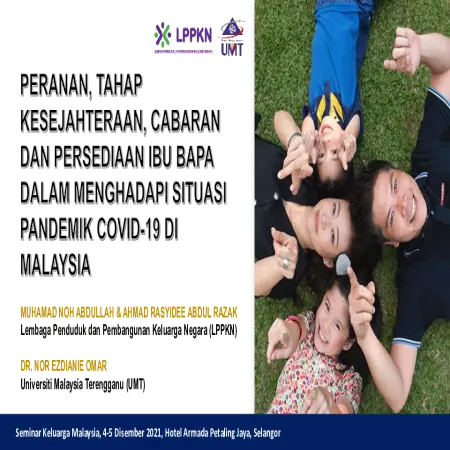
Peranan, tahap kesejahteraan, cabaran dan persediaan ibu bapa dalam menghadapi situasi pandemik COVID-19 di Malaysia
Item Type: Conference or Workshop Item
Editor:
Year: 01/12/2021
Abstract: This slide describes the current situation in family institutions in particular related to the role, level of well-being, challenges and preparation of mothers and fathers in facing the COVID-19 pandemic that has spread in the country since early 2020. The subtopics in this slide are based on 10 public opinion polls conducted by the National Population and Family Development Board (NPFDB) online throughout 2020 and 2021. The survey, which involved nearly 13,000 respondents, focused on Malaysian mothers and fathers who have children aged 3 to 24 years only. There are seven subtopics in this paper, namely (i) Introduction; (ii) Literature Review; (iii) New Norma Family; (iv) The Role of Parents in the Family; (v) Level of Parental Well -Being in Family Institutions; (vi) Challenges and Parental Preparation Related to the Use of Digital Technology; and (vii) Recommendations and Conclusions.
|
|
|
|
|


|
Konseptual kualiti hidup dalam konteks golongan pesara di Malaysia
Item Type: Article
Editor:
Year: 00/12/2021
Abstract: Quality of life carries a more complex meaning in explaining the context of an individual's life status, whether they are satisfied and happy with their living conditions or not. The phenomenon of quality of life can be measured by looking at indicators in various aspects whether monetary or non-monetary. This study was conducted to examine what the meaning of quality of life is in the context of retirees in Malaysia. In addition, this study was also conducted to see what indicators affect the quality of life, especially for retirees in Malaysia. In order to achieve the objectives of this study, a qualitative method was used, particularly working on reading sources from previous studies. The sources were screened through Scopus access. The main findings of this study found that there are various indicators that affect the quality of life
retirees in Malaysia and can be divided into two categories, namely monetary which consists of economic indicators, and
residence. While non-monetary consists of indicators of social support, health and family life. Therefore, this study will analyze and conceptually describe the quality of life of the retirees in Malaysia in a more comprehensive way through research on national policies and policies, as well as see a brief comparison with other countries.
|
|
|
|
|

|
Impak positif daripada pandemik covid-19 kepada institusi kekeluargaan
Item Type: Article
Editor:
Year: 00/12/2021
Abstract: The world was shocked by the presence of the Covid-19 pandemic which changed the norms of human life from the usual. This effect also
felt by every family institution which is the basic group in a community. The routine in family life that has become a habit had to be changed because of it. Previous studies have found that there are various negative or positive impacts from this epidemic. This article places special emphasis on the positive impact of the Covid-19 pandemic on family institutions. The study is exploratory because it is a new issue with limited resources. The study literature is based on references obtained from reading sources related to the Covid-19 pandemic and the concept of new norms for family institutions. In addition to that, independent observation and experience are also the results of the study. The focus of the positive impact of this pandemic on family institutions is seen from a spiritual perspective, habits and attitudes. The result of this writing found that there are several lessons referring to the positive impact useful to be used as a reference or guide in the future. The concept of understanding and returning to religious teachings is the key to getting a positive impact from any form of calamity or disaster.
|
|
|
|
|

|
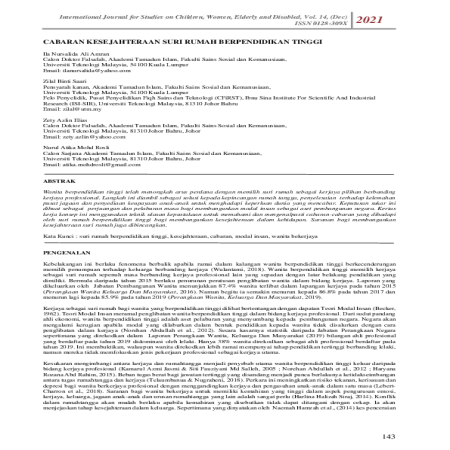
Cabaran kesejahteraan suri rumah berpendidikan tinggi
Item Type: Article
Editor:
Year: 00/12/2021
Abstract: Highly educated women have crossed the mainstream by choosing housewife as a preferred career over a professional career. This step was taken as a solution to the problems of the household, a solution to the weakness of the childcare center and a preparation of children’s ability to meet the demands of a challenging world. This difficult decision was made as a struggle and investment of time to develop human capital as a national development asset. This conceptual paper uses library review techniques to understand and identify the challenges faced by highly educated housewives in developing well-being in life. Suggestions for developing the well-being of housewives are also discussed.
|
|
|
|
|
|
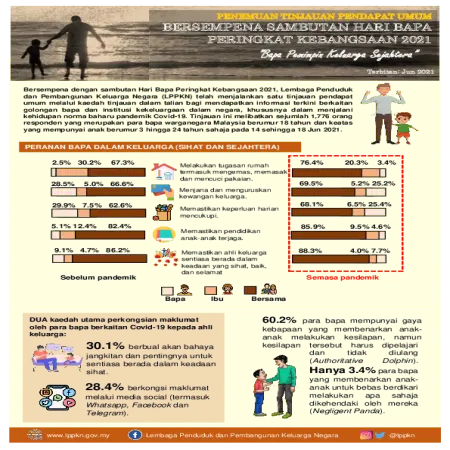
Penemuan tinjauan pendapat umum bersempena Sambutan Hari Bapa Peringkat Kebangsaan 2021 "Bapa Pemimpin Keluarga Sejahtera"
Item Type: Infographic
Editor:
Year: 00/06/2021
Abstract: The findings of an opinion survey conducted by the National Population and Family Development Board (LPPKN) in conjunction with the National Father's Day 2021 celebration.
|
|
|
|
|
|
Ordinal regression for modelling the family well- being among the Malaysians
Item Type: Article
Editor:
Year: 30/06/2021
Abstract: Understanding factors which affect the level of family well-being is important as it contributes to effective decision making among the policymakers to improve the family lives as well as to strengthen the family institution. This study develops an ordinal regression model which identifies demographic, economic and social factors that are significant in explaining the status of family well-being.
|
|
|
|
|

|
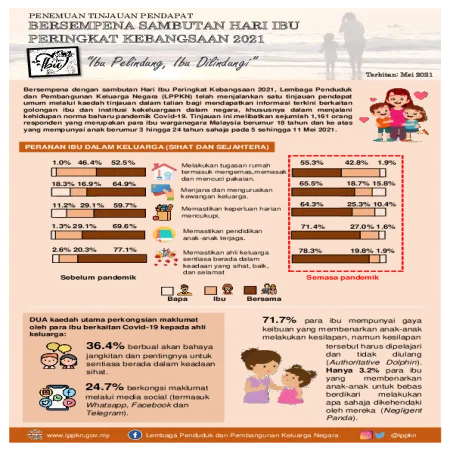
Penemuan tinjauan pendapat bersempena sambutan Hari Ibu Peringkat Kebangsaan 2021 "Ibu Pelindung, Ibu Dilindungi"
Item Type: Infographic
Editor:
Year: 00/05/2021
Abstract: In conjunction with the National Mother's Day 2021 celebration, LPPKN conducted a public opinion poll through online survey. The objective of this study is to obtain the latest information related to mothers and family institutions in the country, especially in living the new norms of the Covid-19 pandemic.
|
|
|
|
|