TOPICS
Results for Topics : "Health"
|
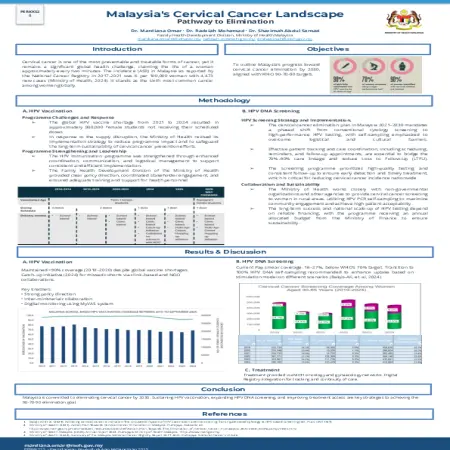
Malaysia’s cervical cancer landscape pathway to elimination
Item Type: Scientific Poster
Editor:
Year: 00/11/2025
Abstract: Cervical cancer is one of the most preventable and treatable forms of cancer, yet it remains a significant global health challenge, claiming the life of a woman approximately every two minutes. The incidence (ASR) in Malaysia as reported by the National Cancer Registry in 2017-2021 was 6 per 100,000 women with 4,473 new cases (Ministry of Health). It stands as the sixth most common cancer among women globally. The objective of this study is to outline Malaysia’s progress toward cervical cancer elimination by 2030, aligned with WHO 90-70-90 targets. Conclusion, Malaysia is commited to eliminating cervical cancer by 2030. Sustaining HPV vaccination, expanding HPV DNA screening, and improving treatment access are key strategies to achieving the 90-70-90 elimination goal.
|
|
|
|
|
|
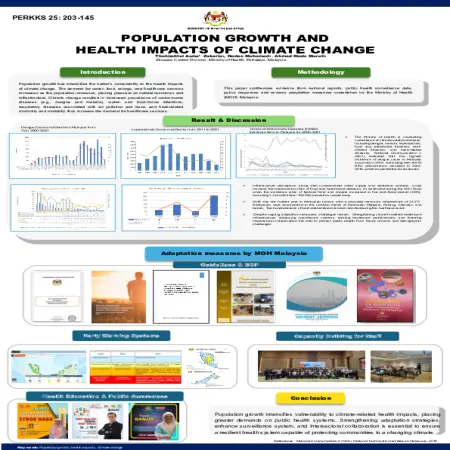
Population growth and health impacts of climate change
Item Type: Scientific Poster
Editor:
Year: 00/11/2025
Abstract: Population growth has intensified the nation’s vulnerability to the health impacts of climate change. The demand for water, food, energy, and healthcare services increases as the population increases, placing pressure on natural resources and infrastructure. Climate change resulted in increased prevalence of vector-borne diseases (e.g., dengue and malaria), water- and food-borne infections, respiratory diseases associated with air pollution and haze, and heat-related morbidity and mortality, thus increase the demand for healthcare services. Conclusion, population growth intensifies vulnerability to climate-related health impacts, placing greater demands on public health systems. Strengthening adaption strategies, enhance surveillance system, and intersectoral collaboration is essential to ensure a resilient health system capable of protecting communities in a changing climate.
|
|
|
|
|
|
Prevalence and associated factors of work-related musculoskeletal disorders (WRMSDs) among manufacturing workers in Malaysia: a secondary data analysis of NODiP 2023-2025
Item Type: Scientific Poster
Editor:
Year: 00/11/2025
Abstract: WRMSDs are a major global occupational health issue, causing 159M YLDs and 162M DALYs (2021). In Malaysia, MSDs contribute 86,340 YLDs and 112,378 DALYs, yet remain underreported despite being the second most common occupational disease. The manufacturing sector (23% of GDP) accounts for 40.4% of WRMSDs cases, driven by awkward posture, static loading, force exertion, and repetitive tasks. Global prevalence ranges 25-46% commonly affecting the shoulders, back, neck, and wrists. The objectives of this study are to determine the prevalence of WRMSDs among manufacturing workers in Malaysia and to identify individual, occupational biomechanical, and organisational factors associated with WRMSDs. Conlcusion, WRMSDs affected 8,7% of manufacturing workers, with force exertion, static posture, and limited OSH information emerging as key modifiable risks. Strengthening ergonomic controls and OSH comuunication, supported by improved national surveillance systems, is essential to reduce the WRMSDs burden in Malaysia’s manufacturing sector.
|
|
|
|
|
 Poster16_PERKKS25 - Prevalence and associated factors of work-related musculoskeletal disorders (WRMSDs) among manufacturing workers in Malaysia - a secondary data analysis of NODiP 2023-2025.pdf.crdownload
|
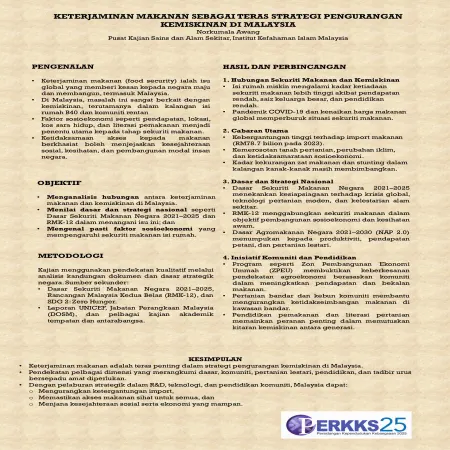
Keterjaminan makanan sebagai teras strategi pengurangan kemiskinan di Malaysia
Item Type: Scientific Poster
Editor:
Year: 00/11/2025
Abstract: Food security is a global issue that affects both developed and developing countries, including Malaysia. In Malaysia, this problem is closely linked to poverty, especially among B40 households and vulnerable communities. Socioeconomic factors such as income, location, cost of living, and nutritional literacy are key determinants of food security. Inequality in access to nutritious food can affect a country's social well-being, health, and human capital development. In conclusion, a multi-dimensional approach that encompasses policy, community, sustainable agriculture, education, and integrated governance is urgently needed. With strategic investments in R&D, technology, and community education, Malaysia can reduce import dependence; ensure access to healthy food for all; and generate sustainable social and economic well-being.
|
|
|
|
|
|
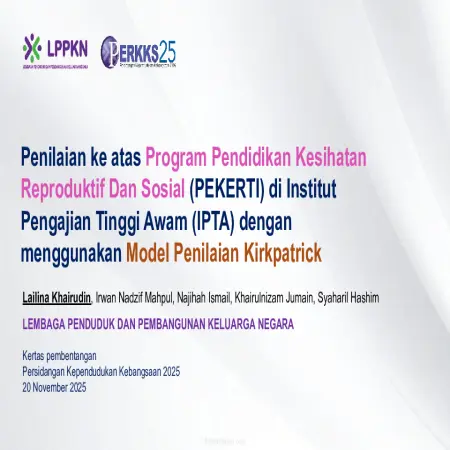
Penilaian ke atas Program Pendidikan Kesihatan Reproduktif dan Sosial (PEKERTI) di Institut Pengajian Tinggi Awam (IPTA) dengan menggunakan model penilaian Kirkpatrick
Item Type: Conference or Workshop Item
Editor:
Year: 00/11/2025
Abstract: The PEKERTI program was introduced by the Ministry of Women, Family and Community Development (KPWKM) through the National Population and Family Development Board (LPPKN) starting in 2009. Its main purpose is to produce individuals who are knowledgeable and have positive attitudes in reproductive and social health aspects. The National Reproductive and Social Health Education Policy and Action Plan (PEKERTI) 2022-2025 has improved the PEKERTI program until introducing the National PEKERTI program in 2025. The objective of the study is to measure the effectiveness of the program using the 4-stage Kirkpatrick Model. In conclusion, the program is effective in increasing knowledge, confidence, and commitment, but the effect is still moderate. Future focus is to increase involvement, satisfaction and interactive activities for better learning effects. Follow-up interventions after the program can close the gap between knowledge and practice (confidence & commitment).
|
|
|
|
|
|
Video Korporat Kerja Lapangan Kajian Penduduk dan Keluarga Malaysia Keenam (KPKM-6)
Item Type: Video
Editor:
Year: 00/09/2025
Abstract: The Sixth Malaysian Population and Family Survey (MPFS-6) 2024 is the sixth study in a series of surveys conducted by the National Population and Family Development Board (NPFDB) since 1974. This study aims to provide up-to-date information and time-series data related to population, family, and reproductive health of the Malaysian population. The MPFS-6 fieldwork was conducted from August 28, 2024 until February 28, 2025.
|
|
|
|
|

|
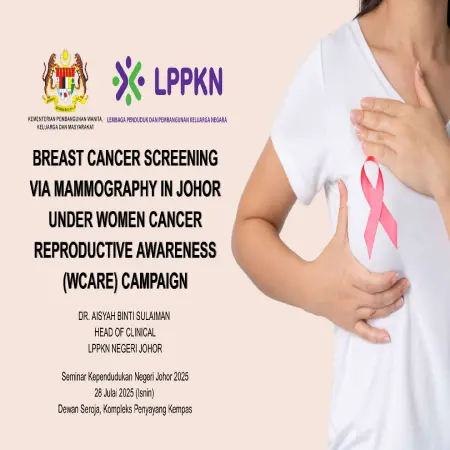
Breast Cancer Screening Via Mammography in Johor under Women Cancer Reproductive Awareness (WCARE) Campaign
Item Type: Conference or Workshop Item
Editor:
Year: 00/08/2025
Abstract: Breast cancer is the most commonly diagnosed cancer among women in Malaysia with increasing observed in both urban and semi urban population. Johor has the highest incidence of breast cancer in Malaysia with 6,564 cases reported between 2012 and 2016 most detected at late stages. Mammography is the most effective method for early detection of breast cancer, particularly among women aged 40 years and above. In Johor mammography service are available through government hospital, private centers, National Cancer Council Malaysia (MAKNA) and Klinik Nur Sejahtera under the National Population and Family Development Board (NPFDB)
|
|
|
|
|
|
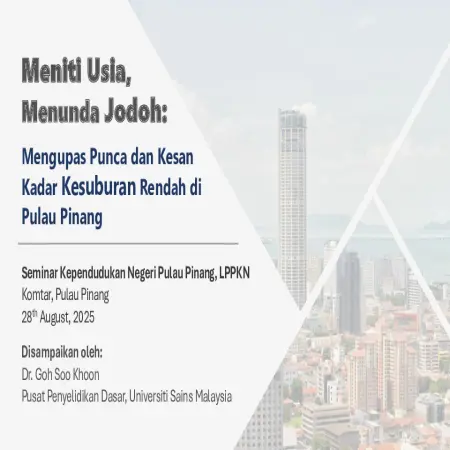
Meniti usia, menunda jodoh: mengupas punca dan kesan kadar kesuburan rendah di Pulau Pinang
Item Type: Conference or Workshop Item
Editor:
Year: 00/08/2025
Abstract: Penang is currently facing persistently low fertility rates as well as rapid population aging. The main factor identified is the low marriage rate, especially among non-Muslims. Policy suggestions to address the low marriage rate include exposing the public to the importance of having more than two children; implementing affordable housing schemes specifically for young couples and newlyweds; and fostering the value of marriage through awareness and educational programs, educating young people about the benefits of marriage, as well as addressing misconceptions about marriage.
|
|
|
|
|
|
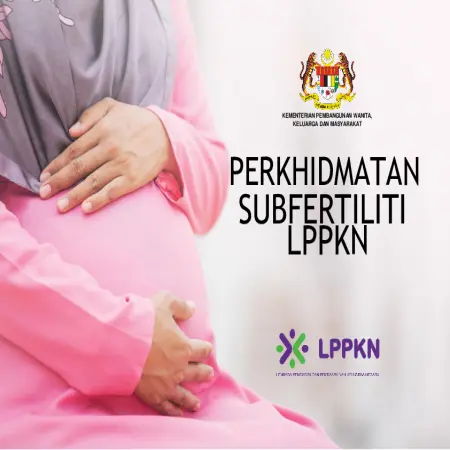
Perkhidmatan subfertiliti LPPKN
Item Type: Conference or Workshop Item
Editor:
Year: 00/08/2025
Abstract: LPPKN provides subfertility services to raise awareness and education on fertility and reproductive health; empower access to fertility treatments and reproductive health services; organize community engagement programs and support services focused on fertility issues and family well-being; establishment of the National Subfertility Center and others. The subfertility treatments provided are Intrauterine Insemination (IUI) and In Vitro Fertilisation (IVF)
|
|
|
|
|
|
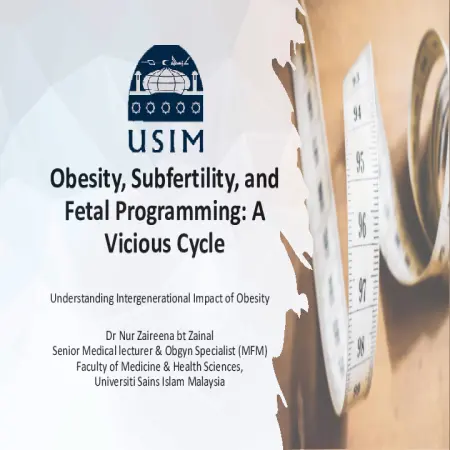
Obesity, subfertility and fetal programming: a vicious cycle
Item Type: Conference or Workshop Item
Editor:
Year: 00/07/2025
Abstract: Obesity increasing rapidly, especially among reproductive age women. Obesity affects fertility, pregnancy outcomes, and future generations. Obesity disrupts reproductive hormones and leads to anovulation, PCOS, poor oocyte quality. Maternal obesity leads to pregnancy complications. Fetus exposed to hyperglycemia and oxidative stress.
|
|
|
|
|