TOPICS
Results for Topics : "Family"
|
Modul My Therapeutic Family: Family Psychological First Aid
Item Type: Module
Editor:
Year: 00/01/2023
Abstract: INTRODUCTION:-
KASIH Keluarga Ceria Program is a comprehensive initiative aimed to bolster the family institution in Malaysia, which is a cornerstone of national well-being. This program comprises two modules, namely:
i. Psychoeducation Module
ii. Support Group "My Therapeutic Family" Module
These modules were based on the Family Psychological First Aid (F-PFA) model, jointly developed by NPFDB and Universiti Pendidikan Sultan Idris (UPSI). The model integrated fundamental family dynamics, functional family systems, and Psychological First Aid principles recognized by the World Health Organization (WHO).
The Support Group "My Therapeutic Family" Module complements the Psychoeducation Module by focusing on maintenance, particularly in the post-intervention phase, addressing crisis management within the family unit.
The objectives of this program are:
1. Enhance parents' awareness regarding mental health and adaptive skills;
2. Educate parents with knowledge of Family Psychological First Aid (F-PFA);
3. Empower parents with referral skills for psychological assistance;
4. Establish support groups platform for parents; and
5. Forge intelligent collaborative network between NGOs, agencies, and referral experts.
|
|
|
|
|
|
Modul Psiko-Pendidikan "Family Psychological First Aid"
Item Type: Module
Editor:
Year: 00/01/2023
Abstract: KASIH Keluarga Ceria Program is a comprehensive initiative aimed to bolster the family institution in Malaysia, which is a cornerstone of national well-being. This program comprises two modules, namely:
i. Psychoeducation Module
ii. Support Group "My Therapeutic Family" Module
These modules were based on the Family Psychological First Aid (F-PFA) model, jointly developed by LPPKN and Universiti Pendidikan Sultan Idris (UPSI). The model integrates fundamental family dynamics, functional family systems, and Psychological First Aid principles recognized by the World Health Organization (WHO).
The Psychoeducation Module serves to impart knowledge on F-PFA concepts and skills necessary during the preparation and intervention phases of managing crises within the family unit. The module encompasses mental health screening, psychosocial intervention, and referral skill. Families, armed with F-PFA knowledge and skills, gain the capacity to adeptly respond during family crisis.
The objectives of this program are:
1. Enhance parents' awareness regarding mental health and adaptive skills;
2. Educate parents with knowledge of Family Psychological First Aid (F-PFA);
3. Empower parents with referral skills for psychological assistance;
4. Establish support groups platform for parents; and
5. Forge intelligent collaborative network between NGOs, agencies, and referral experts.
|
|
|
|
|
|
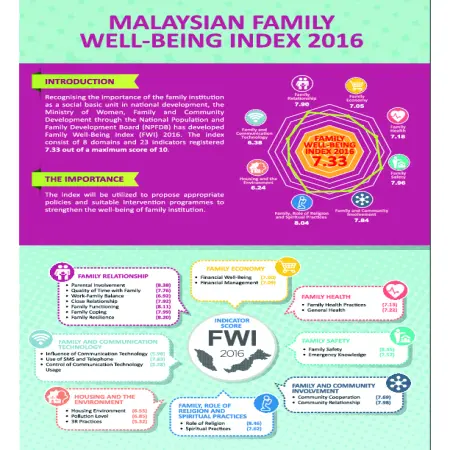
Malaysian Family Well-Being Index 2016
Item Type: Infographic
Editor:
Year: 00/02/2017
Abstract: Recognising the importance of the family institution as a social basic unit in national development, the Ministry of Women, Family and Community Development Board (NPFDB) has developed Family Well-Being Index (FWI) 2016. The consist of 8 domains and 23 indicators registered 7.33 out of a maximum score of 10.
|
|
|
|
|
|
Malaysian Family Wellbeing Index
Item Type: Book Section
Editor:
Year: 00/00/2017
Abstract: Family institutions need to be strengthened to balance the rapid process of social and economic development of the country. This is important because the family is the basic social unit that prepares the supplies the human capital for the national development. Given the importance of family wellbeing for the future of the nation, scientific studies ought to be conducted to measure the wellbeing of families in this country.
|
|
|
|
|

|
Malaysia's initiatives for sustainable family development
Item Type: Book Section
Editor:
Year: 01/01/2014
Abstract: Various initiatives to strengthen the family institution have been undertaken by the Government of Malaysia through the Ministry of Women, Family and Community
Development (MWFCD). Through its agency, the National Population and Family Development Board (NPFDB), the MWFCD has formulated, developed and implemented policies and programmes such as the National Family Policy,
1Malaysia Family First (1MF1st) and 1Malaysia Youth Empowerment and Support (1MYes) programmes, One-Stop Family Centres, and family education programmes such as the Strengthening of Marriage Institution (SmartStart remarriage programme), Parenting@Work, Smart Belanja@Lppkn (family financial management programme), KASIH Parenting Modules and counselling services.
To ensure sustainable family development, the National Family Policy (NFP) and its accompanying plan of action was launched in March 2011 and implemented by the NPFDB in partnership with other ministries, departments and related non-government organizations (NGOs). The aim of this explicit policy is to develop prosperous, healthy and resilient families to ensure social stability. The NFP is
a key policy that focuses on aspects of family well-being and development, providing direction for the development of family-friendly programmes and services for nurturing healthy and resilient families in line with the aspirations
of Vision 2020.
|
|
|
|
|
|
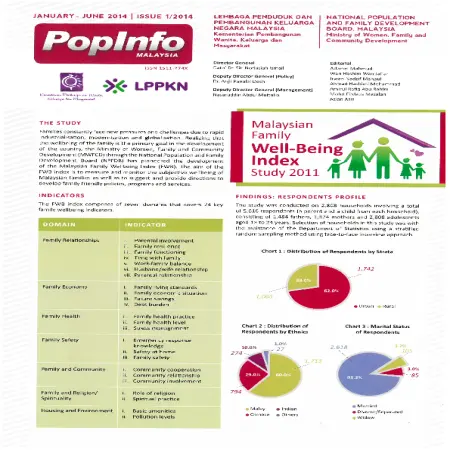
Malaysian family well-being index study 2011
Item Type: Newsletter
Editor:
Year: 00/00/2014
Abstract: Realizing that the wellbeing of the family is the primary goal in the development of the country, the Ministry of Women, Family and Community Development through the National Population and Family Development Board (NPFDB) has pioneered the development of the Malaysian Family Wellbeing Index (FWB). The aim of the FWB index is to measure and monitor the subjective wellbeing of Malaysian families as well as to suggest and provide directions to develop family friendly policies, programs and services. The study was conducted on 2,808 households involving of 5,616 respondents. Through this study, the Family Wellbeing Index (FWB) was recorded at 7.55 out of a maximum score of 10 indicating that Malaysian families have a relatively high level of wellbeing and are able to manage the challenges of development. Of the seven domains identified, the Family and Religion / Spirituality domain recorded the highest score of 8.25.
|
|
|
|
|
|
Mediating effect of work-family psychological contract on the relationship between perceived organization support and job satisfaction
Item Type: Thesis
Editor:
Year: 01/10/2012
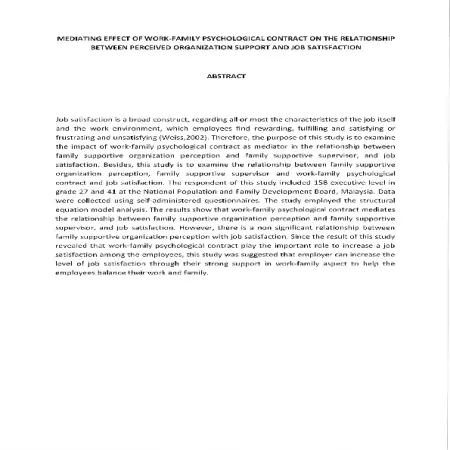
Abstract: Job satisfaction is a broad construct, regarding all or most the characteristics of the job itself and the work environment, which employees find rewarding, fulfilling and satisfying or frustrating and unsatisfying (Weiss,2002). Therefore, the purpose of this study is to examine the impact of work-family psychological contract as mediator in the relationship between family supportive organization perception and family supportive supervisor, and job satisfaction. Besides, this study is to examine the relationship between family supportive organization perception, family supportive supervisor and work-family psychological contract and job satisfaction. The respondent of this study included 158 executive level in grade 27 and 41 at the National Population and Family Development Board, Malaysia. Data were collected using self-administered questionnaires. The study employed the structural equation model analysis. The results show that work-family psychological contract mediates the relationship between family supportive organization perception and family supportive supervisor, and job satisfaction. However, there is a non significant relationship between family supportive organization perception with job satisfaction. Since the result of this study revealed that work-family psychological contract play the important role to increase a job satisfaction among the employees, this study was suggested that employer can increase the level of job satisfaction through their strong support in work-family aspect to help the employees balance their work and family.
|
|
|
|
|
|
Mengharmonikan intergenerasi
Item Type: Conference or Workshop Item
Editor:
Year: 00/00/2012
Abstract: The purpose of the presentation is to give an overview of the differences between the older and younger generations in Malaysia and suggest some steps to bring the old and the young together. The formulation of more policies that consider the needs of the younger generation such as in sports, education, tourism, politics and media. Among the steps that can be taken to bridge the gap between the old and young is to increase public awareness of the issue aging and intergenerational unity through seminars, conferences, writings, films or hold special activities such as concerts, exhibitions, competitions video-games and others.
|
|
|
|
|
|
Malaysia country report at 4th East Asia Ministerial Forum on Families, "Safe and resilient families: protecting and empowering at-risk and high risk families", Kuala Lumpur, 7-10 November 2010
Item Type: Country Statement
Editor:
Year: 00/00/2010
Abstract: Malaysia recognizes the family as a natural and fundamental
social unit that provides valuable human resource and forms the
backbone for solidarity, security and nation building. Malaysia
believes in the importance of family development in line with the
objective of creating a caring society ; Family is PRIORITY NO. 1
|
|
|
|
|