Browse by Year
|
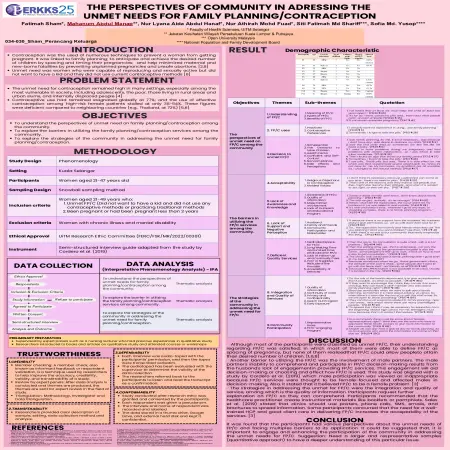
The perspectives of community in addressing the unmet needs for family planning/contraception
Item Type: Scientific Poster
Editor:
Year: 00/11/2025
Abstract: Contraception was the used of numerous techniques to prevent a woman from getting pregnant it was linked to family planning; to anticipate and achieve the desired number of children by spacing and timing their pregnancies; and help minimized maternal and new-borns fatalities by preventing unplanned pregnancies and unsafe abortions. Unmet need was women who were capable of reproducing and sexually active but did not want to have a kid and they did not use current contraceptive methods. Objectives of this study are to understand the perspectives of unmet need on family planning/contraception among the community; to explore the barriers in utilizing the family planning/contraception services among the community and to explore the strategies of the community in addressing the unmet need for family planning. It was found that the participants had various perspectives about the unmet needs of family planning/contraception and facing multiples barriers to its application. It could be suggested that, it is important to engage and enhancing the participation of the community in addressing the unmet needs for family planning/contraception.
|
|
|
|
|
|
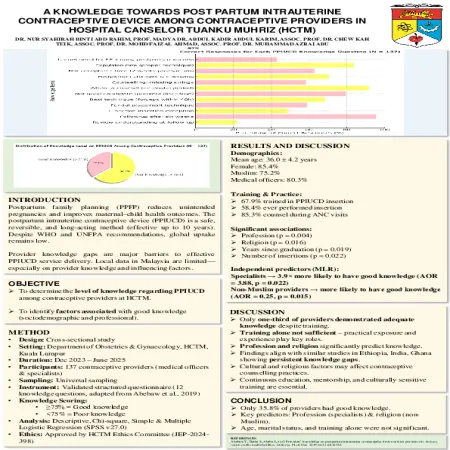
A knowledge towards post partum intrauterine contraceptive device among contraceptive providers in Hospital Canselor Tuanku Muhriz (HCTM)
Item Type: Scientific Poster
Editor:
Year: 00/11/2025
Abstract: Postpartum family planning (PPFP) reduces unintended pregnancies and improves maternal-child health outcomes. The postpartum intrauterine contraceptive device (PPIUCD) is a safe, reversible, and long-acting method(effective up to 10 years). Despite WHO and UNFPA recommendations, global uptake remains low. Objectives of this study are to determine the level of knowledge regarding PPIUCD among contraceptive providers at HCTM and to identify factors associated with good knowledge (Sociodemographic and professional). Conclusion only 35.8% of providers had good knowledge.
|
|
|
|
|
|
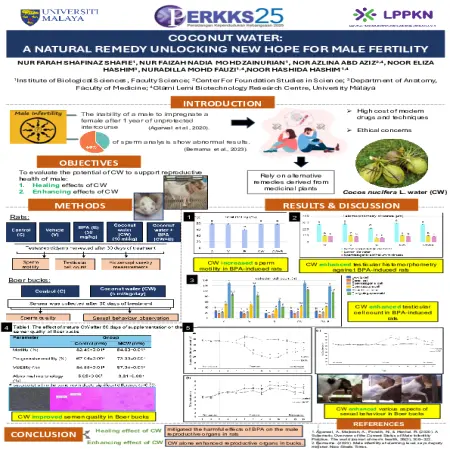
Coconut water: a natural remedy unlocking new hope for male fertility
Item Type: Scientific Poster
Editor:
Year: 00/11/2025
Abstract: Male infertility are the inability of a men to impregnate a female after 1 year of unprotected intercourse. It high course of modern drugs and techniques to heal and involve ethical concerns. Then rely in alternative remedies derived from medicinal plants. Objectives of this study are to evaluate the potential of coconut water to support reproductive health of male for healing effects of coconut water and enhancing effects of coconut water. The conclusion oh healing effect of coconut water are mitigated the harmful effects of BPA on the male reproductive organs in rats. Enhancing effects of coconut water is coconut water alone enhanced reproductive organs in bucks.
|
|
|
|
|
|
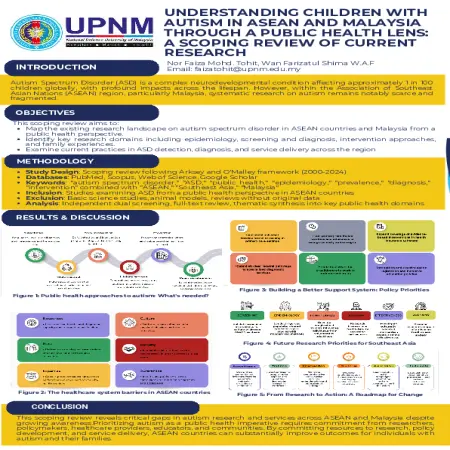
Understanding children with autism in Asean and Malaysia through a public health lens: a scoping review of current research
Item Type: Scientific Poster
Editor:
Year: 00/11/2025
Abstract: Autism Spectrum Disorder (ASD) is a complex neurodevelopmental condition affecting approximately 1 in 100 children globally, with profound impacts across the lifespan. However. Within the Association of Southeast Asian Nations (ASEAN) region, particularly Malaysia, systematic research on autism remains notably scarce and fragmented. This scoping review reveals critical gaps in autism research and services across ASEAN and Malaysia despite growing awareness. Prioritizing autism as a public health imperative requires commitment from researchers, policymakers, healthcare providers, educators, and communities. By committing resources to research, policy development, and service delivery, ASEAN countries can substantially improve outcomes for individuals with autism and their families.
|
|
|
|
|
|
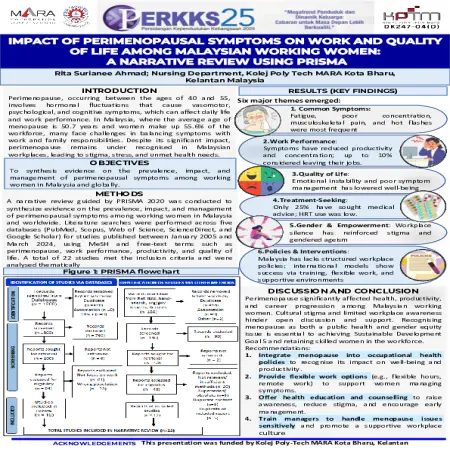
Impact of perimenopausal symptoms on work and quality of life among Malaysian working women: a narrative review using prisma
Item Type: Scientific Poster
Editor:
Year: 00/11/2025
Abstract: Perimenopause, occurring between the ages of 40 and 55, involves hormonal fluctuations that cause vasomotor, psychological, and cognitive symptoms, which can affect daily life and work performance. In Malaysia, where the average age of menopause is 50.7 years and women make up 55.6% of the workforce, many face challenges in balancing symptoms with work and family responsibilities. Despite its significant impact, perimenopause remains under recognised in Malaysian workplaces, leading to stigma, stress and unmet health needs.
|
|
|
|
|
|
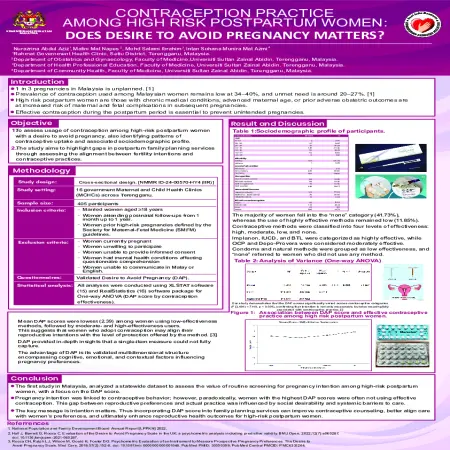
Contraception practice among high risk postpartum women: does desire to avoid pregnancy matters?
Item Type: Scientific Poster
Editor:
Year: 00/11/2025
Abstract: 1 in 3 pregnancies in Malaysia is unplanned. Prevalence of contraception used among Malaysian women remains low at 34-40%, and unmet need is around 20-27%. High risk postpartum women are those with chronic medical conditions, advanced maternal age, or prior adverse obstetric outcomes are at increased risk of maternal and fetal complications in subsequent pregnancies. Effective contraception during the postpartum period is essential to prevent unintended pregnancies.
|
|
|
|
|
|
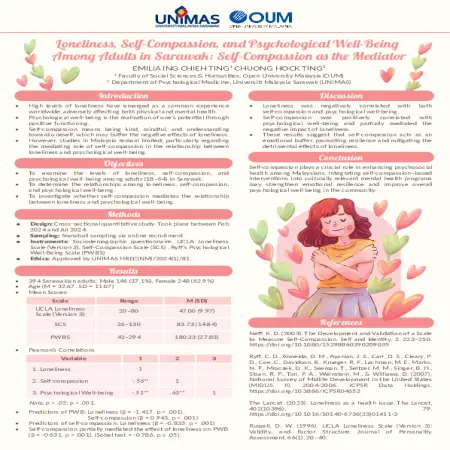
Loneliness, self-compassion, and psychological well-being among adults in Sarawak: self-compassion as the mediator
Item Type: Scientific Poster
Editor:
Year: 00/11/2025
Abstract: High levels of loneliness have emerged as a common experience worldwide, adversely affecting both physical and mental health. Psychological well-being is the realization of one’s potential through positive functioning. Self-compassion means being kind, mindful, and understanding toward oneself, which may buffer the negative effects of loneliness. However, studies in Malaysia remain limited, particularly regarding the mediating role of self-compassion in the relationship between loneliness and psychological well-being. Self- compassion plays a crucial role in enhancing psychosocial health among Malaysians. Integrating self-compassion-based interventions into culturally relevant mental health programs may strengthen emotional resilience and improve overall psychological well-being in the community.
|
|
|
|
|
|
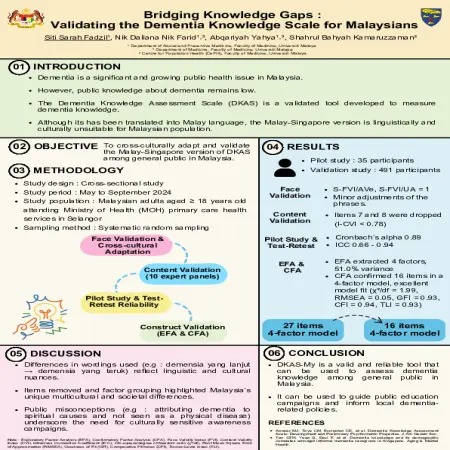
Bridging knowledge gaps: validating the dementia knowledge scale for Malaysians
Item Type: Scientific Poster
Editor:
Year: 00/11/2025
Abstract: Dementia is a significant and growing public health issue in Malaysia. However, public knowledge about dementia remains low. The Dementia Knowledge Assessment Scale (DKAS) is a validated tool developed to measure dementia knowledge. Although its has been translated into Malay language, the Malay-Singapore version is linguistically and culturally unsuitable for Malaysian population. The objective of this study is to cross-culturally adapt and validate the Malay-Singapore version of DKAS among general public in Malaysia/. Conlusion are DKAS-MY is a valid and reliable tool that can be used to assess dementia knowledge among general public in Malaysia. It can be used to guide public education campaign and inform local dementia related policies.
|
|
|
|
|
|
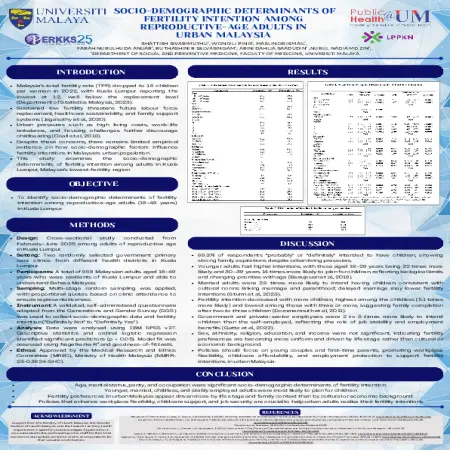
Socio-demographic determinants of fertility intention among reproductive-age adults in urban Malaysia
Item Type: Scientific Poster
Editor:
Year: 00/11/2025
Abstract: Malaysia’s total fertility rate (TFR) dropped to 1.6 children per woman in 2022, with Kuala Lumpur reporting the lowest at 1.2, well below the replacement level. Sustained low fertility threatens future labour force replacement, healthcare sustainability, and family support sustems. Urban pressures such as high living costs, work-life imbalance, and housing challenges further discourage childbearing. Despite these concerns, there remains limited empirical evidence on how socio-demographic factors influence fertility intentions in Malaysia’s Urban population. This study examines the socio-demographic determinants of fertility intention among adults in Kuala Lumpur, Malaysia’s lowest-fertility region.
|
|
|
|
|
|
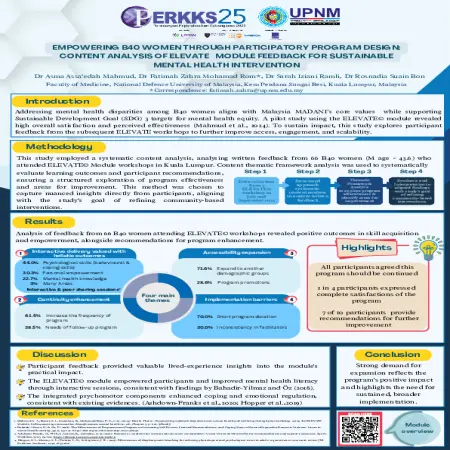
Empowering B40 women through participatory program design: content analysis of elevate module feedback for sustainable mental health intervention
Item Type: Scientific Poster
Editor:
Year: 00/11/2025
Abstract: Addressing mental health disparities among B40 women aligns with Malaysia MADANI’s core values while supporting Sustainable Development Goal (SDG) 3 targets for mental health equity. A pilot study using the ELEVATE module revealed high overall satisfaction and perceived effectiveness. To sustain impact, this study explores participant feedback from the subsequent ELEVATE workshop to further improves access, engagement, and scalability. Conclusion, strong demand for expansion reflects the program’s positive impact and highlights the need for sustained, broader implementation.
|
|
|
|
|