Browse by Year
|
The 4th East Asia Ministerial Forum on Families, "safe and resilient families: protecting and empowering at-risk and high risk families", Kuala Lumpur, 7-10 November 2010
Item Type: Country Statement
Editor:
Year: 00/11/2010
Abstract: A family is a living, evolving institution, affected by socio-economic factors as well as by the changes that shape the social environment in which it functions. More often, the changes and transformations have brought both gains and losses to family institutions. Hence, the challenge today is to reinforce positive changes and secure those in the new environment, and at the same time, to mitigate the negative consequences of changes, without dampening the momentum for positive evolution.
|
|
|
|
|

 |
Parenting@Work module
Item Type: Module
Editor:
Year: 00/00/2010
Abstract: The National Population and Family Development Board (NPFDB) has developed a Parenting@Work courses designed to help dual career families cope with the multiple demands of work and family life. Through the Parenting@Work courses, you will have the opportunity to learn the skills and techniques of balancing family and work, time management as well as gain valuable parenting knowledge and skills to make you a better parent. You are urged to utilize the opportunity provided by NPFDB to enhance your knowledge and skills in facing contemporary family challenges.
|
|
|
|
|
Malaysia country report at 4th East Asia Ministerial Forum on Families, "Safe and resilient families: protecting and empowering at-risk and high risk families", Kuala Lumpur, 7-10 November 2010
Item Type: Country Statement
Editor:
Year: 00/00/2010
Abstract: Malaysia recognizes the family as a natural and fundamental
social unit that provides valuable human resource and forms the
backbone for solidarity, security and nation building. Malaysia
believes in the importance of family development in line with the
objective of creating a caring society ; Family is PRIORITY NO. 1
|
|
|
|
|

|
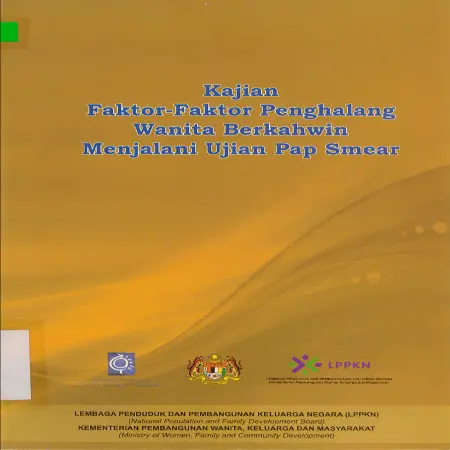
Kajian faktor-faktor penghalang wanita berkahwin menjalani ujian pap smear
Item Type: Research Report
Editor:
Year: 00/00/2010
Abstract: Cervical cancer is the second most dangerous threat to women that not only lead to a loss of pregnancy, but can even be life threatening. 12.9 percent of all cancer deaths among women are also due to this cancer. Unfortunately, 80% of women who are first diagnosed with cervical cancer are already at serious stage and cannot be treated properly even though cervical cancer screening programs such as Pap Smear have existed since 1943. Statistics released by the Ministry of Health Malaysia through the 2003 National Cancer Registry Report showed, even after the implementation of the Pap Smear program, the incidence rate of cervical cancer has increased where in 1990 the incidence rate was 13.3 per 100,000 women compared to 19.7 per 100,000 women in 2003. This illustrates that the Pap Smear program in Malaysia is not comprehensive and not practiced by those who need it which is women who have started sexual activity.
Therefore, the National Population and Family Development Board (LPPKN) has conducted a study in relation to cervical cancer screening or Pap Smear test. This study aimed to provide information on sociodemographic characteristics and reproductive history, women’s awareness on pap screening tests, women’s risk perceptions of cervical cancer, women’s attitudes towards the importance of Pap Smear testing and prevalence of Pap Smear screening test practice. This cross -sectional study was conducted in the Klang Valley, Melaka, Perak and Terengganu using purposive sampling. The total sample was 1000 people. The study population consisted of once married women aged between 20-65 years. This includes married women, widows and widowers. The conditions for rejecting the sample are ineligible women, such as unmarried women, non-Malaysian citizens and women who have had cervical cancer.
The collection of research data is through interviews based on the text of the questionnaire provided. Respondents will be interviewed by interviewers who have been trained to obtain accurate information. To achieve the objectives of the study, the analysis used is descriptive analysis, chi-square test and t test. Therefore, based on the analysis that has been conducted, the prevalence of female Pap Smear test is 55.2 percent. Respondents showed a positive attitude when asked about the importance of Pap Smear test compared to other examinations, many of whom thought that this test was very important (92.7 percent). Only 4.2 percent considered the Pap Smear test not important and there were a few who could not provide certainty about its importance (3.1 percent). Not many can measure the risk they are facing to get cervical cancer as 377 (41.5 percent) people are unaware of the cancer risk they are facing. However, there were a total of 276 (30.4 percent) women who were confident that they were not at risk at all. Only 7.7 percent received a high risk of this cancer, moderate risk (5.6 percent) and low risk (14.9 percent).
|
|
|
|
|
|
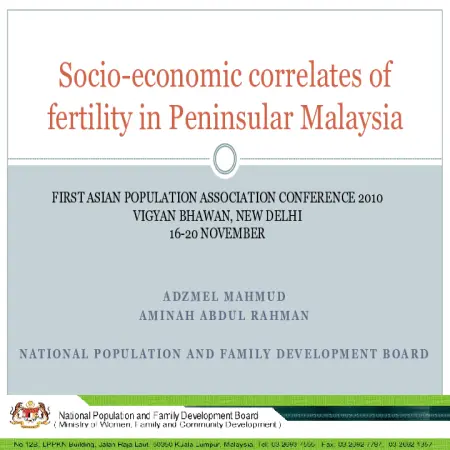
Socio-economic correlates of fertility in Peninsular Malaysia
Item Type: Conference or Workshop Item
Editor:
Year: 00/00/2010
Abstract: To examine fertility trends and differentials among women in Peninsular Malaysia by selected socioeconomic variables which significantly influence the number of children ever born. A total of 3,697 ever-married women aged 15-49 were successfully interviewed in Peninsular Malaysia.
|
|
|
|
|
|
|
A Study on health status of youth in Malaysia
Item Type: Research Report
Editor:
Year: 00/00/2010
Abstract: This study analyzed health screening of 22,840 youths, who were distributed equally by ethnicity and camp sessions. Based on the analysis, 21.6% of youths were underweight, 18.1% pre-obese and 10.3% obese, with 0.3% perceived having body image disorders. With regards to sexual and reproductive health issues, 39.6% admitted viewing pornographic materials, 28.5% practiced masturbation, 6.5% engaged in premarital sexual relationships, 5.5% had multiple partners and 1.6% had been involved in homosexual relationships. History of abortion was discovered by 0.5% of the respondents. Almost a quarter of the youths were smokers, while 8.7% had consumed alcohol and 1.4% admitted taking drugs. The study also revealed that 6.2% of respondents reported to have past involvement in bully and 14.1% in fight. About 7.1% of the respondents revealed they had been physically abused while 1.2% of them had been sexually abused. Mental health problems were noted in 27.5% of the youths, with depression in 9.8% of the youths, anxiety in 20.7% and suicidal ideation in 11.8%. Psycho-social problems such as substance use, antisocial behavior, physical/sexual abuse and mental health problems among youth are interrelated with common risk and protective factors. Management of psycho-social problems in youths should be holistic; looking into risk and protective factors. Programs and interventions should focus on strengthening of protective factors among youth such as family connectedness and religiosity.
|
|
|
|
|
|
Kajian Pendapat Remaja dan Isu Sosial : mencari penyelesaian
Item Type: Research Report
Editor:
Year: 00/00/2010
Abstract: Introduction of Reproductive and Social Health Education Policy and Action of Plan (PKRS) has been developed which aims to produce individuals who are knowledgeable and have a positive attitude in the field of reproductive and social health. Under the PKRS program, the National Population and Family Development Board (NPFDB) has been given the mandate as the main agency in implementing the program. One of the programs is the Life Skills Program for teenagers which uses two (2) modules, namely the Cakna Diri Module (I’m In Control) and the Kesejahteraan Hidup Module. The purpose of this module developed is to improve adolescents' skills in aspects of reproductive health in order to avoid high-risk behaviors that lead to several problems such as premarital pregnancies, sexually transmitted diseases and HIV. Therefore, an opinion poll was conducted to see the general view on social issues of adolescents, especially from the aspect of reproductive health and the implementation of the Life Skills Program for adolescents.
|
|
|
|
|
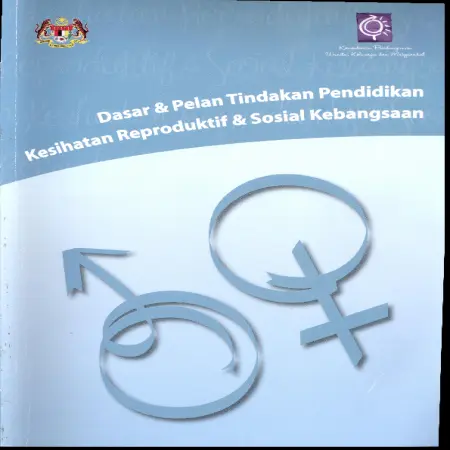
Dasar & Pelan Tindakan Pendidikan Kesihatan Reproduktif & Sosial Kebangsaan
Item Type: Act & Policy
Editor:
Year: 06/11/2009
Abstract: The National Reproductive and Social Health Education Policy that applies to all walks of life regardless of age, to increase the knowledge on sexual reproductive health among Malaysia and to encourage them to have a positive attitudes towards reproductive and social services.
Earlier it was known as PKRS Policy. However, in 2012, the Policy and Action Plan for National Reproductive and Social Health Education was known as PEKERTI Policy. Reproductive and social health education is fundamental to the development of strong and healthy human development, honorable and mutual respect. The policy takes into account the diversity of religion, culture and values of life in Malaysia.
Following the approval of the Parliament of Malaysia on the Policy and Action Plan for National Reproductive and Social Health Education (PEKERTI) in 2009, LPPKN through KPWKM has implemented the PEKERTI Programme at the kafe@TEEN Adolescent Centres, Program Khidmat Latihan Negara (PLKN), and schools.
|
|
|
|
|
|
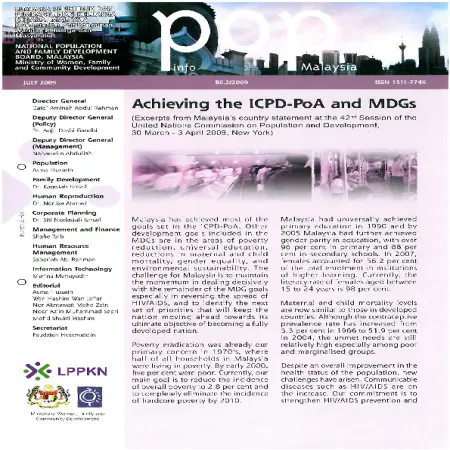
Achieving the ICPD-PoA and MDGs
Item Type: Newsletter
Editor:
Year: 00/07/2009
Abstract: Malaysia has achieved most of the goals set in the ICPD-PoA. Other development goals included in the MDGs are in the areas of poverty reduction, universal education, reductions in maternal and child mortality, gender equality and environmental sustainability.
|
|
|
|
|