Browse by Year
|
Pembangunan dan kebolehlaksanaan program intervensi pasca-Covid untuk keluarga resilien di Malaysia
Item Type: Conference or Workshop Item
Editor:
Year: 00/11/2024
Abstract: This study aims to develop a new, evidence-based family well-being intervention program in response to the challenges faced by families in Malaysia post-COVID-19. Marriage-related stress, particularly from external sources, can negatively affect relationship satisfaction and stability, and the COVID-19 pandemic has exacerbated these pressures. Measures such as travel restrictions and social distancing have contributed to increased psychological stress, leading to deteriorating relationship quality due to mental health issues like depression and anxiety. The impact of the pandemic highlights weaknesses and resilience in family dynamics, underscoring the need for support systems to maintain relationship quality during crises. A collaborative approach in designing the new intervention program should involve not only health experts but also representatives from fields such as education, psychology, and technology. This will ensure a comprehensive and effective intervention to address the various challenges families face.
|
|
|
|
|
|
Penemuan Tinjauan Pendapat Umum Bersempena Sambutan Hari Ibu 2024
Item Type: Infographic
Editor:
Year: 00/07/2024
Abstract: In conjunction with the 2024 National Mother's Day celebration, the Ministry of Women, Family and Community Development (MWFCD) through the National Population and Family Development Board (NPFDB) has conducted an online public opinion poll from 12 to 31 May 2024. With the theme "Terima KASIH Ibu", a total of 3,988 respondents consisting of mothers of Malaysian citizens aged 18 years and above who have children were involved in this survey.
|
|
|
|
|

|
Penemuan tinjauan pendapat umum bersempena Sambutan Hari Bapa 2024
Item Type: Infographic
Editor:
Year: 00/07/2024
Abstract: In conjunction with the 2024 National Father's Day Celebration, the Ministry of Women, Family and Community Development (MWFCD) through the National Population and Family Development Board (NPFDB) has conducted an online public opinion poll from 12 to 30 June 2024. With the theme "Terima KASIH Ayah", a total of 1,238 respondents consisting of fathers of Malaysian citizens aged 18 and above who have children were involved in this survey.
|
|
|
|
|

|
Population redistribution and concentration in Malaysia, 1970-2020
Item Type: Scientific Poster
Editor:
Year: 00/07/2024
Abstract: Migration, population redistribution and development are closely interrelated. Uneven population growth and distribution are the results and causes of religion and urban-rural disparities in development. Population distribution has changed significantly since 1970. 22% of the national population resided in Selangor in 2020. Urbanization level increased from 28% in 1970 to 75% in 2020, making Malaysia the second most urbanized country in SEA. This study is based on census reports and UN databases.
|
|
|
|
|

|
Penyakit Jangkitan Seksual= Sexual Transmitted Diseases (STD)
Item Type: Scientific Poster
Editor:
Year: 00/07/2024
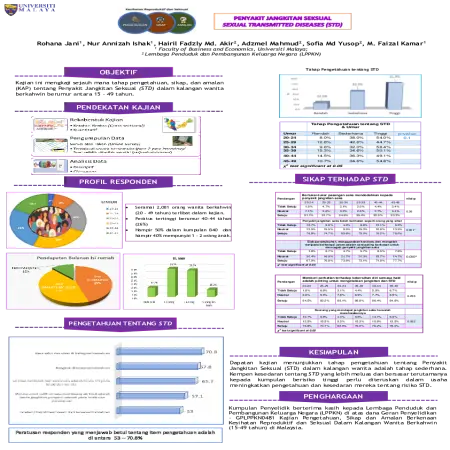
Abstract: This study examines the extent of knowledge, attitudes, and practices (KAP) about Sexually Transmitted Diseases (STDs) among married women aged between 15-49 years. The findings of the study show that the level of knowledge about Sexually Transmitted Diseases (STDs) among women is moderate. Awareness campaigns about STDs that are more widespread and targeted especially at high-risk groups should be continued in an effort to increase their knowledge and awareness of the risks of STDs.
|
|
|
|
|
|
Project concept: a mixed method study of social psychological influences and affordability perception on fertility intentions in Malaysia
Item Type: Scientific Poster
Editor:
Year: 00/07/2024
Abstract: Malaysia, a culturally rich and economically strong Southeast Asian country, is experiencing a major demographic transition. In 1970, the Total Fertility Rate (TFR) was high at 4.9 children per woman, indicating a preference for larger families. By 2022, TFR has drastically reduced to 1.6 children per woman, below the replacement level of 2.1. Pronounced in urban areas especially Kuala Lumpur, with a TFR or just 1.2. The study aims to bridge gaps in understanding fertility intentions in urban Malaysia. Findings will inform public health policies and family planning programs, contributing to sustainable health systems.
|
|
|
|
|

|
Peningkatan penyalahgunaan dadah dan masalah kesuburan dalam kalangan belia dan kesan ke atas pertumbuhan penduduk : satu tinjauan awal
Item Type: Scientific Poster
Editor:
Year: 00/07/2024
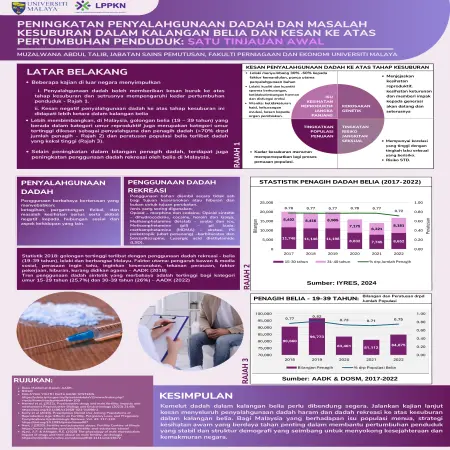
Abstract: Drug abuse can have an adverse effect on fertility levels and subsequently affect the rate of population growth. The negative effect of drug abuse on the level of fertility is found to be more significant among the youth. More worrying in Malaysia, the youth group (19-39 years) who are in the reproductive age category are also the highest age category detected as drug abusers and addicts (>70% of the total number of addicts) and the percentage of the youth population involved in drugs remains high.
|
|
|
|
|
|
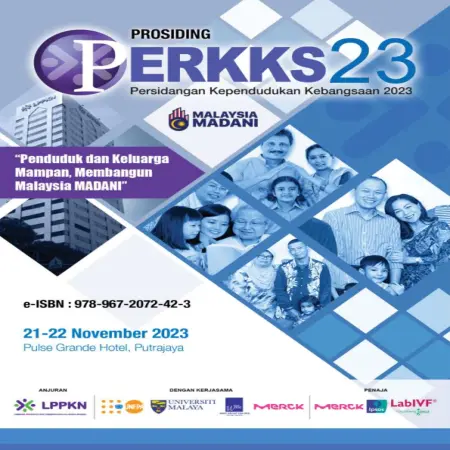
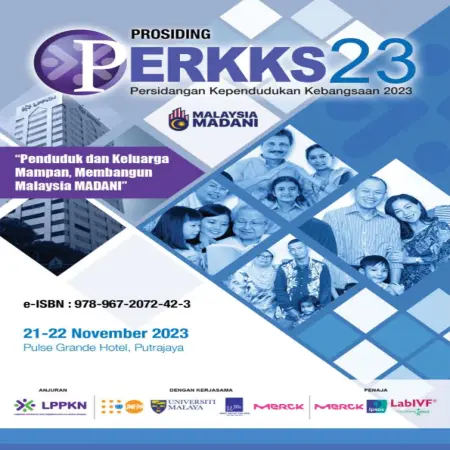
Prosiding Persidangan Kependudukan Kebangsaan 2023 (PERKKS 23): “Penduduk dan Keluarga Mampan, Membangun Malaysia MADANI”
Item Type: Book
Editor:
Year: 00/12/2023
Abstract: Collection of papers presented during the 2023 National Population Conference (PERKKS 23), 21-22 November 2023, Pulse Grande Hotel, Putrajaya.
|
|
|
|
|
|
Perceived social support, mental health and quality of life among recipients of old age financial assistence
Item Type: Book Section
Editor:
Year: 00/12/2023
Abstract: The present study examines multidimensional perceived social support, mental health and quality of life (QOL) in older adults aged 60 years and older who receive the financial assistance provided by the Department of Social Welfare. A cross-sectional study approach was conducted among 487 older adults living in Selangor, Malaysia, who are the recipients of old age financial assistance known as Bantuan Warga Emas (BWE).
|
|
|
|
|
|
Prevalens dan faktor yang mempengaruhi penggunaan perancang keluarga dalam kalangan wanita umur reproduktif di Malaysia
Item Type: Book Section
Editor:
Year: 13/12/2023
Abstract: Family planning enables women to control pregnancy, plan family size, determine the timing of pregnancies, and space out births. Given that family planning practices reduce unwanted pregnancies and high-risk pregnancies, universal access to family planning has become a key indicator in the Sustainable Development Goals (SDG) 2023 Agenda.
Despite positive evidence on family planning practices, the contraceptive use rate in Malaysia has remained around 50 percent since 1984. The aim of this study is to measure knowledge, prevalence, and factors influencing contraceptive use among ever-married women of reproductive age (15-49 years) across Malaysia.
This study employs a quantitative approach through a cross-sectional survey. A two-stage stratified sampling technique was used in sample selection. Data collection from 2,081 respondents was conducted using an online questionnaire and face-to-face interviews. Data were analyzed using descriptive statistics and the Chi-Square test via SPSS version 26.
Nearly half (48.1%) of respondents had low levels of knowledge about family planning. The prevalence of family planning practice was 64.7 percent. Modern methods, such as condoms, and traditional methods, such as withdrawal (azal), were the most commonly used contraceptive methods among women.
The prevalence of family planning was higher among Malays, women aged 30-34, those residing in rural areas, individuals with lower education levels, employed women, the M40 income group, those with 3-4 children, and those with high knowledge of contraceptives.
Family planning use showed no significant relationship with age, employment status, or household income. However, it was significantly associated with ethnicity, place of residence, education level, number of children, and level of knowledge.
Although the prevalence of family planning in this study was high, the level of knowledge among women about family planning remained low. Therefore, efforts to enhance women's knowledge of family planning should be strengthened to ensure they receive accurate information. This will enable them to make informed decisions about contraceptive use, ultimately contributing to the government's efforts to achieve the 2030 Agenda
|
|
|
|
|