


Browse by Year
|
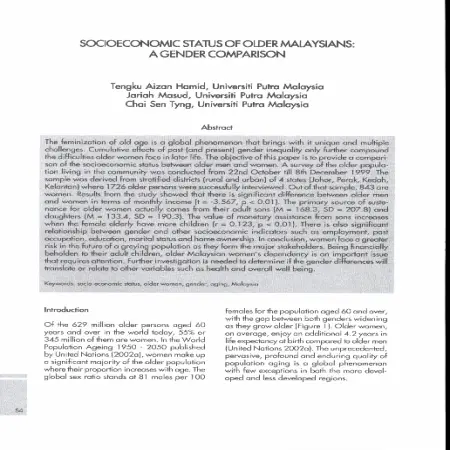
Socioeconomic status of older Malaysians: a gender comparison
Item Type: Article
Editor:
Year: 00/01/2004
Abstract: The feminization of old age is a global phenomenon that brings with it unique and multiple challenges. Cumulative effects of past (and present) gender inequality only further compound the difficulties older women face in later life.The objective of this paper is to provide a comparison of the socioeconomic status between older men and women. A survey of the older population living in the community was conducted from 22nd October till 8th December 1999.The sample was derived from stratified district (rural and urban) of 4 states (Johor, Perak, Kedah, Kelantan) where 1726 older persons were successfully interviewed. Out of that sample, 843 are women. Results from the study showed that there is significant difference between older men and women in terms of monthly income(t=-3.567,p<0.01). The primary source of sustenance for older women actually comes from their adults sons (M=168.3, SD=207.8)and daughters (M=133.4,SD=190.3). The value of monetary assistance from sons increases when the female elderly have more children (r=0.123,p<0.01). There is also significant relationship between gender and other socioeconomic indicators such as employment, past occupation, education, marital status and home ownership. In conclusion, women face a greater risk in the future of a greying population as they form the major stakeholders. Being financially beholden to their adult children, older Malaysian women's dependency is an important issue that requires attention. Further investigation is needed to determine if the gender differences will translate or relate to other variables such as health and overall well being.
|
|
|
|
|
|
Study on childcare & parenting styles among working parents in Peninsular Malaysia 1998
Item Type: Research Report
Editor:
Year: 00/00/1998
Abstract: The Study on Childcare and Parenting Styles among working Parents in Malaysia is one of the three research issues on the family that has been identified by the Ministry of National Unity and Social Development under the "Pelan Induk Tindakan Sosial (PINTAS)". This survey is timely in view of the many challenges faced by Malaysian families who have been affected directly or indirectly by modernisation, urbanisation and industrialisation as a result of socio-economic development. Female labour force participation has increased from 37 per cent in 1970 to 42 per cent in 1991 and is expected to reach 52 per cent by year 2000. The objectives of the study were: • To study the current situation in childcare arrangements among working parents and to elicit suggestions from them regarding improvements in childcare. • To study parenting styles among working parents and to make recommendations for better parenting practices. • To use findings from the study as an input towards designing strategies and programs for the betterment of families. • To obtain indicators on childcare and parenting for the monitoring of goals and targets in the National Plan of Action on Children.
|
|
|
|
|
|
Survey on health and family planning in Johore and Perak Malaysia
Item Type: Research Report
Editor:
Year: 00/00/1982
Abstract: The Malaysian project on Studies on Health and Family Planning aims to make a comprehensive analysis of the state of the health care and family planning service and delivery systems in Malaysia to enable health and population planners and administrators in more effective planning and programme management. This study will include traditional medicine in relation to health and family planning.
|
|
|
|
|
 |
Study on childcare needs of low income women in urban Malaysia
Item Type: Research Report
Editor:
Year: 00/09/1979
Abstract: The project "Child care needs of low income women" focused on the needs of families of each ethnic group in urban Kuala Lumpur. Nearly 500 couples, both husbands and wives, were interviewed to determine the differing problems faced by working and nonworking women in their effort to care for their children and provide for their basic needs. Low income families in selected squatter areas and low-cost flat complexes in Kuala Lumpur.
|
|
|
|
|
|
Study on migration: study of four major cities in Peninsular Malaysia
Item Type: Research Report
Editor:
Year: 00/00/1979
Abstract: This study aims at providing some information about the origin of the migrants in terms of place of birth and previous residence and reason for making the moves. The problem of excessive population growth rate in the metropolitan areas of less developed countries has been a major area of concern. In Peninsular Malaysia, the average annual population growth rate in urban areas during the 1970-1980 period was 4.7 per cent while in the rural areas it was only 0.9 per cent. This difference was due not only to differences in rates of natural increase but mainly because of internal migration. Such trends in migration will have significant demographic and socio-economic effects on both the rural and urban areas. Studies on internal migration in Malaysia have focus primarily on the analysis of levels and trends, using data available from population census. Information obtained from such data are rather limited and thus sample surveys have been conducted to gather detailed information regarding reasons for migration, migrants characteristics, migration related decision-making process and post-migration adaptation.
|
|
|
|
|
Study on the evaluation of the effectiveness of IEC materials in family planning programme
Item Type: Research Report
Editor:
Year: 00/00/1978
Abstract: The objectives of the study are: i) to determine the extent to which IEC (information,education and communication) printed materials have had an effect on creating a favourable attitude towards the concept of planned parenthood, ii) to gauge the actual needs of the people with regards to IEC materials and to utilise these findings in future production of materials which will provide a better and deeper understanding of the concept of planned parenthood.
|
|
|
|
|

|
|
Study of integration project of family planning and parasite control
Item Type: Research Report
Editor:
Year: 00/00/1978
Abstract: The objectives of this study is to make plans to offers in and give information about family planning services and parasite control and to establish and strengthen family planning services in line with national planning and policy.
|
|
|
|