Browse by Subject
|
Executive Summary: youth intervention study: best practices of youth intervention programmes in Malaysia
Item Type: Research Report
Editor:
Year: 01/07/2020
Abstract: In the decades, Malaysia has undergone rapid economic, social and cultural changes which impacted not only the daily lives of its people but also their worldview and values. This is particularly so for young people, as excessive exposure to information from the social media, internet and pornography had inevitably influence their lifestyle and behaviour. The socio-cultural changes are likely associated with an increased rates of non-marital sexual activity, increased rates of sex partner change and increased rates of sexually transmitted infections (STIs). In 2005, the Ministry of Women, Family and Community Development through NPFDB introduced the PEKERTI Programme to be implemented at KafeTEEN adolescents centres. The programme provides reproductive health services, counseling services and education and skill building to promote a healthy life and inculcate positive attitudes and moral values among young people.
|
|
|
|
|
|
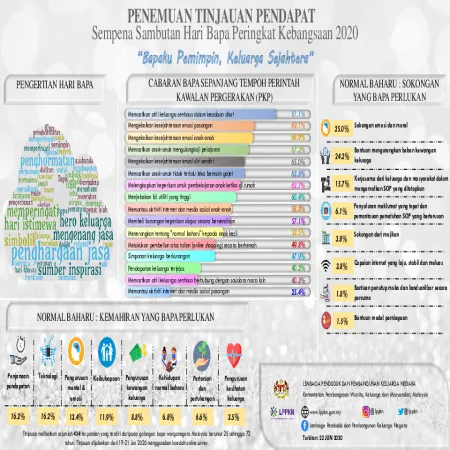
Penemuan tinjauan pendapat sempena sambutan Hari Bapa Peringkat Kebangsaan 2020 "Bapaku Pemimpin, Keluarga Sejahtera"
Item Type: Infographic
Editor:
Year: 22/06/2020
Abstract: This infographic is about findings from public opinion: Bapaku Pemimpin, Keluarga Sejahtera. In observance of National Father's Day 2020.
|
|
|
|
|
|
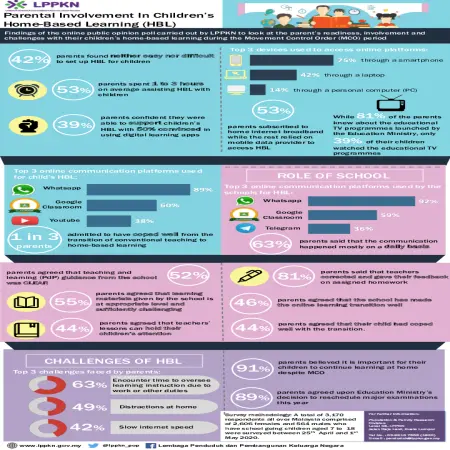
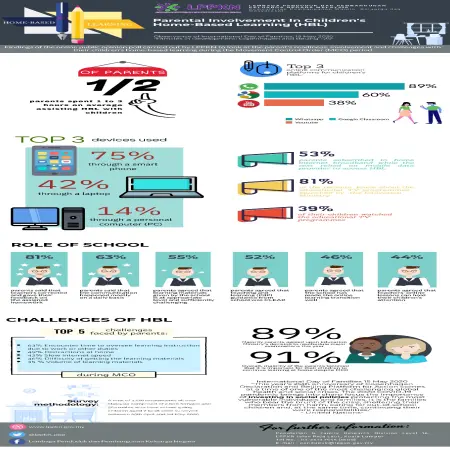
Parental involvement in children's home-based learning (HBL)
Item Type: Infographic
Editor:
Year: 00/05/2020
Abstract: This infographic is about findings of the online public poll carried out by National Population and Family Development Board (NPFDB) to look at the parent’s readiness, involvement and challenges with their children’s home-based learning during the movement control order (MCO) period.
|
|
|
|
|
|
Subjective well-being of the Malaysian citizen: preliminary development of survey instrument
Item Type: Article
Editor:
Year: 00/03/2020
Abstract: A questionnaire is a well-known measurement instrument used by most of the researchers when conducting a survey. It is a powerful tool for collecting data in survey research. It should be noted that the quality of a measurement instrument used plays a key role in ensuring the quality of data gained in the survey. Therefore, it has become essential for the researchers to carefully design their questionnaire so that the quality of the data obtained can be preserved. Then, it is also vital for the researchers to assess the quality of the data obtained before it can be successfully used for further analysis. This article discussed an early process involved in development of the survey instrument for the purpose of assessing subjective well-being of the Malaysian citizen. These include operationalization of definition, identification of the important dimension and indicators of subjective well-being, rating scale and content validity of the items with the experts.
|
|
|
|
|

|
Household income and life satisfaction of single mothers in Malaysia
Item Type: Conference or Workshop Item
Editor:
Year: 00/03/2020
Abstract: This study attempts to explore the socio –demographic and economic background of single mothers in Malaysia and to examine their income category and level of poverty. This study utilizes the Fifth Malaysian Population Survey (MPFS5) data. However, for this study, the target respondents are working single mothers (either widowed, divorced, separated); aged 15- 59 years old; residing in Peninsular Malaysia and have children staying together with them. Findings from this study reveal that household income of single mothers falls under the B40 category but there is not enough evidence to claim that their household income is below the poverty line. Chi – Square test of associations prove relationships between poverty level to socio – demographic variables such as level of education and residential states, while PLS – SEM techniques show that income category of single mothers is somehow related to the predictors of life satisfaction construct and the overall life satisfaction. Single mothers are already facing limited job market and reduced salary with their low level of educational attainment. Therefore, some suggested policy recommendations are to protect and promote single mothers involved in elementary occupations and to create more quality jobs to develop these women from the existing low-paid of the informal into the formal sectors.
|
|
|
|
|
|
Household income and life satisfaction of single mothers in Malaysia
Item Type: Article
Editor:
Year: 00/01/2020
Abstract: Single parenting is not an uncommon family setting in Malaysia. Past studies, however, tend to confirm that increasing number of single mothers is also related to increasing number of households living in poverty. Issues on single mothers in Malaysia has initiated many social groups, non-governmental organizations and government agencies to step in eradicating poverty among the single mothers especially those fall in the B40 income groups. Until today, the current information available on single mothers in Malaysia is still limited. This study attempts to explore the socio – demographic and economic background of single mothers in Malaysia and to examine their income category and level of poverty. This study utilizes the Fifth Malaysian Population Survey (MPFS5) data. MPFS5 is a nationally representative large-scale research conducted by the National Population and Family Development (NPFDB) in 2014. However, for this study, the target respondents are working single mothers (either widowed, divorced, separated); aged 15 – 59 years old; residing in Peninsular Malaysia and have children staying together with them. Findings from this study reveal that household income of single mothers falls under the B40 category but there is not enough evidence to claim that their household income is below the poverty line. Chi – Square test of associations prove relationships between poverty level to socio – demographic variables such as level of education and residential states, while PLS – SEM techniques show that income category of single mothers is somehow related to the predictors of life satisfaction construct and the overall life satisfaction. Suggestions for some policy recommendations to protect and promote single mothers within the informal sectors is also presented.
|
|
|
|
|

|
Household income and life satisfaction of single mothers in Malaysia
Item Type: Article
Editor:
Year: 00/01/2020
Abstract: Single parenting is not uncommon family setting in Malaysia. Past studies, however, tend to confirm that increasing number of single mothers is also related to increasing number of households living in property. Issues on single mothers in Malaysia has initiated many social groups, non-governmental organizations and government agencies to step in eradicating poverty among the single mothers especially those fall in the B40 income groups. Until today, the current information available on single mothers in Malaysia and to examine their income category and level of poverty. This study utilizes the Fifth Malaysian Population Survey (MPFS5) data. MPFS5 is nationally representative large-scale research conducted by the National Population and Family Development (NPFDB) in 2014. However, for this study, the target respondents are working single mothers (either widowed, divorced, separated); aged 15-59 years old; residing in Peninsular Malaysia and have children staying together with them. Findings from this study reveal that household income of single mothers falls under the B40 category but there is not enough evidence to claim that their household income is below the poverty line. Chi-Square test of associations prove relationship between poverty level to socio – demographic variables such as level of education and residential states, while PLS-SEM techniques show that income category of single mothers is somehow related to the predictors of life satisfaction construct and the overall life satisfaction. Suggestions for some policy recommendations to protect and promote single mothers within the informal sectors is also presented.
|
|
|
|
|