


Browse by Division/Agency
|
World Population Day 2023
Item Type: Infographic
Editor:
Year: 00/09/2023
Abstract: The World Population Day 2023 infographic shows Malaysia's Gender Gap Index in conjunction with the theme of the World Population Day 2023 celebration at the national level which is "Unleashing the Power of Gender Equality and Promoting the Rights of Women and Girls" and also an overview of data on women's rights and women's empowerment.
|
|
|
|
|

|
Peranan, tahap kesejahteraan, cabaran dan persediaan golongan wanita dalam menghadapi situasi pandemik covid-19 di Malaysia
Item Type: Book Section
Editor:
Year: 00/06/2023
Abstract: Towards post COVID-19, most of the daily routines of Malaysian women's life have changed. The change in routine includes the management of household affairs, work routine to work from home (work from home) and socializing routine. As a result, society, especially women, is seen as increasingly depressed due to the loss of sources of income, limited involvement in outdoor activities and problems in balancing work and family time. Aware of this situation, the National Population and Family Development Board Malaysia (NPFDB) has taken the initiative to conduct a series of public opinion surveys throughout 2020 and 2021. This study aims to explore the role, level of well-being, challenges and preparations of women in facing the pandemic situation COVID-19 in Malaysia. This study is an online survey study. The findings of this study are a reflection of the current situation of society and family institutions in Malaysia in facing several new waves during the COVID-19 pandemic. The findings of the survey show that women are more affected than men, but the level of well-being of women in Malaysia is seen to be still at a satisfactory level. In addition, the results of the study also found that women stated that they are faced with various issues and challenges especially for those who are married. Issues of family management, children's education at home and more flexible working hours should be highlighted for consideration by the Government. It is hoped that various initiatives and development plans related to women can be planned in addition to strengthening existing policies towards achieving the aspiration of "Building a CIVIL Malaysia". In general, the chapters in this book contribute to knowledge related to the current situation of women in facing the new normal life. While in particular, the chapters in this book contribute to knowledge related to the role, well-being, challenges and preparation of Malaysian women in facing the situation of the COVID-19 pandemic.
|
|
|
|
|
|
Population, education and sustainable developmet
Item Type: Newsletter
Editor:
Year: 00/06/2023
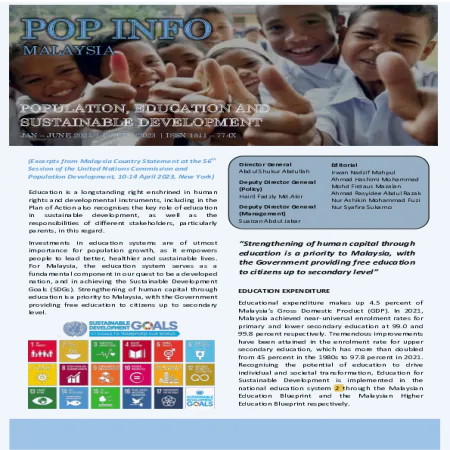
Abstract: Education is a longstanding right enshrined in human rights and developmental instruments, including in the Plan of Action also recognises the key role of education in sustainable development, as well as the responsibilities of different stakeholders, particularly parents, in this regard.
Strengthening of human capital through education is a priority to Malaysia, with the Government providing free education to citizens up to secondary level. Malaysia is also undertaking efforts to ensure that the education system is robust, resilient and fit for the future.
|
|
|
|
|
|
Population Policy Brief: Youth Sexual Education and Reproductive Health
Item Type: Act & Policy
Editor:
Year: 00/06/2023
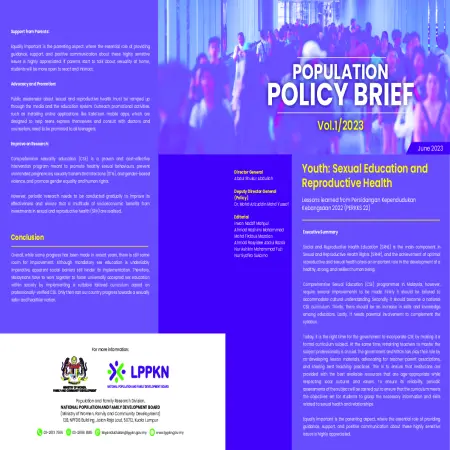
Abstract: Comprehensive sexuality education (CSE) is a proven and cost-effective intervention program meant to promote healthy sexual behaviours, prevent unintended pregnancies, sexually transmitted infections (STIs), and gender-based violence, and promote gender equality and human rights. Therefore Malaysian have to work together to foster universally accepted sex education within society by implementing a suitable tailored curriculum based on professionally-verified CSE.
|
|
|
|
|
|
The 56th Session of The Commission On Population And Development, United Nations New York, 10-14 April 2023
Item Type: Country Statement
Editor:
Year: 11/04/2023
Abstract: Education is a longstanding right enshrined in human rights and developmental instruments, including in the Plan of Action of the International Conference on Population and Development (ICPD). The ICPD Plan of Action also recognizes the key role of education in sustainable development, as well as the responsibilities of different stakeholders, particularly parents, in this regard. Investments in education systems are of utmost importance for population growth, as it empowers people to lead better, healthier and sustainable lives. For Malaysia, the education system serves as a fundamental component in our quest to be a developed nation, and in achieving the Sustainable Development Goals (SDGs). Strengthening of human capital through education is a priority to Malaysia, with the Government providing free education to citizens up to secondary level.
|
|
|
|
|

|
Active engagement and health status of older Malaysians evidence from a household survey
Item Type: Article
Editor:
Year: 17/03/2023
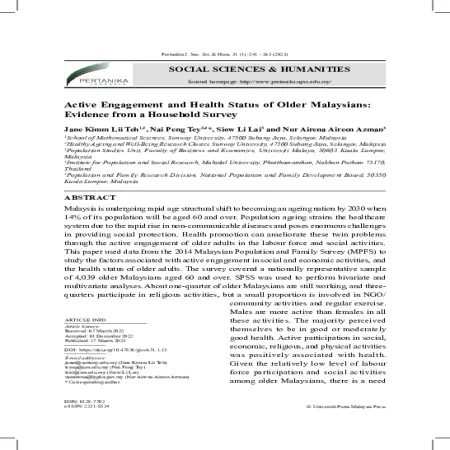
Abstract: Malaysia is undergoing rapid age structural shift to becoming an ageing nation by 2030 when 14% of its population will be aged 60 and over. Population ageing strains the healthcare system due to the rapid rise in non-communicable diseases and poses enormous challenges in providing social protection.
|
|
|
|
|
|
Modul My Therapeutic Family: Family Psychological First Aid
Item Type: Module
Editor:
Year: 00/01/2023
Abstract: INTRODUCTION:-
KASIH Keluarga Ceria Program is a comprehensive initiative aimed to bolster the family institution in Malaysia, which is a cornerstone of national well-being. This program comprises two modules, namely:
i. Psychoeducation Module
ii. Support Group "My Therapeutic Family" Module
These modules were based on the Family Psychological First Aid (F-PFA) model, jointly developed by NPFDB and Universiti Pendidikan Sultan Idris (UPSI). The model integrated fundamental family dynamics, functional family systems, and Psychological First Aid principles recognized by the World Health Organization (WHO).
The Support Group "My Therapeutic Family" Module complements the Psychoeducation Module by focusing on maintenance, particularly in the post-intervention phase, addressing crisis management within the family unit.
The objectives of this program are:
1. Enhance parents' awareness regarding mental health and adaptive skills;
2. Educate parents with knowledge of Family Psychological First Aid (F-PFA);
3. Empower parents with referral skills for psychological assistance;
4. Establish support groups platform for parents; and
5. Forge intelligent collaborative network between NGOs, agencies, and referral experts.
|
|
|
|
|
|
Modul Psiko-Pendidikan "Family Psychological First Aid"
Item Type: Module
Editor:
Year: 00/01/2023
Abstract: KASIH Keluarga Ceria Program is a comprehensive initiative aimed to bolster the family institution in Malaysia, which is a cornerstone of national well-being. This program comprises two modules, namely:
i. Psychoeducation Module
ii. Support Group "My Therapeutic Family" Module
These modules were based on the Family Psychological First Aid (F-PFA) model, jointly developed by LPPKN and Universiti Pendidikan Sultan Idris (UPSI). The model integrates fundamental family dynamics, functional family systems, and Psychological First Aid principles recognized by the World Health Organization (WHO).
The Psychoeducation Module serves to impart knowledge on F-PFA concepts and skills necessary during the preparation and intervention phases of managing crises within the family unit. The module encompasses mental health screening, psychosocial intervention, and referral skill. Families, armed with F-PFA knowledge and skills, gain the capacity to adeptly respond during family crisis.
The objectives of this program are:
1. Enhance parents' awareness regarding mental health and adaptive skills;
2. Educate parents with knowledge of Family Psychological First Aid (F-PFA);
3. Empower parents with referral skills for psychological assistance;
4. Establish support groups platform for parents; and
5. Forge intelligent collaborative network between NGOs, agencies, and referral experts.
|
|
|
|
|
|
K.A.S.I.H
Item Type: Video
Editor:
Year: 00/01/2023
Abstract: The Family KASIH campaign is an initiative of the Ministry of Women, Family and Community Development (MWFCD) through the National Population and Family Development Board (NPFDB) to deal with mental health problems among family members post-Covid-19. This campaign focuses on the application of pure family values which is LOVE which is the main core of family well-being. LOVE means Affection, Morality, Health and Safety, Knowledge and Harmony.
|
|
|
|
|

|
Cepat Tahu, Cepat Tindak
Item Type: Video
Editor:
Year: 00/01/2023
Abstract: Educational video regarding the importance of undergoing a mammogram test which is an examination to detect the early stages of breast cancer while the HPV DNA test is a test to detect the Human Papillomavirus (HPV) that is infected through sexual contact. Cervical cancer is cancer at the base of the uterus caused by HPV.
|
|
|
|
|

