Browse by Author
|
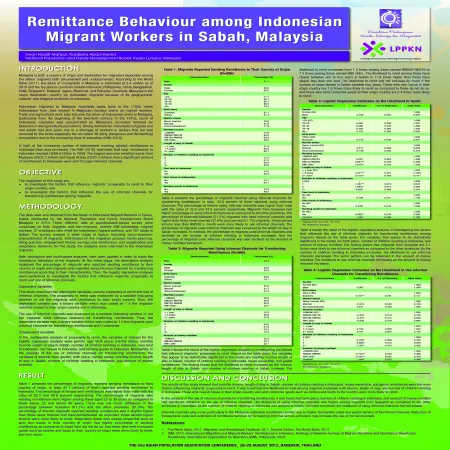
Remittance behaviour among Indonesian migrant workers in Sabah, Malaysia
Item Type: Scientific Poster
Editor:
Year: 00/08/2012
Abstract: Malaysia is both a country of origin and destination for migration especially among the labour migrants both documented and undocumented. According to The World Bank's Migration and Remittances Factbook 2011, the stock of immigrants in Malaysia is estimated at 2.4 million as at 2010 and the top source countries include Indonesia, Philippines, China, Bangladesh, India, Singapore, Thailand, Japan, Myanmar, and Pakistan. Generally, Malaysia is the major destination country for Indonesian migrants because of its geographical, cultural, and religous proximity to Indonesia.
The objective of this study is to investigate remittance behaviour among Indonesian migrants including the decision to remit and use of informal methods of transferring remittance. The data used was obtained from the Study of Indonesian Migrant Workers in Tawau, Sabah conducted by the National Population and Family Development Board Malaysia in 2010. Three different sets of questionnaire-based survey were conducted on both migrants and non-migrants, namely 896 Indonesian migrant workers, 37 employers who hired the Indonesian migrant workers, and 787 locals in Sabah. Both descriptive and multivariate analyses have been applied in order to study the remittance behaviour of the migrants. At the initial stage, the descriptive analysis explained the percentage of migrants who send remittance and migrants who use informal channels according to their characteristics. Then, logistic regression analysis was performed to investigate the factors that influence migrants' decision to send remittance and the use of informal methods of transferring remittance. The results of this study showed that age, monthly income, number of children residing in Indonesia, having own house in Indonesia and sending goods to Indonesia are the main factors contributing to the migrants' decision to remit. It was found that the likelihood to remit among migrants increased with age, income and number of children residing in Indonesia. Those who own house in their origin country and sending goods to the country are more likely to remit. In the analysis of methods of transferring remittance, it was found that birth place, number of children residing in Indonesia and the total amount of money remitted have significant relationship with the use of informal channels. The likelihood of using informal channels is higher among migrants from Sulawesi as compared to the other parts of Indonesia. As the number of children residing in Indonesia and amount of money remitted increased, the likelihood of using informal channels had decreased.
|
|
|
|
|
|
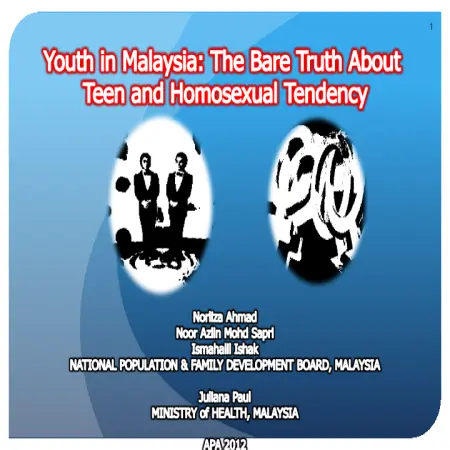
Youth in Malaysia: the bare truth about teen and homosexual tendency
Item Type: Conference or Workshop Item
Editor:
Year: 01/07/2012
Abstract: Sexuality is a result of the interplay of biological, psychological, socio-economic, cultural, ethics and religious/spiritual factors. Youth sexuality, particularly homosexuality has always been a matter of concern to many parties. Furthermore, the issue of homosexuality has already caused much controversy in Malaysia recently. This study aims to explore the homosexual tendency among Malaysian youths. Methods a nationwide cross sectional study was done using secondary data from Adolescent Health Screening Forms (BSSK/R/1/2008). Data was obtained from randomly selected participants of a national youth programme aged between 18-25 years and was analyzed using SPSS. Results A total of 22,750 youth participated with almost equal ratio by sex. Mean age was 19.0 years old. This study revealed that the homosexual tendency was more common amongst male youths (4.1%), 21-24 years old (5.5%) and no formal education (6.1%). There is a relationship between homosexual tendency and sex, ethnicity and educational attainment. Homosexual tendency was found to be significantly associated with risky behavior, abuse, anti-social behavior, substance abuse and family connectedness. Multivariate analysis using logistic regression found that homosexual tendency was two times higher among abused youth followed by youth with anti-social (OR=1.9), risky behavior (OR=1.6), lack of family connectedness (OR=1.7), less religious (OR=1.4) while controlling for age, ethnicity and education level. Conclusion, the prevalence of homosexual tendency among youths in Malaysia is an alarming issue and many cases are still under-reported. Misunderstanding and a lack of information on sexual diversity have caused a concern for many, as there is a tendency for judgments, stereotypes, discrimination and prejudice towards homosexuality in society. Instead of treating it as a disease, ways and measures of educating youths need to be explored.
|
|
|
|
|
|
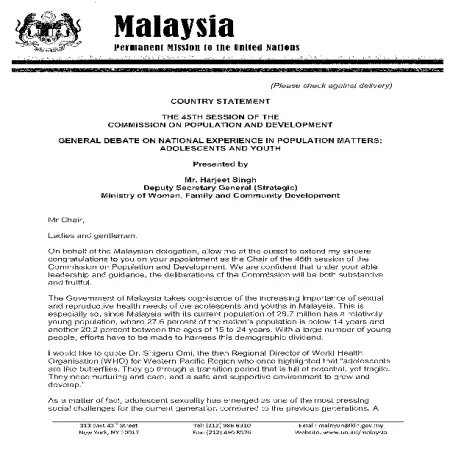
The 45th session of the Commission on Population and Development at the general debate on national experience in population matters: adolescents and youth, New York, 24th April, 2012
Item Type: Country Statement
Editor:
Year: 00/04/2012
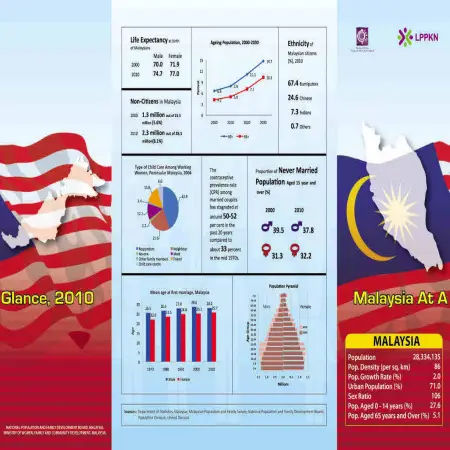
Abstract: The Government of Malaysia takes cognisance of the increasing importance of sexual and reproductive health needs of the adolescents and youths in Malaysia. Since Malaysia with its current population of 28.7 million has a relatively young population, where 27.6 percent of the nation's population is below 14 years and
another 20.2 percent between the ages of 15 to 24 years. With a large number of young people, efforts have to be made to harness this demographic dividend.
|
|
|
|
|
|
Community based program in Ethiopia: from CBD to massive, state-run health extension program
Item Type: Conference or Workshop Item
Editor:
Year: 00/00/2012
Abstract: The Family Guidance Association of Ethiopia (FGAE) pioneered a Community-based FP Distribution [CBD] program in Ethiopia in 1991. The CBD agents were selected by the community members through prior set selection criteria including interest and willingness to volunteer for community work and sufficient knowledge about the socio-economic and cultural context of the community. The CBD program was very widely replicated by many other institutions as a low cost, effective strategy to increase access to modern contraceptive services in under-served communities. Considering the challenges related to distance and access to fixed health facilities among women with high unmet needs and the lessons drawn from project based success stories of the CBD programs, the government of Ethiopia initiated the Health Extension Program (HEP) in 2003 to accelerate utilization of primary health care services in rural communities. The HEP is implemented by trained health extension workers or practitioners at the community level with strong focus on health promotion and disease prevention and empowering community members to make decisions and take actions on their own health. The Health Extension Workers (HEW) were recruited from the community among those who completed high school and trained for one year. Currently, two female HEWs are assigned at each kebele (the lowest administrative unit) and to implement a package of 16 primary health care services including FP and maternal health. A total of about 35,000 rural HEWs and 4,800 urban Health Extension Professionals [Graduate Nurses] are deployed by MoH as government employees throughout the country. The program has created a better opportunity, particularly for rural women and young people to access health services including FP/RH.
|
|
|
|
|
|
Nurturing healthy, happy, well-planned and empowered Filipino families: the Philippine experience
Item Type: Conference or Workshop Item
Editor:
Year: 00/00/2012
Abstract: This paper discuss about challenges facing by Filipino families in nurturing healthy, happy, well-planned and empowered and the strategies in Philippine Development Plan 2011-2016 to overcome this problem.
|
|
|
|
|
|
Kesan amalan dan status kesihatan terhadap kemurungan di kalangan warga tua lelaki di Semenanjung Malaysia
Item Type: Conference or Workshop Item
Editor:
Year: 00/00/2012
Abstract: This study aims to look at the factors of practice and health status that contribute to depression among elderly men aged 60 years and above in Peninsular Malaysia. The data used in this study was obtained from the 4th Malaysian Population and Family Survey which was conducted by the National Population and Family Development Board (LPPKN). The data obtained were analyzed using Descriptive Statistics and Logistic Regression. Among the variables used were the level of health, frequency of treatment, disease, frequency of exercise and health check-ups. The results of the analysis showed that coronary heart disease, decreased labor capacity, restless inability to sleep and attending religious ceremonies were independent variables influencing the risk of depression.
|
|
|
|
|
|
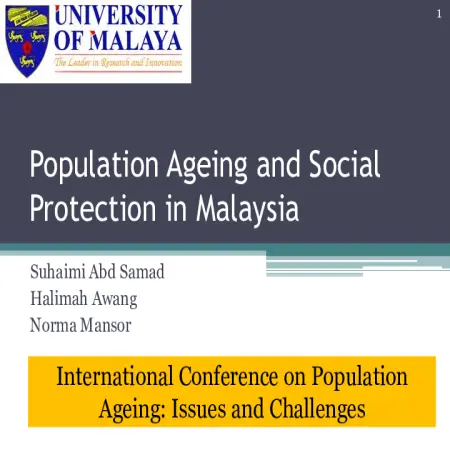
Population ageing and social protection in Malaysia
Item Type: Conference or Workshop Item
Editor:
Year: 00/00/2012
Abstract: With rapid increase in number of older persons, Malaysia is faced with multitude issues of graying population resulting from declining birth rate and rising life expectancy. In 2010 4.7% of the population was above 65 years old and the life expectancy was 71.7 years for males and 75 years for females. The New Economic Model for Malaysia (NEM) 2010 defines inclusiveness, high income and sustainability, as the three prong objective towards a developed nation in 2020. The underlying principle of the inclusiveness objective is to enable every Malaysian to have access to opportunities in order to contribute to the economy and to ensure that essential needs of the people are met. At least ten policy measures were recommended to improve the well being of the bottom 40% of the population, which has been identified as underserved. The question is, to what extent is the existing social safety net policy adequate to support every Malaysian to sustain a decent living? What are the issues and gaps with social safety net for older people? This paper attempts to answer these questions and to examine other related issues. It is divided into three parts: the first parts is an assessment of the existing social safety net in Malaysia; the second part looks at some case studies of NGO’s working with the older people and the final part offers some policy recommendations as a way forward.
|
|
|
|
|