Browse by Author
|
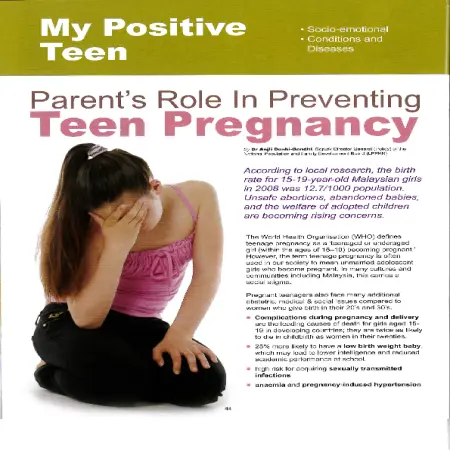
Parent's role in preventing teen pregnancy
Item Type: Article
Editor:
Year: 00/00/2015
Abstract: The World Health Organisation (WHO) defines teenage pregnancy as a ‘teenaged or underaged girl (within the ages of 15–19) becoming pregnant.’ However, the term teenage pregnancy is often used in our society to mean unmarried adolescent girls who become pregnant. In many cultures and communities including Malaysia, this carries a social stigma.
Pregnant teenagers also face many additional obstetric, medical & social issues compared to women who give birth in their 20’s and 30’s.
|
|
|
|
|
|
Population and Family Policies in Malaysia
Item Type: Conference or Workshop Item
Editor:
Year: 26/06/2014
Abstract: One of the objectives of development in the country is to improve the quality of life for all the people. Therefore, populations are at the core of development. Understanding demographic trends provides policy-makers with the tools to design interventions that lead to development especially in social sectors (family, health, education and labour) and providing infrastructure services. Knowledge on the population is crucial for planning resource allocation and designing appropriate policies. This paper intends to provide a review of population trends and population-related policies in Malaysia.It considers descriptions of Malaysia demographic changes, and then turns to the 1966 family planning programmes, the 70 million Population Policy in 1984 and to the recent Family Policy. This paper also attempts to provide insight into these policies by their evolutions, patterns and approaches, characteristics and provide recommendations for the future challenges.
|
|
|
|
|

|
Population change and environmental issues in Malaysia
Item Type: Conference or Workshop Item
Editor:
Year: 00/00/2014
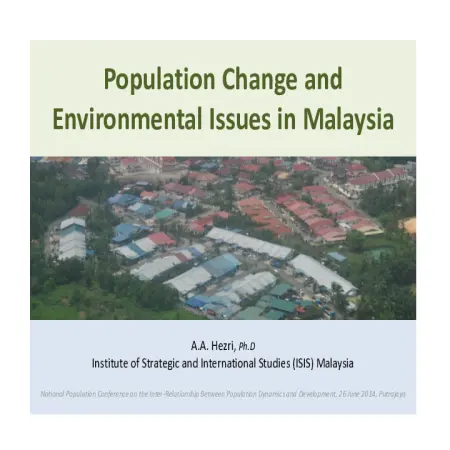
Abstract: Human influence on ecological footprint was negligible for thousands of years until population numbers started to increase dramatically. For instance, prior to the Industrial Revolution, the forests of many European countries were cleared mainly for subsistence, with little effect on ecosystem functioning. By the late 17th century, the fall in mortality and higher birth rates had catalysed the spread of settled agriculture with a rapid decline in Europe's forest cover. The population growth also triggered migration within Europe. When some natural resources fell into short supply, European powers started to search other parts of the New World. These explorations later on resulted in migration not just for subsistence, but also for settlements, agriculture and industry. This presentation will explains about population change and environmental issues in Malaysia.
|
|
|
|
|

|
Population change and educational planning in Malaysia
Item Type: Conference or Workshop Item
Editor:
Year: 00/00/2014
Abstract: Strengthen national capacity to plan and manage changing. Educational systems in response to the needs of society. Planning and preparing the education sector through long-term involvement and focused [sustainable] interventions. Improve the quality of the educational experience itself. Realise global agenda like ESD, EFA, MDGs and post-2015 Development (Education) Agenda. This presentation is describes about population change and educational planning in Malaysia.
|
|
|
|
|
|
Population, human capital and development: the Malaysia experience
Item Type: Conference or Workshop Item
Editor:
Year: 00/00/2014
Abstract: Like other countries in East and Southeast Asia, Malaysia has undergone a rapid demographic transition to low fertility. This has meant a growing share of the economically active population that will eventually peak as ageing becomes more pronounced. The potential increase in the labor force has been undermined by both rising enrollment in upper secondary and tertiary education, as well as by many females remaining outside the labor force. Together with high economic growth, this has created a shortage of labor. Immigrant labor, both legal and illegal, has stepped in to fill the gap but entrenched a low labor cost model. Breaking out of this requires strengthening the country’s human capital base. While generous government expenditure and liberalization of the education sector has resulted in significant gains in numbers enrolled, several factors have had a negative effect on education quality. Unless reversed, this deterioration has long-term implications for the country’s development.
|
|
|
|
|
|
Population and development linkages
Item Type: Conference or Workshop Item
Editor:
Year: 00/00/2014
Abstract: Demographic factors remain very important in the overall development equation, but the meaning of development remains contested, the increasing inequality in many countries’ income distribution provides a fundamental challenge to current economic systems, and the sustainability of what we have achieved remains in question. The United Nations has issued a challenge to academics and planners by claiming that the framework for population and development beyond 2014 should rest on the five thematic pillars of dignity and human rights, health, place and mobility, governance and accountability, and sustainability. Integrating population policy into overall development policy will continue to require both good analytical abilities and a broader vision of what the goals are.
|
|
|
|
|

|
Population projection for development planning in Malaysia
Item Type: Conference or Workshop Item
Editor:
Year: 00/00/2014
Abstract: The purpose of this paper is to identify the data needs, and provide projected population figures, disaggregated by age and other characteristics, which may be used by planners from the government and the industry for planning purposes. Specifically, the paper seeks to illustrate the requirements for education, health and economic sectors in terms of human resources, infrastructure and expenditure to meet the needs of the population.
|
|
|
|
|

|
Pendekatan sokongan keluarga dalam kalangan penjaga warga tua: pengetahuan, kemahiran dan kesejahteraan
Item Type: Conference or Workshop Item
Editor:
Year: 00/00/2013
Abstract: This study is conducted in line with global development (modernization) the impact on the care of elderly parents in their own (informal) families is declining and may worsen in the future. This phenomenon does not only occur in Malaysia but it is a global issue especially in developed and developing countries. Among the causes of this phenomenon are due to the increase in life expectancy of elderly parents (Department of Statistics Malaysia, 2000), the effects of modernization and changes in family structure, increase in divorce rates, reduction in birth rates, geographical movements and globalization.
|
|
|
|
|

|
Population ageing and social protection in Malaysia
Item Type: Conference or Workshop Item
Editor:
Year: 00/00/2012
Abstract: With rapid increase in number of older persons, Malaysia is faced with multitude issues of graying population resulting from declining birth rate and rising life expectancy. In 2010 4.7% of the population was above 65 years old and the life expectancy was 71.7 years for males and 75 years for females. The New Economic Model for Malaysia (NEM) 2010 defines inclusiveness, high income and sustainability, as the three prong objective towards a developed nation in 2020. The underlying principle of the inclusiveness objective is to enable every Malaysian to have access to opportunities in order to contribute to the economy and to ensure that essential needs of the people are met. At least ten policy measures were recommended to improve the well being of the bottom 40% of the population, which has been identified as underserved. The question is, to what extent is the existing social safety net policy adequate to support every Malaysian to sustain a decent living? What are the issues and gaps with social safety net for older people? This paper attempts to answer these questions and to examine other related issues. It is divided into three parts: the first parts is an assessment of the existing social safety net in Malaysia; the second part looks at some case studies of NGO’s working with the older people and the final part offers some policy recommendations as a way forward.
|
|
|
|
|
|
Productive aging - role of NGO
Item Type: Conference or Workshop Item
Editor:
Year: 00/00/2012
Abstract: Butler and Gleason (1985) define productive ageing as “the capacity of an individual or a population to serve in the paid workforce, to serve in volunteer activities, to assist in the family and to maintain himself or herself as independent as possible.” USIAMAS is a non-governmental organization (NGO), registered in 2002 with the Registrar of Societies. It is a non-profit and welfare related organization whose members are senior citizens themselves. USIAMAS was formed with the objectives of being a smart partner or consultant to government, corporate and other volunteer bodies who share the same mission and vision of planning, implementing, coordinating, evaluating policies, projects and programs for the wellbeing of senior citizens towards quality and meaningful life. Among the various programs run by USIAMAS to support productive ageing are seminars, capacity training programs for volunteers and with the cooperation of the Social Welfare Department of Malaysia manages an Activity Center for Senior Citizens in Kompleks Penyayang Sungai Buloh. USIAMAS was honored to be chosen by HELPAGE Korea to implement a pilot project on home-help in 2005. Home-help is a community support program aimed at ‘recruiting, developing and deploying volunteers to make regular visits as informal companions and soft-skilled caregivers to older persons staying in their homes.’The normal duties of a volunteer in a home-help program include ‘personal grooming, running errands, feeding, reminders on medication, writing letters, accompanying them on recreational activities, visit to hospitals, banks or supermarkets’ More often the mere art of listening and responding to the needs of older persons will help to overcome their feelings of ‘rejection, isolation, boredom and loneliness’. The pilot project which commenced in 2005 has now been extended to Negeri Sembilan and Melaka with the support of the Social Welfare Department of Malaysia.
|
|
|
|
|