Browse by Author
|
Keluarga dan cabaran norma baharu
Item Type: Book Section
Editor:
Year: 00/00/2021
Abstract: This paper describes the current situation in family institutions during the pre-pandemic period of Covid-19 by also showing the pattern of family well-being in the country through the Malaysian Family Well-being Index (FWI), a special measurement that has been introduced by the National Population and Family Development Board (NPFDB) since 2011. Although there was an increase in scores in the third series of FWI in 2019, the situation in family institutions seemed to change with the start of the outbreak of the Covid-19 in the country at the beginning of 2020.
|
|
|
|
|
|
The impact of aging and fertility rate on economic growth in Malaysia: new evidence using ARDL model
Item Type: Book Section
Editor:
Year: 00/00/2021
Abstract: Population aging and the health status of the community are the primary agenda in the achievement of the Sustainable Development Goals 2030 (SDG, 2030). However, current trends in the world have shown a rapid increase in the aging population rate, whereas the birth rate has shown a downward trend. Malaysia is no exception in this regard, which is expected to become an old country status by 2030 when the population aged 60 years and above reaches 15% of the total population.
|
|
|
|
|
|
A multimodal analysis of Malaysian contraceptive promotional materials
Item Type: Book Section
Editor:
Year: 00/00/2021
Abstract: Communicating about contraception is still a taboo subject for many Malaysians. This study focuses on the use of multimodal communication in providing information and promoting contraception to the Malaysian public. Employing Kress and Van Leeuwen’s visual grammar framework and linguistic genre analysis, the study unpacks the social-cultural practices represented in printed and digital promotional materials disseminated by Malaysia’s three main responsible agencies. These resources were published by the National Population and Family Development Board (NPFDB), the Ministry of Health (MOH) and the Federation of Reproductive Health Association of Malaysia (FRHAM).
|
|
|
|
|
|
Trends and variations in contraceptive use in Malaysia
Item Type: Book Section
Editor:
Year: 00/00/2021
Abstract: The contraceptive prevalence rate (CPR-the proportion of married women in the reproductive age group using any family planning method) in Malaysia CPR had stagnated since the mid-1980s when the government shifted its programme thrust from family planning to family development.
|
|
|
|
|
|
Fatherhood program and children’s development: Does it mature?
Item Type: Book Section
Editor:
Year: 00/00/2021
Abstract: The prevalence of social problems and criminal cases among teenagers in Malaysia is at an alarming level. Often, such problems are associated with the fragility of the family institution underpinned by the role of the father. In Malaysia, fatherhood-related programs are still limited and minimal compared to the United States where most initiatives to support fathers have been implemented through father-specific programs designed to improve fathers' economic self-sufficiency, parenting knowledge and skills.
|
|
|
|
|
|
Peraturan perkahwinan transnasional: Kajian kes dan penelitian semula berasaskan konvensyen penghapusan semua bentuk diskriminasi terhadap wanita (CEDAW)
Item Type: Book Section
Editor:
Year: 00/00/2021
Abstract: This paper discusses the issue of transnational marriage from the context of determining the nationality of a child resulting from the marriage of a Malaysian women to a foreign citizen’s spouse based on the Convention on the Elimination of Discrimination against Women (CEDAW).
|
|
|
|
|
|
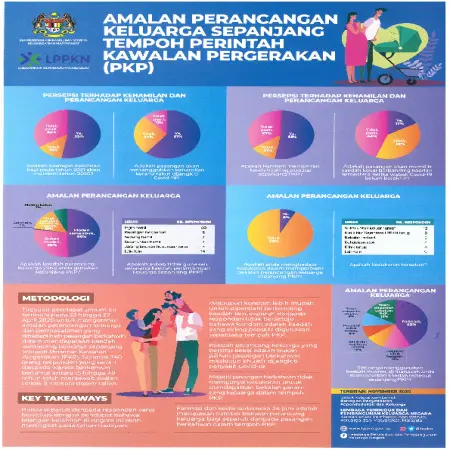
Amalan perancangan keluarga sepanjang tempoh perintah kawalan pergerakan
Item Type: Infographic
Editor:
Year: 00/12/2020
Abstract: A total of 740 respondents of married women aged 15 to 49 years were involved in this public opinion poll to find out family planning practices and problems faced by married couples in obtaining family planning methods during the period of Movement Control Order (MCO).
|
|
|
|
|
|
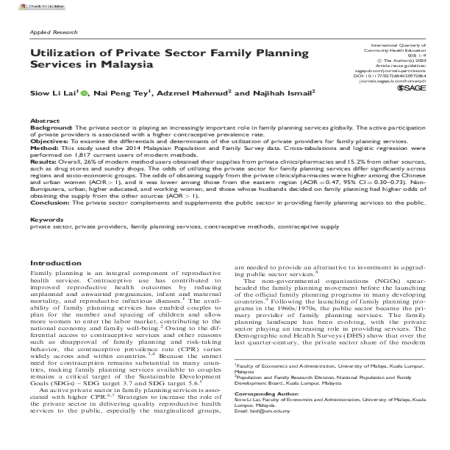
Utilization of private sector family planning services in Malaysia
Item Type: Article
Editor:
Year: 00/12/2020
Abstract: The private sector is playing an increasingly important role in family planning services globally. The active participation of private providers is associated with a higher contraceptive prevalence rate. The objectives is to examine the differentials and determinants of the utilizatio of private providers for family planning services. This study used the 2014 Malaysian Population and Family Survey Data. Cross-tabulations and logistic regression were performed on 1.817 current users of modern methods. Overall, 26% of modern method users obtained their supplies from private clinics/pharmacies and 15.2% from other sources, such as drug stores and sundry shops. The odds of obtaining supply from the private clinics/pharmacies were higher among the Chinese and urban women (AOR>1), and it was lower among those whose husbands decided on family planning had higher odds of obtaining the supply from the other sources (AOR>1). Conclusions, the private sector complements and supplements the public sector in providing family planning services to the public.
|
|
|
|
|
|
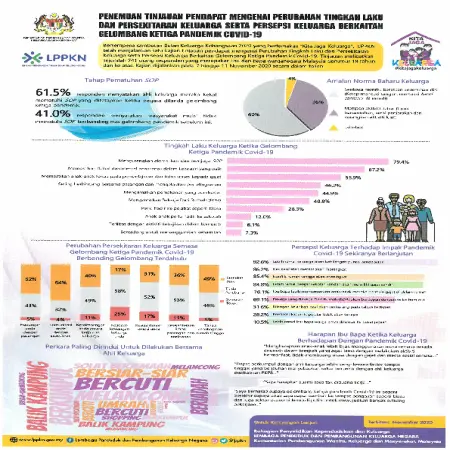
Penemuan tinjauan pendapat mengenai perubahan tingkah laku dan persekitaran keluarga serta persepsi keluarga berkaitan gelombang ketiga pandemik Covid-19
Item Type: Infographic
Editor:
Year: 00/11/2020
Abstract: This infographic is about findings from public opinion poll that was conducted in conjunction with the 2020 National Family Month celebration themed "Kita Jaga Keluarga". The survey involved a total of 741 respondents who are parents of Malaysian citizens aged 18 years and above.
|
|
|
|
|
|
Public opinion: impact of covid-19 on behavioural and lifestyle changes, work from home (WFH) and family planning
Item Type: Infographic
Editor:
Year: 27/07/2020
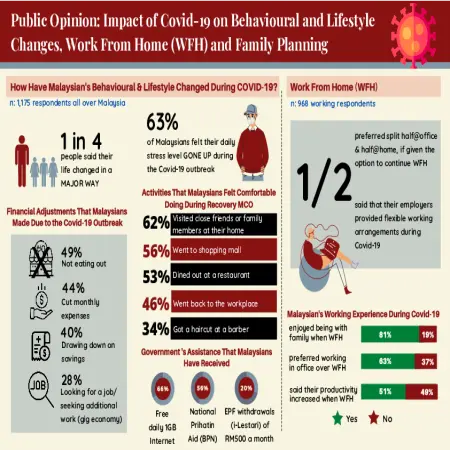
Abstract: This infographic shows the findings from the study covered the below areas: changes in Malaysians’ personal lives, emotional health / stress levels observed during the pandemic, financial adjustments during and since the pandemic, benefits from employers during the pandemic, changes in working conditions, environment and styles and family planning amidst COVID-19.
|
|
|
|
|