Browse by Author
|
Population and Family Policies in Malaysia
Item Type: Conference or Workshop Item
Editor:
Year: 26/06/2014
Abstract: One of the objectives of development in the country is to improve the quality of life for all the people. Therefore, populations are at the core of development. Understanding demographic trends provides policy-makers with the tools to design interventions that lead to development especially in social sectors (family, health, education and labour) and providing infrastructure services. Knowledge on the population is crucial for planning resource allocation and designing appropriate policies. This paper intends to provide a review of population trends and population-related policies in Malaysia.It considers descriptions of Malaysia demographic changes, and then turns to the 1966 family planning programmes, the 70 million Population Policy in 1984 and to the recent Family Policy. This paper also attempts to provide insight into these policies by their evolutions, patterns and approaches, characteristics and provide recommendations for the future challenges.
|
|
|
|
|

|
The 47th session of the Commission on Population and Development on agenda item 4: general debate on national experience in population matters: assessment of the status of implementation of the programme of action of the international conference on population and development, New York, 8 April 2014
Item Type: Country Statement
Editor:
Year: 08/04/2014
Abstract: Malaysia shares the view that the current state of the world’s population is one of unprecedented diversity and change, reflected in new patterns of fertility, mortality, migration, urbanisation and ageing. The continuation and consequences of these population trends will present both opportunities and challenges for the formulation and implementation of the post-2015 development agenda and for the achievement of all internationally agreed development goals.
|
|
|
|
|

|
Seminar Antarabangsa Kekeluargaan di Persada Johor pada 13 Februari 2014.
Item Type: Video
Editor:
Year: 13/02/2014
Abstract: Johor College of Islamic Studies (MARSAH) in collaboration with the National Population and Family Development Board (NPFDB), Ministry of Women, Family and Community Development and Johor Bahru City Council (JBCC) took the initiative to organize the International Conference on Family from a Global Perspective to contribute towards development efforts ummah in an integrated manner based on a tajdid approach that takes into account the ideas of ijtihad that are deemed appropriate to be implemented in today’s society. The objective of this conference is to expose issues related to family institutions from a global perspective, explore views related to family issues especially children's rights from an Islamic perspective, explain the position and stance of Islam on family issues that touch on matters related to religion, social, culture, education and so on. In addition, look at the legal provisions related to children in Malaysia and the Southeast Asian region and others. The era of globalization is a century that greatly challenges the integrity of identity and survival of Muslims today, including family institutions. In facing the challenge, Muslims need to plan a futuristic agenda based on the development that will take place in the future. This is in line with the theme of the conference, "Challenges and Future of Islamic Family Institutions". This one-day conference consists of three slots: i) Adopted Children and Illegal Children in Islam ii) Hukum Hakam Related to Marriage in Islamic Family Law iii) Challenges in Islamic Family Issues The main speech in the conference was Honoured Tun Dr. Mahathir bin Mohamad, former Prime Minister of Malaysia. Conference paper presenters include senior lecturers from Institutions of Higher Learning in and outside the country including from Thailand, Brunei Darussalam and Indonesia. The one-day conference was attended by 300 participants consisting of officials from government agencies, non-governmental organizations (NGOs), research institutions, academics, professional organizations and Higher Institutions students.
|
|
|
|
|

|
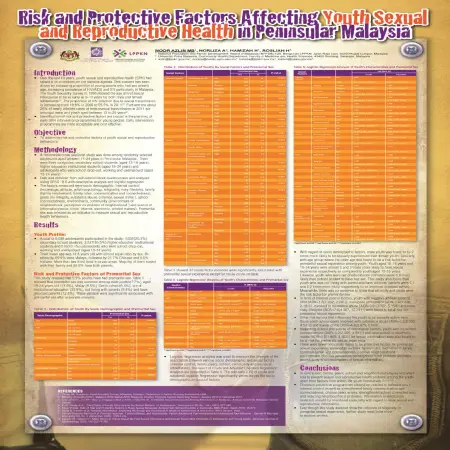
Risk and protective factors affecting youth sexual and reproductive health in Peninsular Malaysia
Item Type: Scientific Poster
Editor:
Year: 00/01/2014
Abstract: Over the last 10 years, youth sexual and reproductive health (SRH) had raised a lot of concern on the national agenda. This concern has been driven by increasing proportion of young people who had sex at early age, increasing prevalence of HIV/AIDS and STI particularly in Malaysia.
|
|
|
|
|
|
Malaysia's initiatives for sustainable family development
Item Type: Book Section
Editor:
Year: 01/01/2014
Abstract: Various initiatives to strengthen the family institution have been undertaken by the Government of Malaysia through the Ministry of Women, Family and Community
Development (MWFCD). Through its agency, the National Population and Family Development Board (NPFDB), the MWFCD has formulated, developed and implemented policies and programmes such as the National Family Policy,
1Malaysia Family First (1MF1st) and 1Malaysia Youth Empowerment and Support (1MYes) programmes, One-Stop Family Centres, and family education programmes such as the Strengthening of Marriage Institution (SmartStart remarriage programme), Parenting@Work, Smart Belanja@Lppkn (family financial management programme), KASIH Parenting Modules and counselling services.
To ensure sustainable family development, the National Family Policy (NFP) and its accompanying plan of action was launched in March 2011 and implemented by the NPFDB in partnership with other ministries, departments and related non-government organizations (NGOs). The aim of this explicit policy is to develop prosperous, healthy and resilient families to ensure social stability. The NFP is
a key policy that focuses on aspects of family well-being and development, providing direction for the development of family-friendly programmes and services for nurturing healthy and resilient families in line with the aspirations
of Vision 2020.
|
|
|
|
|
|
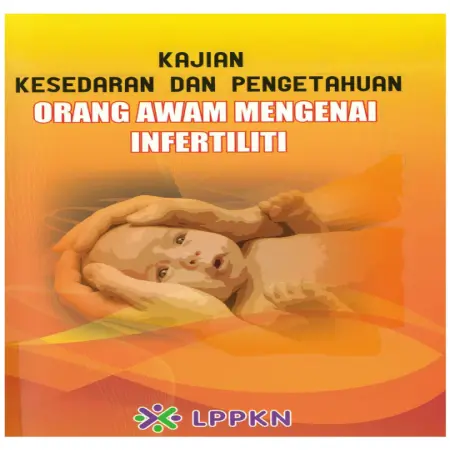
Kajian kesedaran dan pengetahuan orang awam mengenai infertiliti
Item Type: Research Report
Editor:
Year: 00/01/2014
Abstract: The study conducted by the Human Reproductive Division, National Population and Family Development Board aims to identify the extent of the public awareness and knowledge about infertility. The sampling method of the study is convenience sampling; involving the display of questionnaires on other websites are also provided. The completed questionnaires were collected, recorded and analyzed using SPSS software. The statistical analysis carried out is descriptive statistics and the Chi-square Test.
|
|
|
|
|
|
Kajian Penduduk dan Keluarga Malaysia Kelima (KPKM-5)
Item Type: Video
Editor:
Year: 00/00/2014
Abstract: Announcement of the implementation of the Malaysian Population and Family Survey 2014 (MPFS-5).The purpose of this survey was to collect the latest information and time series data in respect of demography, family and reproductive health of the Malaysian population.
|
|
|
|
|

|
Determinant of marriage dissolution
Item Type: Conference or Workshop Item
Editor:
Year: 00/00/2014
Abstract: Nowadays, the number of divorce cases among Muslim couples is very worrisome whereby the total cases reported in 2013 increased by half of the total cases reported in the previous year. Thus, the objective of this study is to reveal the factors that contribute to the dissolution of marriage. A total of 181 cases and ten potential determinants were included in this study. The potential determinants considered were age at marriage of husband and wife, educational level of husband and wife, employment status of husband and wife, income of husband and wife, the number of children and the presence at a counseling session. Logistic regression analysis was used to analyze the data. The findings revealed that four determinants, namely the income of husband and wife, number of children and the presence at a counselling session were significant in predicting the likelihood of divorce among Muslim couples.
|
|
|
|
|