Browse by Author
|
The changing age structures of populations and their implications for development
Item Type: Newsletter
Editor:
Year: 00/07/2007
Abstract: The demographic transition in Malaysia is characterized by rapid declines in mortality and moderate declines in fertility. Rapid decline in mortality was due to the availability of modern medical and health facilities and the general improvement in socio-economic condition. While, steady decline in fertility due to the availability of family planning services and indirectly, due to the general improvement in the socio-economic conditions associated with development.
|
|
|
|
|
|
The 40th session of the Commission on Population and Development on agenda item 4: general debate on national experience in population matters: the changing age structures of populations and their implications for development, New York, 10 April 2007
Item Type: Country Statement
Editor:
Year: 10/04/2007
Abstract: The transition from a regime of high mortality and high fertility to one of low mortality and low fertility in Malaysia is a relatively recent phenomenon. similar to the trends in many developing countries, the demographic transition in Malaysia is characterized by rapid declined in mortality and moderate declines in fertility. The crude death rate has drastically declines from a high of 20.0 in 1947 to a very low level of 4.5 deaths per thousand populations in 2006. Such a rapid declines was due to improvements in the health sectors and higher socio-economic development in the country.
|
|
|
|
|
|
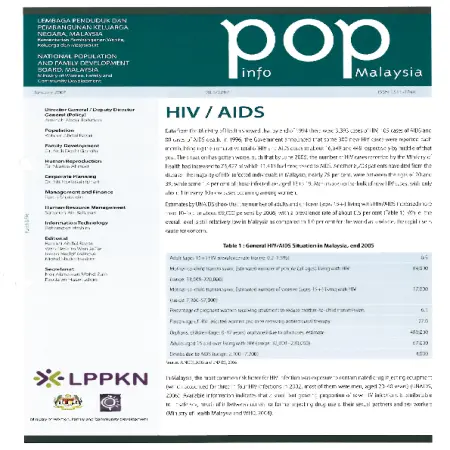
HIV/AIDS
Item Type: Newsletter
Editor:
Year: 00/01/2007
Abstract: Data from the Ministry of Health showed that by end of 1994 there were 3393 cases of HIV, 105 cases of AIDS and 80 cases of AIDS death. In Malaysia , the most common risk factor from HIV infection was exposure to contaminated drug injecting equipment.
|
|
|
|
|
|
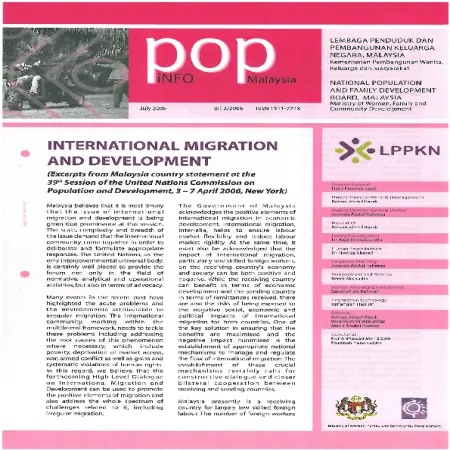
International migration and development
Item Type: Newsletter
Editor:
Year: 00/07/2006
Abstract: The Government of Malaysia acknowledges the positive elements of international migration in economic development. International migration, inter-alia, helps to ensure labour market rigidity. At the same time, it must also be acknowledged that the impact of international migration, particularly low skilled foreign workers, on the receiving country's economy and society can be both positive and negative.
|
|
|
|
|
|
The 39th session of the Commission on Population and Development on agenda item 4: general debate on national experience in population matters: international migration and development, New York, 5 April 2006
Item Type: Country Statement
Editor:
Year: 05/04/2006
Abstract: International migration, inter-alia, helps to ensure labour market flexibility and reduce labour market rigidity. At the same time, it must also be acknowledged that the impact of international migration, particularly low skilled foreign workers, on the receiving country's economy and society can be both positive and negative.
|
|
|
|
|
|
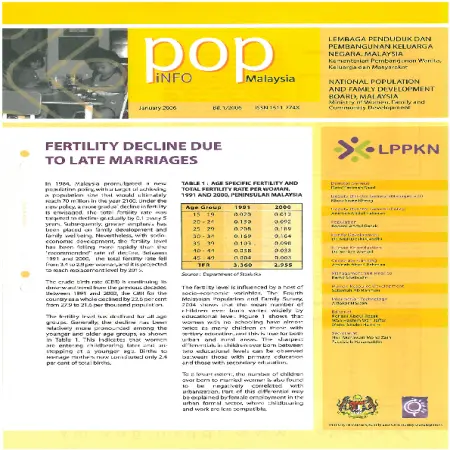
Fertility decline due to late marriages
Item Type: Newsletter
Editor:
Year: 00/01/2006
Abstract: Rising education, delayed and non-marriage will become more prevalent. Marriage postponement shortens childbearing span, and it will result in further fertility decline. Changes in marital structure have significant implications on the family system and the care of older persons. With rising age at marriage and consequently delayed childbearing , many retirees are still supporting children who are studying in institutions of higher learning.
|
|
|
|
|
 |
SMARTSTART module
Item Type: Module
Editor:
Year: 00/00/2006
Abstract: Couples planning to get married must be well prepared in order to create a harmonious marriage. Hence, the National Population and Family Development Board organises the SMARTSTART Premarital Programme for couples who are planning to get married and those who have recently married (not more than five years) in four languages, i.e. Malay, English, Mandarin and Tamil.
This module has been developed to provide newly married couples and those who are planning to get married with knowledge and skills on the various aspects of marriage and parenting so as to support them psychologically and prepare them for a harmonious marriage life.
|
|
|
|
|
Tingkah laku seks di kalangan warga 45 tahun dan ke atas
Item Type: Research Report
Editor:
Year: 00/00/2006
Abstract: An opinion survey on 'Sexual Behavior Among Citizens 45 Years and Above' which was first conducted by the Human Reproduction Division (BRM) was conducted in the Klang Valley area from February to June 2003. The 'Convenience Sampling' sampling method was used where respondents who meet certain criteria fill in the questionnaire themselves. A total of 473 respondents consisting of 50.1% Malays, Indians (26.6%) and Chinese (23.3%) where men (53.5%) outnumber than women (46.5%). The majority of respondents comprised the age group of 50-59 years (41.25%). From the 220 female respondents, only 7.3% took hormone replacement therapy. The results of the study found that the importance and satisfaction of sex decreases with age where it is more pronounced among women than men. The frequency of sexual intercourse is performed in the range of 4-8 times a month (46.3%). Although only 16.7% of respondents had sex-related problems, 70.9% of them did not know the source of help and treatment for their problems. Among those who received treatment, 56.4% chose to seek modern treatment. 55.7% of respondents with sexual problems have at least one chronic disease. A total of 85.6% disagreed and looked for another partner as a way out of sex -related problems. Expectations for better sex in the future are still high at 69.1%. In conclusion, for middle-aged and above despite the declining importance of sexual intercourse, their right to access to knowledge and services related to sexual problems needs to be addressed immediately, especially by medical practitioners, especially the Human Reproduction Division and LPPKN in general. A systematic and ‘gender-sensitive’ approach can help overcome the problem of family institutional breakdown and problems related to incest.
|
|
|
|
|