Browse by Type
Results for Item type : "Scientific Poster"
2015 (1)
|
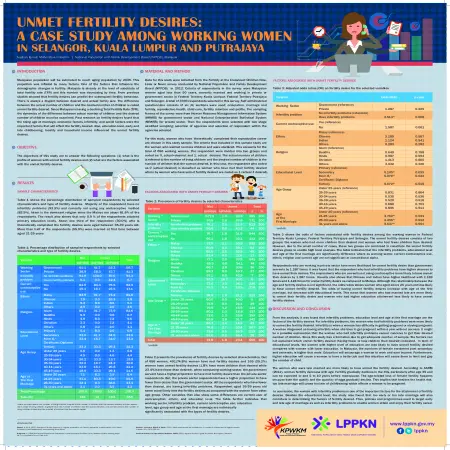
Unmet fertility desires: a case study among working women in Selangor, Kuala Lumpur and Putrajaya
Item Type: Scientific Poster
Editor:
Year: 00/00/2015
Abstract: Malaysia population will be estimated to reach aging population by 2035. This projection was inflated by many factors. One of the factors that influence the demographic changes is fertility. Malaysia is already at the level of substitute of total fertility rate (TFR) and this number was decreasing by time. From previous studies showed that fertility desires can predict the subsequent fertility behavior. There is always a disjoint between desired and actual family size. The difference between the actual number of children and the desired number of children is called unmet fertility desired. Since Malaysia is having a declining Total Fertility Rate (TFR), the dynamics of the difference between actual number of children and the desired number of children must be examined. Past research on fertility desires found that the rising age at marriage, economic factors, infertility, and social factors were the important factors that will affect the fertility desired. Also, education level, early and late childbearing, locality and household income influenced the unmet fertility desires.
|
|
|
|
|