Browse by Type
Results for Item type : "Conference or Workshop Item"
|
SDGS and the impact of megatrends on Families: perspectives from Malaysia
Item Type: Conference or Workshop Item
Editor:
Year: 00/05/2024
Abstract: 57th Commissions on Population and Development (CPD57): Assessing the status of implementation of the Programmed of Action of the International Conference on Population and Development and its contribution to the follow-up and review of the 2030 Agenda for Sustainable Development during the decade of action and delivery for sustainable development. Strengthening Malaysian Families in era of megatrends, National Population and Family Development Board Malaysia (NPFBD) had LPPKN Family Centre, Nur Sejahtera Clinic Services, Population and Family Research, Training and education (family), Counseling service and program, online accessibility etc.
|
|
|
|
|

|
Bridging Boundaries: Empowering SRHE Through KafeTEEN Peer Educators
Item Type: Conference or Workshop Item
Editor:
Year: 00/05/2024
Abstract: There is increase in sexual activity prevalence among youth and high risk practice among youth who engaged in sexual activity. SRHE knowledge is known to be one of protective factors in preventing youth from engaging in high risk sexual activity. KafeTEEN YOUTH Centre Program is one of NPFBD initiative to lead SRH education dissemination for youth in Malaysia.
|
|
|
|
|
|
Malaysia SDG roadmap and the road towards 2030
Item Type: Conference or Workshop Item
Editor:
Year: 00/05/2024
Abstract: Malaysia has undertaken periodic reviews to assess the achievement of ICPD goals and objectives. Malaysia has continuously embraced sustainable development in the national agenda. In this regard, the commitment to the 2030 Agenda for Sustainable Development (2030 Agenda) has been mapped with the Mid-Term Review of the 11th Malaysia Plan to support the Sustainable Development Goals (SDGs). The national development priorities of the Twelfth Plan continue to be aligned to the Sustainable Development Goals (SDGs) of the 2030 Agenda.
|
|
|
|
|
|
The development of Family Well-Being Index: Malaysia experience. EGM on interlinkages between migration, urbanization, new technologies, demographic trends and climate change in Asia.
Item Type: Conference or Workshop Item
Editor:
Year: 00/05/2024
Abstract: The Malaysian Family Well-Being Index (MFWBI) was initiated in 2011 by the NPFDB with the aim to measure the levels of family well-being in the country and to recommend strategic initiatives to strengthen the implementation of future family intervention programs in Malaysia. In 2016, measurement of the MFWBI was repeated using an improvised instrument. The MFWBI 2016 had maintained all the 7 domain in the MFWBI 2011 and added one more domain, namely, Family and Communication Technology. The instrument’s refinement exercise was repeated again in 2019, and 2022 in order to measure the family well-being. The purpose of the refinement exercise was to ensure that the questionnaire was valid and relevant for current and near future use. The domain in the MFWBI are Family Relationship, Family Economy, Family Health, Family Safety, Family and Community Engagement, Role of Religion & Spiritual Practice, Housing and Environment, Family and Communication Technology. At the national level, the MFWBI has been recognized by the federal government as one of the national KPI in the country’s 5-year development planning (Eleventh Malaysia Plan, 2016 -2020 and Twelfth Malaysia Plan, 2012 – 2025).
|
|
|
|
|
|
Peranan, tahap kesejahteraan, cabaran dan persediaan golongan wanita dalam menghadapi situasi pandemik Covid-19 di Malaysia: Hasil penemuan siri kajian tinjauan pendapat umum LPPKN
Item Type: Conference or Workshop Item
Editor:
Year: 26/02/2022
Abstract: Since the outbreak of the COVID-19 epidemic in the country since early 2020, the economy and community life have been severely affected. The increase in the number of daily cases as a result of several new waves of COVID-19 has also prompted the Government to implement a series of Movement Control Orders (MCO) nationwide. As a result, society, especially women, are seen to be increasingly stressed due to the loss of sources of income, limited involvement in outdoor activities and problems in balancing between work and family hours. Aware of this situation, the National Population and Family Development Board (NPFDB) has taken the initiative to conduct a series of public opinion polls throughout 2020 and 2021. This study aims to explore the role, level of well -being, challenges and preparation of women in facing pandemic situations. COVID-19 in Malaysia. This study is an online survey study. The findings of this study are a reflection of the current situation of society and family institutions in the face of the new wave of COVID-19. The results of a survey that focused on women showed that women were more affected than men. Although the level of well -being of women in the country is still at a satisfactory level, various issues and challenges are faced especially for those who are married. Issues of family management, children's education at home and more flexible working hours should be highlighted for consideration by the Government. It is hoped that various initiatives and development plans related to women can be planned as well as further strengthen the existing policies towards achieving the aspirations of the Malaysian Family. In general, this paper contributes to the knowledge related to the current situation of women in the face of new normative life. While in particular, this paper contributes to knowledge related to the role, well-being, challenges and preparation of women in facing the COVID-19 pandemic situation.
|
|
|
|
|
|
Peranan, tahap kesejahteraan, cabaran dan persediaan ibu bapa dalam menghadapi situasi pandemik COVID-19 di Malaysia
Item Type: Conference or Workshop Item
Editor:
Year: 01/12/2021
Abstract: This slide describes the current situation in family institutions in particular related to the role, level of well-being, challenges and preparation of mothers and fathers in facing the COVID-19 pandemic that has spread in the country since early 2020. The subtopics in this slide are based on 10 public opinion polls conducted by the National Population and Family Development Board (NPFDB) online throughout 2020 and 2021. The survey, which involved nearly 13,000 respondents, focused on Malaysian mothers and fathers who have children aged 3 to 24 years only. There are seven subtopics in this paper, namely (i) Introduction; (ii) Literature Review; (iii) New Norma Family; (iv) The Role of Parents in the Family; (v) Level of Parental Well -Being in Family Institutions; (vi) Challenges and Parental Preparation Related to the Use of Digital Technology; and (vii) Recommendations and Conclusions.
|
|
|
|
|
|
Keluarga dan cabaran norma baharu
Item Type: Conference or Workshop Item
Editor:
Year: 00/00/2021
Abstract: This slide describes the current situation in family institutions during the pre-pandemic COVID-19, by also showing the pattern of family well-being in the country through the Malaysian Family Well-Being Index (FWBI), a special measure introduced by the National Population and Family Development Board (NPFDB) since 2011. Despite the increase in scores in the third series of FWBI in 2019, the situation in family institutions seems to have changed with the onset of the COVID-19 epidemic in the country in early 2020. Sensitive to the increasing number of daily cases of the effects of the COVID-19 pandemic wave in the country, NPFDB has conducted a series of online public opinion poll studies to know some aspects of life including (i) the current situation of the pandemic era family; (ii) the family's behavior in facing a pandemic situation (iii) the role of mothers and fathers in the family during a pandemic; (iv) the level of well -being of mothers and fathers in the family institution; and (iv) the challenges and preparation of parents related to the use of digital technology. The results of this survey have been used as the main input to assist the Ministry of Women, Family and Community Development (MWFCD), especially NPFDB to develop appropriate programs and services as well as disseminate findings through existing social media platforms to the general public. Various initiatives including economic and social stimulus packages have been implemented by the Government to address the issue of the COVID-19 pandemic, particularly to the affected groups, in line with the "No One Left Behind" statement. With the allocation that has been channeled, MWFCD through its agencies including the Social Welfare Department (JKM) and NPFDB has intensified efforts to help the affected target groups, in addition to continuing existing activities, programs and services. In general, these stimulus and assistance packages have not only had a positive impact on economic recovery, but also on the social development of the community. Recently, with the concept of "Malaysian Family" introduced by YAB Dato 'Sri Ismail Sabri Yaakob, the Prime Minister of Malaysia is seen to be able to be a medium for the unification of society across religious, racial and ethnic boundaries to work together to solve the big problems facing the country when this. In addition, it can indirectly help further strengthen the family institution, as a basic unit that produces quality human capital for national development.
|
|
|
|
|
|
The association between work family conflict and social demographic characteristics among fathers in Malaysia
Item Type: Conference or Workshop Item
Editor:
Year: 00/00/2021
Abstract: Those living in urban, Indian, age 30-44 years, higher educational level, single father, and non Muslim’s tend to face Work Family Conflict than their counterparts. More hectic/busy environment and higher cost of living in urban area compared to the rural area may contribute to the Work Family Conflict among fathers.
|
|
|
|
|
|
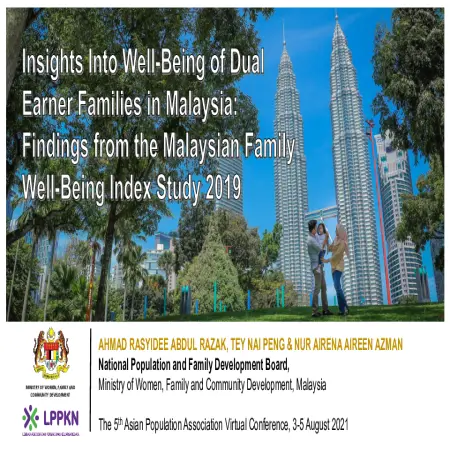
Insights into the well-being of dual earner families in Malaysia: findings from the Malaysian Family Well-Being Index Study 2019
Item Type: Conference or Workshop Item
Editor:
Year: 00/00/2021
Abstract: Traditionally, GDP has been used as a measure of a country’s level of development, and the quality of life of citizens. Of late, the happiness index has gained increasing attention, as a measure of well-being, to include income distribution and non-financial aspects, such religious and spiritual well-being, and inter-personal relationship. Malaysia has conducted three rounds of the family well-being surveys to provide inputs for the five-year development plans. The overall family well-being score among dual earner families in Malaysia was 7.84 out of a maximum scale of 10, which is at the moderate level.
|
|
|
|
|
|
Household income and life satisfaction of single mothers in Malaysia
Item Type: Conference or Workshop Item
Editor:
Year: 00/03/2020
Abstract: This study attempts to explore the socio –demographic and economic background of single mothers in Malaysia and to examine their income category and level of poverty. This study utilizes the Fifth Malaysian Population Survey (MPFS5) data. However, for this study, the target respondents are working single mothers (either widowed, divorced, separated); aged 15- 59 years old; residing in Peninsular Malaysia and have children staying together with them. Findings from this study reveal that household income of single mothers falls under the B40 category but there is not enough evidence to claim that their household income is below the poverty line. Chi – Square test of associations prove relationships between poverty level to socio – demographic variables such as level of education and residential states, while PLS – SEM techniques show that income category of single mothers is somehow related to the predictors of life satisfaction construct and the overall life satisfaction. Single mothers are already facing limited job market and reduced salary with their low level of educational attainment. Therefore, some suggested policy recommendations are to protect and promote single mothers involved in elementary occupations and to create more quality jobs to develop these women from the existing low-paid of the informal into the formal sectors.
|
|
|
|
|