Advanced Search
|
Impact of Covid 19 on family planning and ending gender based violence
Item Type: Conference or Workshop Item
Editor:
Year: 00/00/2020
Abstract: Women represent 70 % of the global health workforce. Hence, women are disproportionately exposed to the coronavirus. Global Supply chains are disrupted, impacting the availability of contraceptives and heightening the risk of unintended pregnancy. As countries are on lockdown and health systems struggle to cope, sexual and reproductive health services are being sidelined and gender-based violence is on the rise. The pandemic is making existing gender inequality even worse. Recent UNFPA projections highlighted the impact of a 6 month lockdown to women and girls which is 47 million women in developing countries may not be able to access modern contraceptives resulting in 7 million unintended pregnancies. This presentation slides discuss the impact of Covid-19 on family planning and ending gender based-violence.
|
|
|
|
|
|
The social, health and economic impacts of Covid-19 in Malaysia
Item Type: Conference or Workshop Item
Editor:
Year: 00/00/2020
Abstract: Can life ever return to normal? YES... Evolutionary-wise, humans are resilient beings. This is not a life-ending Pandemic. With a prepared healthcare system with sufficient capacity. “March of the Vaccines”. Acknowledging our vulnerability demands humility, but will allow us to mitigate this pandemic better. Fear clouds our intellect. To make better-informed decisions, we need to let go of our fear.
|
|
|
|
|
|
The well-being of adolescents in divorced families
Item Type: Thesis
Editor:
Year: 00/00/2020
Abstract: This study aimed to explore an in-depth understanding on the wellness of teenagers in divorced families. This qualitative study used the phenomenological approach to explore the experience of ten teenagers living with single mothers after the divorce of their parents. Participants in this research are 10 teenagers age between 16 to 18 years’ old who lived with their mothers after their parents' divorce. The duration of their parents' divorce during the data collection was in the range of one to ten years. Data were collected using semi-structured interviews and document analysis by social media. Data were analysed using NVIVO12 software. Nine themes and 26 sub-themes emerged from this study. Three main themes and ten subthemes answered the first research question on, what is the meaning of wellness among teenagers in divorced families? Another three more theme and eight sub themes answered the second research question on, what are the perception of teenagers towards wellness in divorced families? The remaining three themes and eight sub themes answered the third research question on, how does divorce changes the wellness in teenager’s life? In conclusion, teenagers’ in this study accepted the changes that occurred as a result of parental divorce. The implications of this study is viewed from three aspects; 1) practical implications for professions such as counselors, 2) theoretical implications for future research, and 3) implications in the field of education for the wellness of the community. The information extracted from the findings of this study can help counselors to understand better on the actual living experience of teenagers in divorced families. The study also helps counsellors to understand how some teenagers manage to live a successful life and fulfilling all the wellness of life in spite of living in divorced families. As this study only focus on teenagers living with their mother after their parents’ divorce, it recommends future researchers to consider exploring areas of wellness among teenagers in joint custody parents or teenagers living with their single father after the parental divorce.
|
|
|
|
|
|
Perkembangan hubungan perkahwinan pasangan kekal berkahwin dalam kitaran perkembangan keluarga
Item Type: Thesis
Editor:
Year: 00/00/2020
Abstract: The developmental perspective is one of the elements taken into account in the development of marital relationships in the family development cycle as it explains the process of transformation encountered by the lasting marriage couples chronologically, before marriage to ageing. Therefore, this study is inspired to explore the process of marital relationships development, the developmental tasks and challenges endured by the lasting marriage couples in the family development cycle through three research. questions. These questions are (I) What is the marital relationship development process of the lasting marriage couples in the family development cycle? (ii) How do the developmental tasks of the lasting marriage couples remain in each phase of development? and (iii) What challenges do the lasting
marriage couples faced during each phase of development? In addition to answer every question, the researcher employs qualitative research through hermeneutic phenomenology design. The researcher applies the purposive sampling method. This research involves 12 urban and rural couples that fulfilled the criteria. The researcher used three data sources which includes in-depth interviews, observations and
documents analysis. The data were analysed through the hermeneutic circle method and analyzed thematically using the Nvivo Plus 12 application. Overall, the study found 179 themes explaining the developmental process of marriage relationships, developmental tasks and strategies of achievement and also challenges facing married couples in the chronology of the development in marriage relationship in the family development cycle. This study proposes four phases of the development in marital relationships development in the family development cycle, namely (i) the premarital development phase; (ii) the early developmental phase of the marriage; (iii) the mid-marriage development phase; and (iv) the developmental phase of lasting
marriage. The four stages of the development incorporate eight transitional elements, ten roles and 22 marital relationship goals. Besides that, there are a total of 22 developmental tasks undergone by the lasting marriage couples in all four phases of development. The developmental task is a responsibility that must be fulfilled in marriage. In this research, the task of sustaining a marital relationship is one of the
most critical responsibilities couples do in every phases other than parenting duties and relationships with others, such as in-laws and communities. Implementation of development tasks involves 96 strategies. The main strategy used by couples to carry out duties of development involves elements of religion, love and affection and
responsibility. Lasting marriage couples also undergone 21 challenges according to the chronology of the developmental phase of the marriage relationship. The most common challenges faced by couples throughout the marriage are third-party intervention, financial and an unexpected event. Furthermore, the dyadic coping, which involves the cooperation of the couple in their marriage reflects the couples'
success through each phase of development. Hence, the outcomes of the research develop the conceptual model of the development of marital relationships in the family cycle, as a reference and guide in the field of marriage and family research. This study also proposes significant suggestions in developing future lasting marriage relationship research.
|
|
|
|
|
|
The Family Well-Being Index 2019
Item Type: Video
Editor:
Year: 00/00/2020
Abstract: A Short video on Family well-being index. The family well-being index (FWBI) is developed to measure the level of family well-being in the country. To continue monitoring the level of well-being of Malaysian families, the third series of FWBI was held in 2019 maintained all eight domains of FWBI 2016.
|
|
|
|
|

|
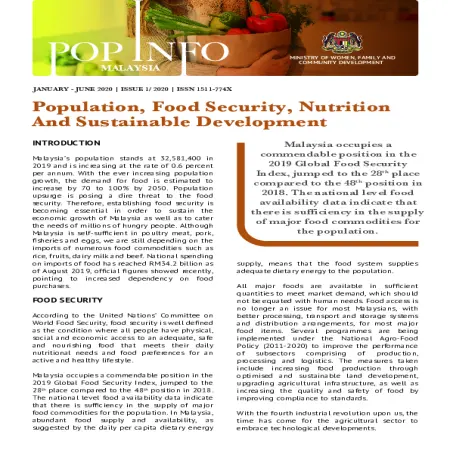
Population, food security, nutrition and sustainable development
Item Type: Newsletter
Editor:
Year: 00/00/2020
Abstract: Malaysia occupies a commendable position in the 2019 Global Food Security Index, jumped to the 28th place compared to the 48th position in 2018. The national level food availability data indicate that there is sufficiency in the supply of major food commodities for the population.
|
|
|
|
|
|
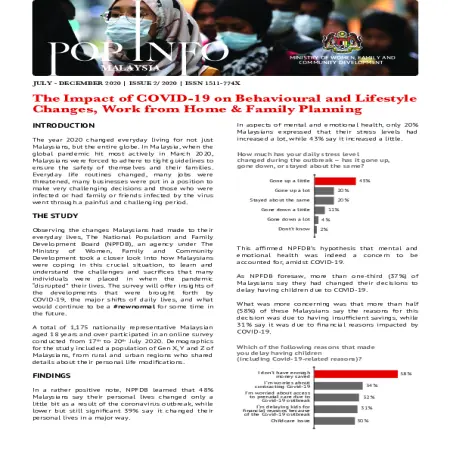
The impact of COVID-19 on behavioural and lifestyle changes, work from home & family planning
Item Type: Newsletter
Editor:
Year: 00/00/2020
Abstract: This survey will offer insights of the developments that were brought forth by COVID-19, the major shifts of daily lives, and what would continue to be a #newnormal for some time in the future.
|
|
|
|
|
|
Indeks Kesejahteraan Keluarga Malaysia 2019
Item Type: Infographic
Editor:
Year: 00/00/2020
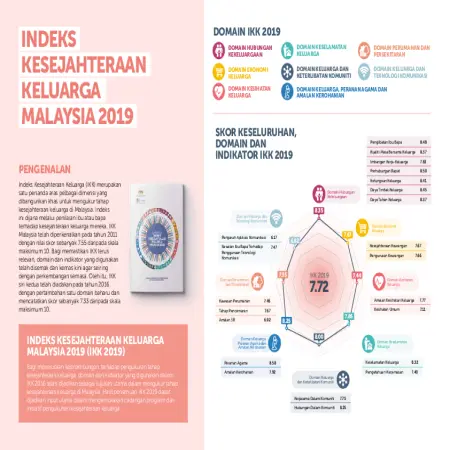
Abstract: The Malaysian Family Well-Being Index is a multi -dimensional benchmark that specially developed to measure levels family well-being in Malaysia. Index is generated through maternal or paternal assessment to the well -being of their families. The Family Well-being Index 2019 score has increased to 7.72 from a maximum scale of 10 compared to 7.33 in 2016.
|
|
|
|
|
|
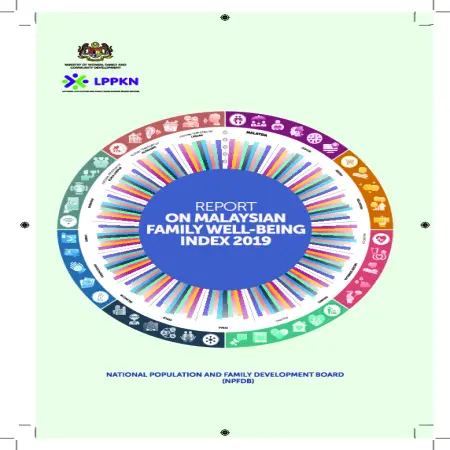
Report on Malaysia Family Well-Being Index 2019
Item Type: Research Report
Editor:
Year: 00/00/2020
Abstract: The Family Well -Being Index (FWI) is a multi -dimensional benchmark specially developed to measure the level of family well -being in Malaysia. This index is generated through a mother’s or father’s assessment of their family’s well -being. The 2019 Malaysian Family Well -Being Index score recorded in this study is 7.72 out of a maximum scale of 10. Of the eight domains that have been identified, the Family Relationship Domain recorded the highest domain score of 8.35. This is followed The study also found that the 2019 FWI score is increasing according to household income group. The 2019 FWI score is higher in families living in rural areas. In terms of family type, FWI 2019 scores were higher in family groups by Family Domain, Role of Religion and Spiritual Practice (8.25), Family Domain and Community Involvement (8.00), Family Safety Domain (7.86), Family Economics Domain (7.67), Family Health Domain (7.44), Housing and Environment Domain (7.35) and Family and Communication Technology Domain (6.82). Although the score of FWI 2019 is still at a moderate level but it has shown an increase of 0.39 points compared to 7.33 for FWI 2016.
|
|
|
|
|
|
Situational analysis on family planning and reproductive health education in Malaysia and other selected Muslim countries Part I: needs analysis on family planning policy Part II: reproductive health education: policy and plan of action
Item Type: Research Report
Editor:
Year: 00/00/2020
Abstract: This study is an initiative by the Ministry of Women, Family and Community Development (MWFCD) through the National Population and Family Development Board (NPFDB) in collaboration with the United Nations Population Fund (UNFPA), who has been a strategic partner of NPFDB since the 1990s in the Sexual and Reproductive Health (SRH) programmes. This study was conducted at where there are rapid changes in the population dynamics and demographic trends together with the advancement in human capacity development and new communication technologies.
It is an effort that enables the nation to achieve its commitment locally towards Malaysia’s Shared Prosperity Vision 2030 agenda and internationally, such as the ICPD Plan of Action. The objective of the study is to identify the best practices of reproductive and sexual health (SRH) programs including family planning and reproductive and sexual health education (SRHE) among selected Islamic countries that practice sunni sects to provide direction to Malaysia. Five (5) countries were selected for the purpose of comparison with Malaysia are Turkey, Egypt, Morocco and Bangladesh.
The report of this study proposes several strategies and improvements as a result of a gap analysis with other Muslim countries that can help strengthen the strategy and implementation of the National Sexual and Reproductive Health programmes to improve reproductive health indicators such as Maternal Mortality Rate, Infant Mortality Rate and Age Specific Fertility Rate, as well as reducing the number of cases of teenage pregnancy, abortion, sexual abuse and sexual crimes.
|
|
|
|
|