Advanced Search
|
Seroprevalence and factors associated with chlamydia trachomatis Infection among subfertile couples attending local public subfertility clinic
Item Type: Thesis
Editor:
Year: 00/00/2020
Abstract: Chlamydia trachomatis is one of the agents that cause the sexually transmitted infections called chlamydia. People practicing risky sexual behaviours such as having multiple sex partners, exercising sexual intercourse at an early age, and undergoing unprotected sexual
intercourse (without condom) with casual partners, are at risk of getting Chlamydia trachomatis infection. One of the significant, long term implications of risky sexual behaviours and sexually transmitted infection is infertility problems. The objectives of this study are to determine the seroprevalence of Chlamydia trachomatis (CT) among subfertile couples (husband and wife) of The Lembaga Penduduk dan
Pembangunan Keluarga Negara (LPPKN) Subfertility Clinic and the factors associated with it (i.e. socio-demographic, duration of marriage, infertility factor, knowledge, attitude, practice of risky sexual behaviour (RSB) and predictors of Chlamydia trachomatis infection). The study is a cross-sectional study involving 112 infertile couples who underwent fertility treatment at LPPKN Subfertility Clinic from February 2018 until February 2019. Sociodemographic factors, duration of marriage, infertility factor, knowledge, attitude and practice (KAP) of risky sexual behavior (RSB) variables were determined via self-administered
questionnaire that includes close ended questions. Meanwhile, Chlamydia trachomatis antigen and antibody (CT IgG) were determined via Enzyme Linked Immunosorbent Assay (ELISA) and rapid visual immunoassay test kit. This approach is selected to detect past and
current infections of Chlamydia trachomatis through antibody and antigen detection in the blood serum, endocervical swab and urine samples. The response rate of this study was 97.39%. Majority of the respondents were aged between 25-34 years old and dominated by Malay ethnicity. Half of the respondents were among those with tertiary level of education and working in the private sector. In term of duration of marriage, half of the samples were couples who have been married for 3-7 years with majority of them had primary infertility. The female factor was reported to be the most dominant, followed by the unexplained factor and male factor. The seroprevalence of Chlamydia trachomatis among subfertile couples was 22.1% with 14.7% in husbands and 17.9 %, was reported among wives. In terms of knowledge, the results showed that most couples had high level of knowledge
about risky sexual behaviours with a score of more than the mean (> 6) for both husbands and wives. Meanwhile, each husband and wife group had positive attitude towards risky sexual behavior. Approximately, 35.7% of husbands and 12.5% of wives were engaged with risky sexual behavior while a higher percentage of premarital sex was reported among the husbands compared to the wives. The chi-square results showed no association between CT status and socio -demographic factors, marital status and knowledge of RSB among subfertile couples. A significant association was recorded between CT and practices of RSB among couples (p< 0.05) particularly among those with multiple sex partners and husbands who had premarital sex (p<0.05). However, the Binary Logistic Regression analysis showed that none of the selected variables were significant predictors of CT status among the couples (p> 0.05). This study has determined that the seroprevalence of Chlamydia trachomatis (22.1%) and practices of risky sexual behavior among subfertile couples were high. Even though the results have shown no association between the dependent and independent variables, our finding has given an evidence based detection of past infection of Chlamydia trachomatis among
subfertile couples. The practice of RSB has interrelated risk of getting CT and its long term consequences particularly on women reproductive system. Since the awareness on CT among public is considered low, it is crucial to sensitize them about it to ensure early detection and prevention. Therefore, CT screening is strongly recommended to be integrated in fertility work up. treatment and be promoted among sexually active adolescents and those young in age.
|
|
|
|
|
|
Women subjective well-being In Malaysia: findings from Fifth Malaysian Population and Family Survey (Mpfs-5)
Item Type: Article
Editor:
Year: 00/10/2019
Abstract: The subjective well-being is defined as one's cognitive and affective assessment of a person's life (Diener, Lucas & Oshi, 2002). This article aims to measure the subjective well-being of women between age 20 to 59 years old in Malaysia. For measurement purposes, this article has adopted the Personal Well-being Index (PWI) instrument developed by the International Wellbeing Group.
|
|
|
|
|
|
World Population Day 2019: 25 years of the ICPD: accelerating the promise
Item Type: Infographic
Editor:
Year: 00/07/2019
Abstract: In 1989, the United nations recommended that 11 July as World Population Day, a day to increase people's awareness on global population issues such as the importance of family planning, gender equality, poverty, maternal health and human rights. The theme for this year's World Population day is "25 years of the ICPD: accelerating the promise" in keeping with the overall theme of the Nairobi Summit, to be held from 12 to 14 November 2019.
|
|
|
|
|

|
Penemuan tinjauan pendapat sempena sambutan Hari Ibu Bapa Peringkat Kebangsaan 2019 "Keibubapaan Kreatif Mendepani Cabaran Alaf Baru"
Item Type: Infographic
Editor:
Year: 00/07/2019
Abstract: The survey involved a total of 753 respondents .The survey was conducted from 5 -9 July 2019 using the online survey method.
|
|
|
|
|

|
The 52nd session of the commission on population and development:general debate on review and appraisal of the programme of action of the international conference on population and development and its contribution to the follow-up and review of the 2030 agenda for sustainable development
Item Type: Country Statement
Editor:
Year: 01/04/2019
Abstract: The population of Malaysia has increased more than three-fold from 10.5 million in 1970 to about 33 million today. the population was growing around 2.5 percent per annum for the period 1970-2000 but it has declined to 1.7 percent between 2010 and 2018.
|
|
|
|
|
|
2005-2019 NPFDB research activity report
Item Type: Book
Editor:
Year: 00/00/2019
Abstract: This report highlights the research programmes and activities conducted by NPFDB over the past 15 years. One of the primary functions of NPFDB is to identify, promote and conduct research and studies on population, family development and reproductive health. NPFDB is responsible to advise the government on matters relating to policies and programmes through the findings of research in these three thematic areas. The Board established the Research Committee in 2009 to identify priority research, provide guidance and monitor the research activities in NPFDB. The first Research Committee meeting was held on 13th January 2010 comprising of selected NPFDB Board Members including Associate Professor Tey Nai Peng as Chairman (University of Malaya), Associate Professor Normah Mohd Dali (MARA University of Technology), Datuk Dr. Zulkifli Haji Ismail (Selangor Medical Center), Associate Professor Siti Hawa Ali (University Science Malaysia), Dato’ Dr. Kamaruzaman Ali (FRHAM) and Mr. Lee Wee Min (Focus on the Family) and several division directors of NPFDB.
|
|
|
|
|
|
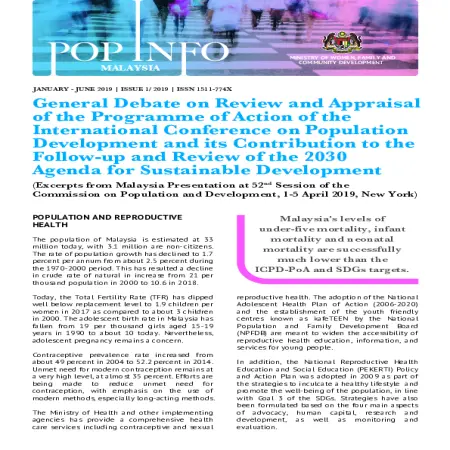
General debate on review and appraisal of the programme of action of the International Conference on Population Development and its contribution to the follow - up and review of the 2030 agenda for sustainable development
Item Type: Newsletter
Editor:
Year: 00/00/2019
Abstract: The Population of Malaysia is estimated at 33 million today with 3.1 million are non-citizens. The rate of population growth has declined to 1.7 per cent per annum from about 2.5 per cent during the 1970-2000 period. Malaysia is moving towards becoming one of the aged countries by 2030. The fast pace of ageing population is as a result of longer life expectancy and rapid decline in Total Fertility Rate (TFR).
|
|
|
|
|
|
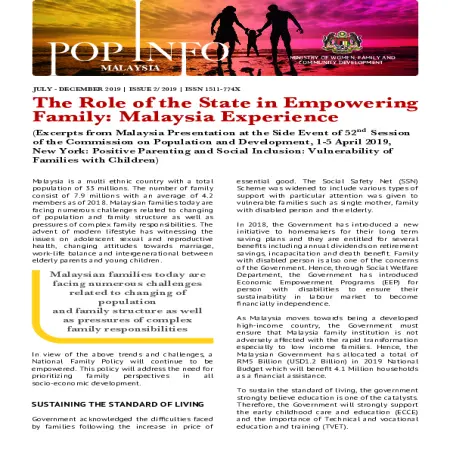
The role of the state in empowering family: Malaysia experience
Item Type: Newsletter
Editor:
Year: 00/00/2019
Abstract: Malaysia families today are facing numerous challenges related to changing of population and family structure as well as pressure of complex family responsibilities. The advent of modern lifestyle has witnessing the issues on adolescent sexual and reproductive health, changing attitudes towards marriage, work-life balance and intergenerational between elderly parents and young children. In view of the above trends and challenges, a National Family Policy will continue to be empowered.
|
|
|
|
|
|
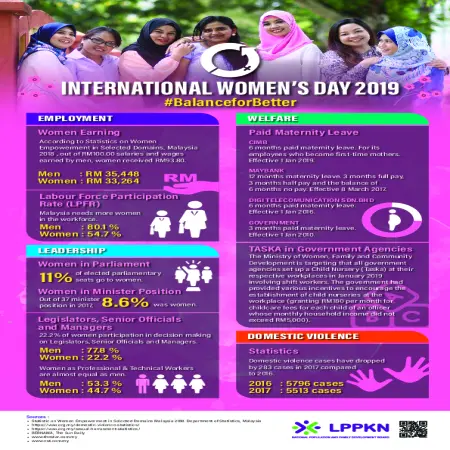
International Women's Day 2019 # BalanceforBetter
Item Type: Infographic
Editor:
Year: 00/00/2019
Abstract: This infographic shows statistics on women's involvement in Malaysia in areas such as employment, leadership, welfare as well as incentives provided by the government and the private sector in supporting women's involvement in the labor force.
|
|
|
|
|
|
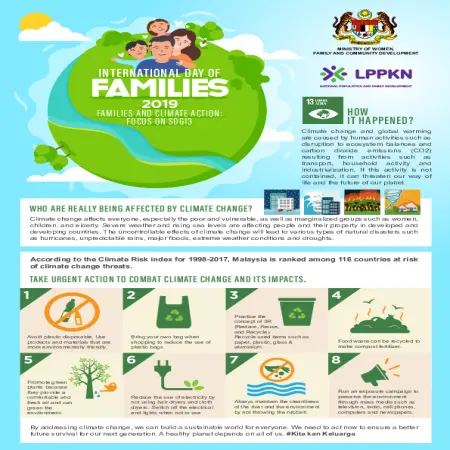
International Day of Families 2019: families and climate action: focus on SDG13
Item Type: Infographic
Editor:
Year: 00/00/2019
Abstract: Climate change and global warming are caused by human activities such as discruption to ecosystem balances and carbon dioxide emissions (CO2) resulting from activities such as transport, household activity and industrialization. If this activity is not contained, it can threaten our way of life and the future of our planet.
|
|
|
|
|