PUBLICATIONS
|
Family-based on drug abuse prevention: know your child programme
Item Type: Conference or Workshop Item
Editor:
Year: 00/00/2014
Abstract: This study was to evaluate the effectiveness of the Drug Prevention Program from family perceptive. The respondents was the participants who attended the Know your Child (Kenali Anak Kita) Drug prevention program and sampled by convinence in all the six zones in Malaysia. The aim of this program is to create awareness of family to prevent deviant behaviours, particularly substance abuse among teenagers. The campaign had been implemented phase by phase in six zone involve from various organization, agencies and individual.
|
|
|
|
|
|
Future study- understanding the puzzling trend of high birth rate among contraceptive users in Malaysia: A case study from Malaysian Population and Family Survey, 2004
Item Type: Conference or Workshop Item
Editor:
Year: 00/00/2014
Abstract: In 1957-1966, Family Planning Association has pioneering the family planning services in most of the states of Malaysia. At that time, the family planning services were mostly available only in urban areas (NPFDB: Kuala Lumpur, Report on Malaysian Population and Family Survey, 1974). Family planning was first made as an official policy during the First Malaysia Plan in 1966, successfully through the National Planning Programme (NPP). The objectives of this study is to examine the fertility levels of respondents whose practiced family planning compared to that of who have never practiced it and this study also to study the link between socio-economic and cultural variables with those eight intermediate variables on fertility in Malaysia.
|
|
|
|
|
|
Family education@LPPKN = Pendidikan kekeluargaan@LPPKN
Item Type: Book
Editor:
Year: 00/00/2013
Abstract: The National Population and Family Board (NPFDB), agency under the Ministry of Women Family and Community Development which was initially known as the National Family Planning Board (NFPB) was established in 1966 as a statutory body. Its main objective was to implement the National Family Planning Programme but its scope has now been expanded to Population, Family Development and Reproductive Health which is in line with 1984 Amendments Act. The Malaysian family today is facing numerous challenges due to rapid socio-economic development and globalization. New challenges have emerged in the social and economic arena, which have had an impact on Malaysian families. Among the challenges experienced by the family institution are changing family structure and dynamics, balancing family and career, fulfilling economic needs parenting of young children and adolecents as well as weakening marital and family relationships. Parallel with the Government's emphasis on strengthening the family institution, the NPFDB has developed and implemented a wide range of family development programmes encompassing advocacy activities and promotion, training and education, services, research and development (R&D) as well as policy formulation. In December 2010, the Government approved the National Family Policy and its Plan of Action, thus mainstreaming the family perspective in all socio-economic planning and development.
|
|
|
|
|
|
Factors influencing family life satisfaction among parents in Malaysia: the structural equation modeling approach (SEM))
Item Type: Article
Editor:
Year: 00/00/2013
Abstract: The study attempts to investigate the factors that influence family life satisfaction (FLS) among parents in Malaysia. The study modeled the variable of parental involvement, family functioning, family resilience and time with family as independent constructs. Data for the study was gathered from nationally representative survey of “Family Well-Being Index” study conducted by National Population and Family Development Board Malaysia. Response from 2808 sampled households which involved about 1484 (52.8%) fathers and 1324 (47.2%) mothers of having a child aged at least 13 years old were utilized for the purpose of the current study. A Structural Equation Modeling (SEM) was employed by using Analysis of Moment Structure (AMOS) software. The study found all the modeled independent constructs tested had a significant and direct influence on family life satisfaction among the respondents except for parental involvement construct. The findings of the study suggests that some improvement should be made for the parental involvement constructs which covers different aspects of family life satisfaction which will lead the measurement model be more heterogeneous.
|
|
|
|
|

|
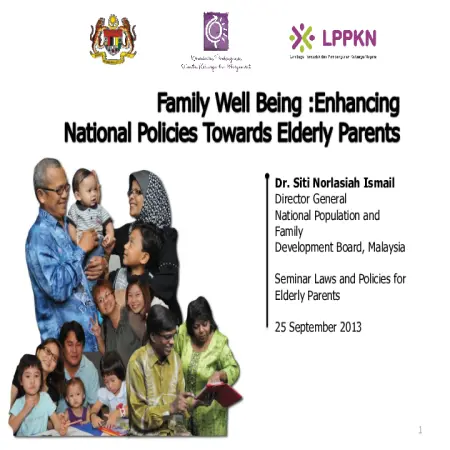
Family well being: enhancing National Policies towards elderly parents
Item Type: Conference or Workshop Item
Editor:
Year: 00/00/2013
Abstract: Malaysia will be aged by the year 2030. The objective of National Policy for Older Persons, 2011 is to enhance the respect for and self-worth of the elderly in family, society and nation, to develop the potential of the elderly so that they remain active and productive in national development and to create opportunities for them to continue to live independently and to encourage the establishment and the provision of specific facilities to ensure the care and protection of the elderly.
|
|
|
|
|
|
Foreign workers in Malaysia: assessment of their economic effects and review of the policy
Item Type: Conference or Workshop Item
Editor:
Year: 00/00/2013
Abstract: This study aims to help Ministry of Human Resource to better manage existing human resources in the country and to plan for the development of future human capital needs.
|
|
|
|
|
|
Financing old age in a rapidly ageing high income city state: the case of Singapore
Item Type: Conference or Workshop Item
Editor:
Year: 00/00/2012
Abstract: Singapore, an affluent city state, is among the most rapidly ageing society globally. This is due to low fertility rate (TFR of 1.2 in 2011); and increasing life expectancy (18.3 years for men and 21.8 years for women at age 65 in 2011). Its support ratio (working age persons/elderly) is projected to decline from 7.9 in 2011 to 2.2 by 2030, representing a steep decline. It primarily relies on a mandatory savings tier to finance old age. This tier is administered by a statutory Board called Central Provident Fund (CPF) under the Ministry of Manpower. The CPF has over the years been used not just for retirement, but for housing health care, and other purposes. Its wide scope and mandate has resulted in considerable complexity. This paper provides an assessment of the extent to which the current old age financing arrangements are likely to address longevity, inflation, and survivors’ risks faced by individuals in their old age. Not only each person will need support for a longer period in old age, but societal and individual expectations about old age support are also changing, reflecting the affluent society.
|
|
|
|
|
|
Fertility and religion in Malaysia
Item Type: Conference or Workshop Item
Editor:
Year: 00/00/2012
Abstract: This paper presents a summary of literature review on the subject of religious fertility differential for a research at the Institute of Graduate Studies, University of Malaya and initial results from investigations using the MPFS 41 (Peninsular Malaysia) data. Conceptual frameworks due to Davis and Blake (1956) and Bongaarts (1978) are used to construct a framework of data analysis using SPSS, concentrating on one-way ANOVA and Stepwise Multiple Regression. Next, the influence of religion on age-at-firt-marriage is compared to that of education level, pre-marital working experience and place of residence. Similar to studies done elsewhere, Muslims in Peninsular Malaysia have the highest fertility level and the lowest age at first marriage.
|
|
|
|
|

|
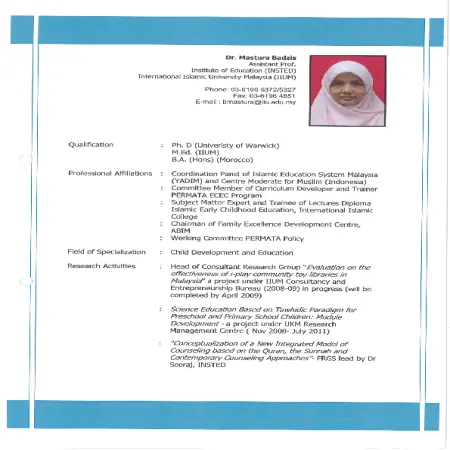
Families resilience and children and families of low income: maximizing opportunities through PERMATA ECEC Program
Item Type: Conference or Workshop Item
Editor:
Year: 00/00/2009
Abstract: PERMATA Early Childhood Education and Care (ECEC) Program in Malaysia was launched on the basis of evidence from research and practice which illustrates that early intervention through high quality program enhances children's social, emotional, spiritual, physical, and cognitive development. PERMATA is a child-focused, community integrated program with the overall goal of increasing school readiness in young children in low-income families, particularly in deprived areas. Despite its various learning outcomes, ECEC main underpinning goal is to produce generations of youth who are able to manage and regulate emotion, possess high EQ skill, and resillient in facing different challenges in life. Its long-term effect can be better understood as children develop into responsible citizens who will take a much more positive role in the society and are free of social ills that now seem to beset the country. This paper presents some strategies of best practices that have been applied in this program to foster and instill resilience in children mainly, increasing caring relationship, developing social competence, encouraging, self-help skills, create partnerships with family and community, and awareness of the existence and supremacy of God.
|
|
|
|
|
|
Family functioning and child well-being amongst urban Malay single mother families: resilence despite challenges
Item Type: Conference or Workshop Item
Editor:
Year: 00/00/2009
Abstract: This study was designed to determine the contribution of risk and protective factors in predicting urban Malay single mother's family functioning and child well being. In addition, this study examine the moderating role of protective factors (risk x protective factor interaction) on the relationship between risk factors and family functioning and child well-being. Result highlight the role of protective factors in promoting better family functioning and child well-being and the extent to which protective factor buffer risk factors in the design of intervention aimed at strengthening family functioning and enhancing child well-being in urban Malay single mother families.
|
|
|
|
|