PUBLICATIONS
|
Migration in Malaysia: social and family impact
Item Type: Conference or Workshop Item
Editor:
Year: 00/00/2013
Abstract: This paper highlights the key findings from surveys done by the Ministry of Women, Family and Community Development (MWFCD) and the National Population and Family Development Board (NPFDB). The Survey on the Implications of Employing Foreign Domestic Helpers (FDH) on the Family Institution in Malaysia was conducted by the MWFCD in 2009. The study found that many families rely on FDH for child care and domestic work. Some of the families find that having a FDH has a negative effect on their family relationships while some have no problems with it. The study on Indonesian Migrants in Tawau, Sabah conducted by the NPFDB in 2010 found that the local community in Sabah felt that the presence of Indonesian migrants in their community had both positive and negative effects. The effects of migrants were studied from the perspective of economy, education, health, safety, culture, housing and neighbourhood.
|
|
|
|
|
|
Mediating effect of work-family psychological contract on the relationship between perceived organization support and job satisfaction
Item Type: Thesis
Editor:
Year: 01/10/2012
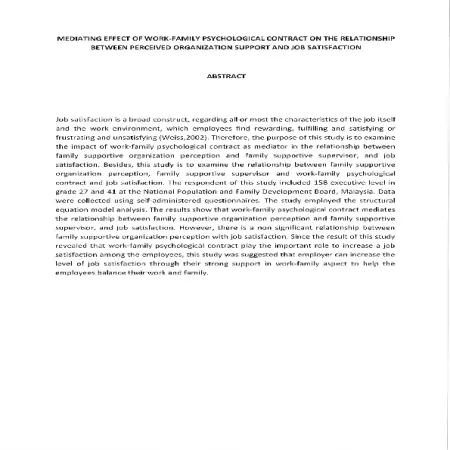
Abstract: Job satisfaction is a broad construct, regarding all or most the characteristics of the job itself and the work environment, which employees find rewarding, fulfilling and satisfying or frustrating and unsatisfying (Weiss,2002). Therefore, the purpose of this study is to examine the impact of work-family psychological contract as mediator in the relationship between family supportive organization perception and family supportive supervisor, and job satisfaction. Besides, this study is to examine the relationship between family supportive organization perception, family supportive supervisor and work-family psychological contract and job satisfaction. The respondent of this study included 158 executive level in grade 27 and 41 at the National Population and Family Development Board, Malaysia. Data were collected using self-administered questionnaires. The study employed the structural equation model analysis. The results show that work-family psychological contract mediates the relationship between family supportive organization perception and family supportive supervisor, and job satisfaction. However, there is a non significant relationship between family supportive organization perception with job satisfaction. Since the result of this study revealed that work-family psychological contract play the important role to increase a job satisfaction among the employees, this study was suggested that employer can increase the level of job satisfaction through their strong support in work-family aspect to help the employees balance their work and family.
|
|
|
|
|
|
Mengharmonikan intergenerasi
Item Type: Conference or Workshop Item
Editor:
Year: 00/00/2012
Abstract: The purpose of the presentation is to give an overview of the differences between the older and younger generations in Malaysia and suggest some steps to bring the old and the young together. The formulation of more policies that consider the needs of the younger generation such as in sports, education, tourism, politics and media. Among the steps that can be taken to bridge the gap between the old and young is to increase public awareness of the issue aging and intergenerational unity through seminars, conferences, writings, films or hold special activities such as concerts, exhibitions, competitions video-games and others.
|
|
|
|
|
|
Meeting the needs of older Malaysians: expansion, diversification, and multi-sector collaboration
Item Type: Conference or Workshop Item
Editor:
Year: 00/00/2012
Abstract: The older population in Malaysia grew from 0.5 million in 1970 to almost 2.3 million in 2010, making up about 8% of the current total population. By 2020, one in ten Malaysians will be an older persons aged 60 years or over. Older Malaysians are a heterogeneous group with diverse demographic, socio-economic, cultural and religious characteristics. This paper assesses the adequacy, affordability, sustainability, equitability, predictability and robustness of current policies, programs and services to meet the needs of the ageing population in Malaysia. Based on the World Bank’s multipillar pension taxonomy, the analysis will focus on the social assistance scheme for the elderly (BOT), Pay-as-you-go financed state pension (JPA) and defined contribution funds (EPF). Between conditional cash transfers and mandatory retirement savings, the central role of informal support systems in old age has often been overlooked. Result from the past studies have shown that the family has played a central role in providing care and support for aged in Malaysia. A majority of older Malaysians still co-reside with their adult children and receives financial assistance from them. Older Malaysians today are living longer, better educated and wealthier and they will become consumers of a burgeoning silver industry. Balancing social and economic priorities in national development is a challenging task, but the two goals are not mutually exclusive. My topic focus on welfarism or paternalism will continue to render ageing populations as a dependent population, instead of empowering them. An inter-dependence approach, rooted in a mix of individual responsibility, family obligations, active civil society and state provisions (regulatory and non-regulatory), will enable a more broad-based and sustainable solution to meet the present and future needs of the elderly.
|
|
|
|
|
|
Malaysia country report at 4th East Asia Ministerial Forum on Families, "Safe and resilient families: protecting and empowering at-risk and high risk families", Kuala Lumpur, 7-10 November 2010
Item Type: Country Statement
Editor:
Year: 00/00/2010
Abstract: Malaysia recognizes the family as a natural and fundamental
social unit that provides valuable human resource and forms the
backbone for solidarity, security and nation building. Malaysia
believes in the importance of family development in line with the
objective of creating a caring society ; Family is PRIORITY NO. 1
|
|
|
|
|

|
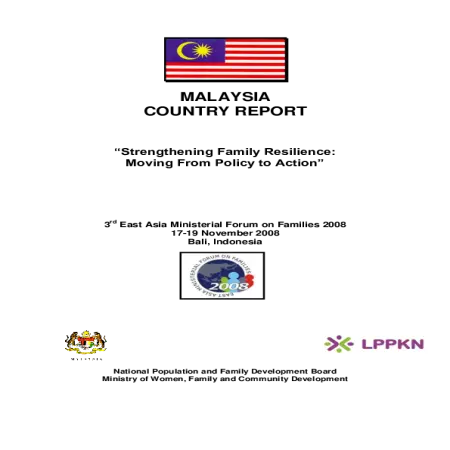
Malaysian country report 3rd East Asia Ministerial Forum on Families 2008, "Strengthening family resilience: moving from policy to action"
Item Type: Country Statement
Editor:
Year: 00/11/2008
Abstract: Social policies and programmes affecting families have been revised and improved from time to time since Independence in 1957 to adapt to new challenges and needs of families. The importance of the family as a foundation for a strong Malaysia was first given prominence when Vision 2020 (now renamed the National Vision Policy–NVP) was announced in 1991 which strived to make Malaysia an industrialised nation by the year 2020. This vision recognizes that PEOPLE are the center of development and the critical element of this Vision is to produce citizens of good character embedded with an appropriate balance of suitable knowledge and skills and the inculcation of positive moral values, ethics and innovativeness. It particularly identified a “social system in which society will come before self, in which the welfare of the people will revolve not around the state or the individual but around a strong and resilient family system.”
|
|
|
|
|
|
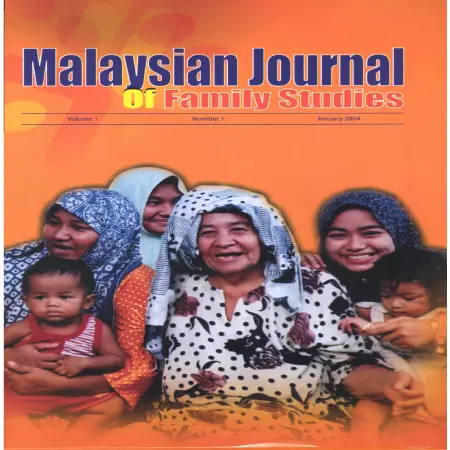
Malaysian Journal of Family Studies ( Volume 1, Number 1, January 2004)
Item Type: Book
Editor:
Year: 00/01/2004
Abstract: The publication of the Malaysian Journal of Family Studies (MJFS)
by the National Population and Family Development Board marks
another milestone for the Ministry of Women, Family and
Community Development in our quest towards intellectual
excellence. As we strive to be o knowledge-based society,
information derived from scientific studies enables us to understand
better the social milieu in which we live. Thus it is hoped that this
journal could serve as a useful reference for all those interested
and concerned with family issues.
|
|
|
|
|