PUBLICATIONS
|
What adolescents have to say about mental health? Recognizing their views on the impact of home-based learning and teaching (PDPR) and technology usage during the covid-19 pandemic
Item Type: Book Section
Editor:
Year: 00/12/2023
Abstract: The aim of the study is to explore adolescents/students mental health during pandemic COVID-19. Qualitative approach was used to obtain data from respondents. Specifically, semi-structured interviews were conducted among adolescents/students who aged between 13 – 19 years old. A total of 47 students were selected from secondary schools in Kedah, Malaysia to participate in the study. The results showed that educational and technology were among the factors revealed by students as to influence their mental health during pandemic.
|
|
|
|
|

|
Prevalens dan faktor yang mempengaruhi penggunaan perancang keluarga dalam kalangan wanita umur reproduktif di Malaysia
Item Type: Book Section
Editor:
Year: 13/12/2023
Abstract: Family planning enables women to control pregnancy, plan family size, determine the timing of pregnancies, and space out births. Given that family planning practices reduce unwanted pregnancies and high-risk pregnancies, universal access to family planning has become a key indicator in the Sustainable Development Goals (SDG) 2023 Agenda.
Despite positive evidence on family planning practices, the contraceptive use rate in Malaysia has remained around 50 percent since 1984. The aim of this study is to measure knowledge, prevalence, and factors influencing contraceptive use among ever-married women of reproductive age (15-49 years) across Malaysia.
This study employs a quantitative approach through a cross-sectional survey. A two-stage stratified sampling technique was used in sample selection. Data collection from 2,081 respondents was conducted using an online questionnaire and face-to-face interviews. Data were analyzed using descriptive statistics and the Chi-Square test via SPSS version 26.
Nearly half (48.1%) of respondents had low levels of knowledge about family planning. The prevalence of family planning practice was 64.7 percent. Modern methods, such as condoms, and traditional methods, such as withdrawal (azal), were the most commonly used contraceptive methods among women.
The prevalence of family planning was higher among Malays, women aged 30-34, those residing in rural areas, individuals with lower education levels, employed women, the M40 income group, those with 3-4 children, and those with high knowledge of contraceptives.
Family planning use showed no significant relationship with age, employment status, or household income. However, it was significantly associated with ethnicity, place of residence, education level, number of children, and level of knowledge.
Although the prevalence of family planning in this study was high, the level of knowledge among women about family planning remained low. Therefore, efforts to enhance women's knowledge of family planning should be strengthened to ensure they receive accurate information. This will enable them to make informed decisions about contraceptive use, ultimately contributing to the government's efforts to achieve the 2030 Agenda
|
|
|
|
|
|
Descriptive analysis: family planning method in Klinik Nur Sejahtera ( National Population and Family Development Board Malaysia) in the year 2018-2022
Item Type: Scientific Poster
Editor:
Year: 00/11/2023
Abstract: Family Planning (FP) is a component of sexual and reproductive health (SRH) and refers to the human right of individuals to regulate the number and spacing of birth. In Malaysia, contraceptive prevalence rate (CPR) during the past three decades has remained stagnant, with only 34-35% of women practicing modern contraception, this number relatively low compared to global rate and neighboring countries. It has 49 clinics (Klinik Nur Sejahtera) located all around Malaysia whose services focus in Women’s Health particularly in family planning and reproductive cancer screening.
|
|
|
|
|

|
Penurunan Kadar Kesuburan Di Malaysia
Item Type: Infographic
Editor:
Year: 00/10/2023
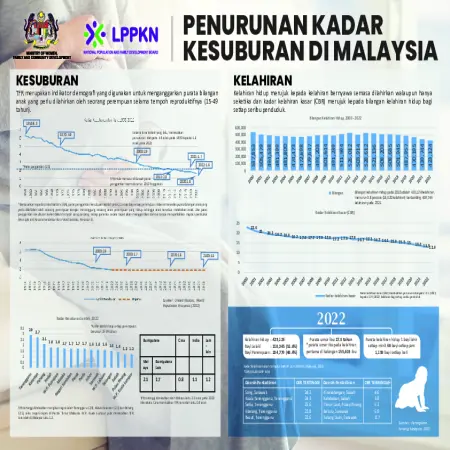
Abstract: Total Fertility rate (TFR) is a demographic indicator used to estimate the average number of children a woman should give birth to during her reproductive period. The findings of a poll in Sarawak found that the total TFR for the state of Sarawak is decreasing drastically. 12.6% of couples have had or are experiencing fertility problems and it is difficult to conceive within a year after marriage.
|
|
|
|
|
|
World Population Day 2023
Item Type: Infographic
Editor:
Year: 00/09/2023
Abstract: The World Population Day 2023 infographic shows Malaysia's Gender Gap Index in conjunction with the theme of the World Population Day 2023 celebration at the national level which is "Unleashing the Power of Gender Equality and Promoting the Rights of Women and Girls" and also an overview of data on women's rights and women's empowerment.
|
|
|
|
|

|
Peranan, tahap kesejahteraan, cabaran dan persediaan golongan wanita dalam menghadapi situasi pandemik covid-19 di Malaysia
Item Type: Book Section
Editor:
Year: 00/06/2023
Abstract: Towards post COVID-19, most of the daily routines of Malaysian women's life have changed. The change in routine includes the management of household affairs, work routine to work from home (work from home) and socializing routine. As a result, society, especially women, is seen as increasingly depressed due to the loss of sources of income, limited involvement in outdoor activities and problems in balancing work and family time. Aware of this situation, the National Population and Family Development Board Malaysia (NPFDB) has taken the initiative to conduct a series of public opinion surveys throughout 2020 and 2021. This study aims to explore the role, level of well-being, challenges and preparations of women in facing the pandemic situation COVID-19 in Malaysia. This study is an online survey study. The findings of this study are a reflection of the current situation of society and family institutions in Malaysia in facing several new waves during the COVID-19 pandemic. The findings of the survey show that women are more affected than men, but the level of well-being of women in Malaysia is seen to be still at a satisfactory level. In addition, the results of the study also found that women stated that they are faced with various issues and challenges especially for those who are married. Issues of family management, children's education at home and more flexible working hours should be highlighted for consideration by the Government. It is hoped that various initiatives and development plans related to women can be planned in addition to strengthening existing policies towards achieving the aspiration of "Building a CIVIL Malaysia". In general, the chapters in this book contribute to knowledge related to the current situation of women in facing the new normal life. While in particular, the chapters in this book contribute to knowledge related to the role, well-being, challenges and preparation of Malaysian women in facing the situation of the COVID-19 pandemic.
|
|
|
|
|
|
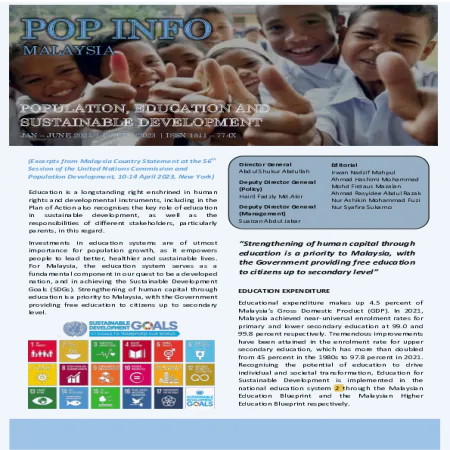
Population, education and sustainable developmet
Item Type: Newsletter
Editor:
Year: 00/06/2023
Abstract: Education is a longstanding right enshrined in human rights and developmental instruments, including in the Plan of Action also recognises the key role of education in sustainable development, as well as the responsibilities of different stakeholders, particularly parents, in this regard.
Strengthening of human capital through education is a priority to Malaysia, with the Government providing free education to citizens up to secondary level. Malaysia is also undertaking efforts to ensure that the education system is robust, resilient and fit for the future.
|
|
|
|
|
|
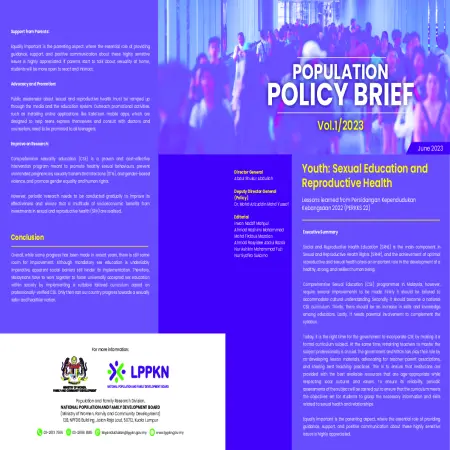
Population Policy Brief: Youth Sexual Education and Reproductive Health
Item Type: Act & Policy
Editor:
Year: 00/06/2023
Abstract: Comprehensive sexuality education (CSE) is a proven and cost-effective intervention program meant to promote healthy sexual behaviours, prevent unintended pregnancies, sexually transmitted infections (STIs), and gender-based violence, and promote gender equality and human rights. Therefore Malaysian have to work together to foster universally accepted sex education within society by implementing a suitable tailored curriculum based on professionally-verified CSE.
|
|
|
|
|
|
The 56th Session of The Commission On Population And Development, United Nations New York, 10-14 April 2023
Item Type: Country Statement
Editor:
Year: 11/04/2023
Abstract: Education is a longstanding right enshrined in human rights and developmental instruments, including in the Plan of Action of the International Conference on Population and Development (ICPD). The ICPD Plan of Action also recognizes the key role of education in sustainable development, as well as the responsibilities of different stakeholders, particularly parents, in this regard. Investments in education systems are of utmost importance for population growth, as it empowers people to lead better, healthier and sustainable lives. For Malaysia, the education system serves as a fundamental component in our quest to be a developed nation, and in achieving the Sustainable Development Goals (SDGs). Strengthening of human capital through education is a priority to Malaysia, with the Government providing free education to citizens up to secondary level.
|
|
|
|
|