TOPICS
|
Ke arah memantapkan sistem sokongan keluarga di Malaysia: pendekatan holistik dalam penyelesaian pertikaian keluarga
Item Type: Conference or Workshop Item
Editor:
Year: 00/00/2017
Abstract: This topic gives an overview of the institutions that are dealing with family disputes in Malaysia. Generally, these institutions can be divided into judicial institutions and non-judicial institutions. Judicial institutions refer to the civil courts and Syariah courts. While non-judicial institutions refer to the other bodies that provide family services, including the Ministry of Women, Family and Community Development, LPPKN, Legal Aid Department, Malaysian Mediation Centre, religious institutions, private counsellors and NGOs. However, one of the downsides in the present system is lack of cooperation between judicial and non-judicial institutions that are dealing with family matters. In the meantime, resolution of legal disputes does not necessarily indicate that the disputes have been treated from the root. In order to promote holistic resolution of family disputes, family members need to be given further treatment outside of the courts, to tackle other non-legal issues, such as emotional and mental conflicts. The family support system can facilitate the individuals, particularly by giving social support and counselling. In fact, the family support institutions are able to deal with family conflicts at the early stage, thus reducing the number of cases that need to go for court trial. Family service centres that have been established in other countries such as Singapore and Australia indicated a high success rate in the resolution of family disputes. It is viewed that a cooperation between judicial and non-judicial institutions can provide a holistic approach to the resolution of family disputes. Therefore, it is suggested that a strong networking to be established between these institutions, so as to improve the referral function between them. At the same time, it is important to create awareness among the society regarding family services that are available and how these services can help them in handling their family disputes.
|
|
|
|
|
|
Malaysian infertile men and women : do they suffer mental health issues?
Item Type: Conference or Workshop Item
Editor:
Year: 00/00/2017
Abstract: This study revealed that Malaysian infertile men and women demonstrated susceptibility to mental health problems that occurs more commonly among women than men. Thus, this study may facilitate fertility facilities to strategize and redesign better intervention for the infertile couples.
|
|
|
|
|

|
Kesan perubahan demografi terhadap institusi keluarga
Item Type: Conference or Workshop Item
Editor:
Year: 00/00/2017
Abstract: Since the 1980s, the fertility rate (TFR) has declined slowly from 4.0 to 2.0 children per woman in 2016. This means that every woman in the country at this point , on average, gives birth to 2 children in her lifetime. The rapid decline in fertility rate (TFR) has accelerated the aging process of the country. The TFR is likely to remain between 1.9 and 2.0 by 2020 and below 1.9 in the next decade. This presentation is about the impact of demographic change on family institutions.
|
|
|
|
|
|
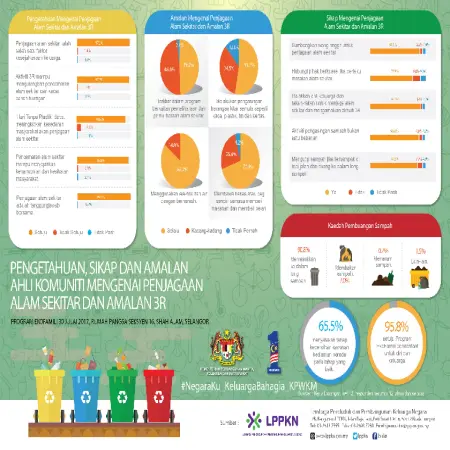
Pengetahuan, sikap dan amalan ahli komuniti mengenai penjagaan alam sekitar dan amalan 3R di Perak
Item Type: Infographic
Editor:
Year: 00/00/2017
Abstract: Findings of the opinion survey knowledge, attitudes and practices of community members on environmental care and 3R practices during eco family -programs in Perak
|
|
|
|
|
|
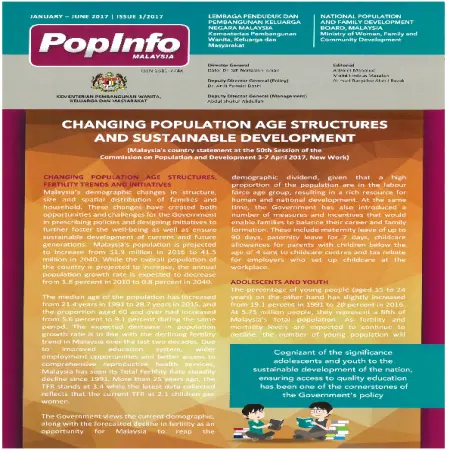
Changing population age structures and sustainable development
Item Type: Newsletter
Editor:
Year: 00/00/2017
Abstract: Malaysia's demographic changes in structure, size and spatial distribution of families and household. These changes have created both opportunities and challenges for the Government in prescribing policies and designing initiatives to further foster the well-being as well as ensure sustainable development of current and future generations. Malaysia's population is projected to increase from 31.9 million in 2016 to 41.5 million in 2040. While the overall population of the country is projected to increase, the annual population growth rate is expected to decrease from 1.8 percent in 2010 to 0.8 percent in 2040.
|
|
|
|
|
|
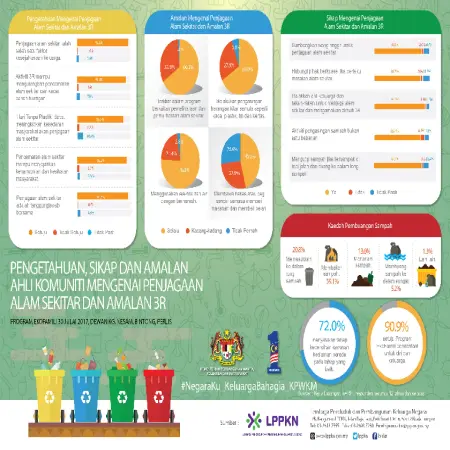
Pengetahuan, sikap dan amalan ahli komuniti mengenai penjagaan alam sekitar dan amalan 3R di Perlis
Item Type: Infographic
Editor:
Year: 00/00/2017
Abstract: Findings of the opinion survey knowledge, attitudes and practices of community members on environmental care and 3R practices during eco family -programs in Perlis.
|
|
|
|
|
|
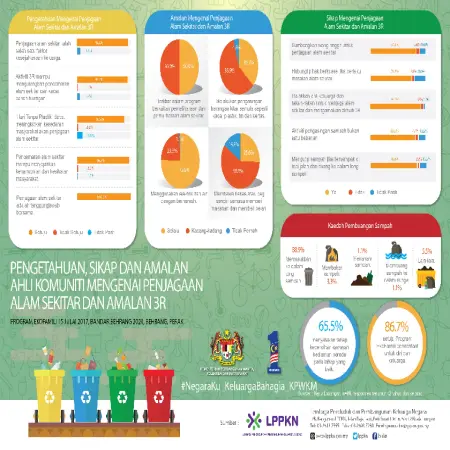
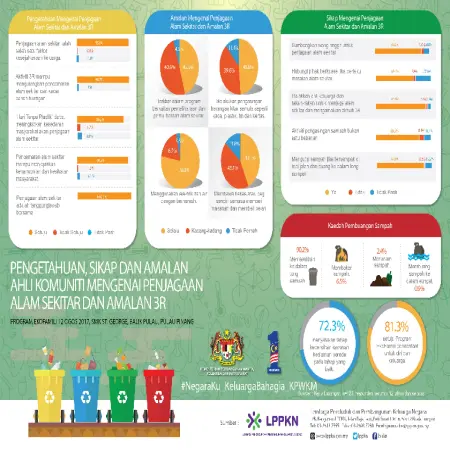
Pengetahuan, sikap dan amalan ahli komuniti mengenai penjagaan alam sekitar dan amalan 3R di Pulau Pinang
Item Type: Infographic
Editor:
Year: 00/00/2017
Abstract: Findings of the opinion survey knowledge, attitudes and practices of community members on environmental care and 3R practices during eco family-programs in Pulau Pinang
|
|
|
|
|
|
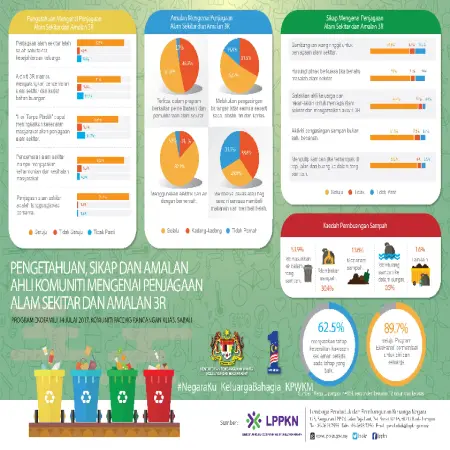
Pengetahuan, sikap dan amalan ahli komuniti mengenai penjagaan alam sekitar dan amalan 3R di Sabah
Item Type: Infographic
Editor:
Year: 00/00/2017
Abstract: Findings of the opinion survey knowledge, attitudes and practices of community members on environmental care and 3R practices during eco family-programs in Sabah
|
|
|
|
|
|
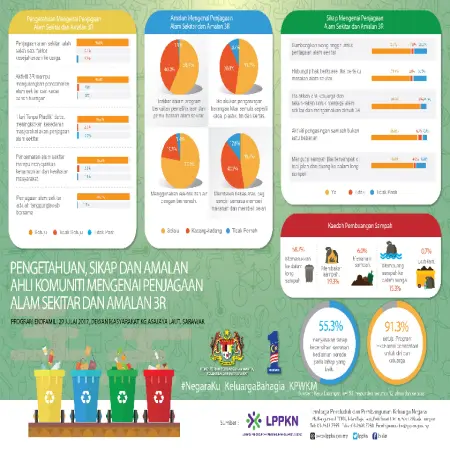
Pengetahuan, sikap dan amalan ahli komuniti mengenai penjagaan alam sekitar dan amalan 3R di Sarawak
Item Type: Infographic
Editor:
Year: 00/00/2017
Abstract: Findings of the opinion survey knowledge, attitudes and practices of community members on environmental care and 3R practices during eco family -programs in Sarawak
|
|
|
|
|
|
Pengetahuan,sikap dan amalan ahli komuniti mengenai penjagaan alam sekitar dan amalan 3R di Selangor
Item Type: Infographic
Editor:
Year: 00/00/2017
Abstract: Findings of the opinion survey knowledge, attitudes and practices of community members on environmental care and 3R practices during eco family -programs in Selangor
|
|
|
|
|