TOPICS
Results for Topics : "Reproductive Health"
|
The 57th Session of The Commission On Population And Development, United Nations New York, 29 April – 3 May 2024
Item Type: Country Statement
Editor:
Year: 00/05/2024
Abstract: Malaysia like many other countries is becoming an aging nation due to declining fertility and increasing life expectancy. As 10.7 per cent of its population aged above 60 in 2020, Malaysia is expected to reach aged nation status by 2030. In this regard, Malaysia has revised its National Policy for Older Persons to enhance the integration of the elderly into society and introduced measures to boost the number of geriatricians and aged care health professionals under the National Health Policy for Older Persons. Malaysia's commitment to adolescent healthcare is evident in the National Adolescent Health Plan of Action (2015-2020) and the revised National Policy and Plan of Action on Social and Reproductive Health Education (2022-2025). These initiatives emphasize sexual and reproductive health education rooted in religious and moral principles across different settings and age groups. The Government also provides comprehensive health care services which includes contraceptive and sexual and reproductive health services that are integrated into primary health-care facilities nationwide. Family planning services are also provided by the National Population and Family Development Board of the Ministry of Women, Family and Community Development, NGOs such as the Family Planning Associations as well as private practitioners.
|
|
|
|
|

|
SDGS and the impact of megatrends on Families: perspectives from Malaysia
Item Type: Conference or Workshop Item
Editor:
Year: 00/05/2024
Abstract: 57th Commissions on Population and Development (CPD57): Assessing the status of implementation of the Programmed of Action of the International Conference on Population and Development and its contribution to the follow-up and review of the 2030 Agenda for Sustainable Development during the decade of action and delivery for sustainable development. Strengthening Malaysian Families in era of megatrends, National Population and Family Development Board Malaysia (NPFBD) had LPPKN Family Centre, Nur Sejahtera Clinic Services, Population and Family Research, Training and education (family), Counseling service and program, online accessibility etc.
|
|
|
|
|

|
Bridging Boundaries: Empowering SRHE Through KafeTEEN Peer Educators
Item Type: Conference or Workshop Item
Editor:
Year: 00/05/2024
Abstract: There is increase in sexual activity prevalence among youth and high risk practice among youth who engaged in sexual activity. SRHE knowledge is known to be one of protective factors in preventing youth from engaging in high risk sexual activity. KafeTEEN YOUTH Centre Program is one of NPFBD initiative to lead SRH education dissemination for youth in Malaysia.
|
|
|
|
|
|
Prosiding Persidangan Kependudukan Kebangsaan 2023 (PERKKS 23): “Penduduk dan Keluarga Mampan, Membangun Malaysia MADANI”
Item Type: Book
Editor:
Year: 00/12/2023
Abstract: Collection of papers presented during the 2023 National Population Conference (PERKKS 23), 21-22 November 2023, Pulse Grande Hotel, Putrajaya.
|
|
|
|
|
|
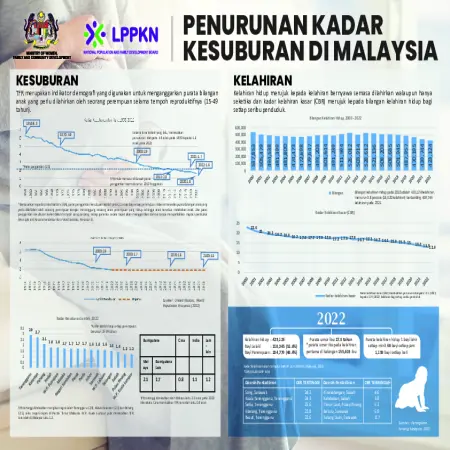
Penurunan Kadar Kesuburan Di Malaysia
Item Type: Infographic
Editor:
Year: 00/10/2023
Abstract: Total Fertility rate (TFR) is a demographic indicator used to estimate the average number of children a woman should give birth to during her reproductive period. The findings of a poll in Sarawak found that the total TFR for the state of Sarawak is decreasing drastically. 12.6% of couples have had or are experiencing fertility problems and it is difficult to conceive within a year after marriage.
|
|
|
|
|
|
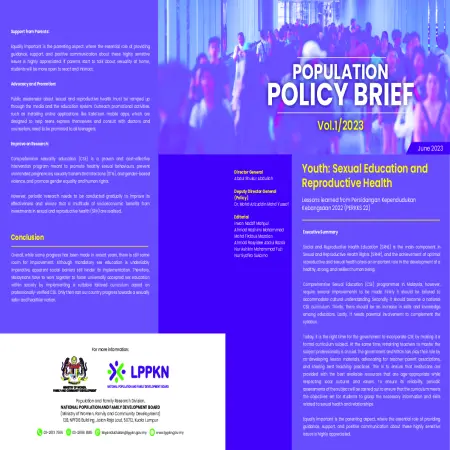
Population Policy Brief: Youth Sexual Education and Reproductive Health
Item Type: Act & Policy
Editor:
Year: 00/06/2023
Abstract: Comprehensive sexuality education (CSE) is a proven and cost-effective intervention program meant to promote healthy sexual behaviours, prevent unintended pregnancies, sexually transmitted infections (STIs), and gender-based violence, and promote gender equality and human rights. Therefore Malaysian have to work together to foster universally accepted sex education within society by implementing a suitable tailored curriculum based on professionally-verified CSE.
|
|
|
|
|
|
The 56th Session of The Commission On Population And Development, United Nations New York, 10-14 April 2023
Item Type: Country Statement
Editor:
Year: 11/04/2023
Abstract: Education is a longstanding right enshrined in human rights and developmental instruments, including in the Plan of Action of the International Conference on Population and Development (ICPD). The ICPD Plan of Action also recognizes the key role of education in sustainable development, as well as the responsibilities of different stakeholders, particularly parents, in this regard. Investments in education systems are of utmost importance for population growth, as it empowers people to lead better, healthier and sustainable lives. For Malaysia, the education system serves as a fundamental component in our quest to be a developed nation, and in achieving the Sustainable Development Goals (SDGs). Strengthening of human capital through education is a priority to Malaysia, with the Government providing free education to citizens up to secondary level.
|
|
|
|
|

|
Cepat Tahu, Cepat Tindak
Item Type: Video
Editor:
Year: 00/01/2023
Abstract: Educational video regarding the importance of undergoing a mammogram test which is an examination to detect the early stages of breast cancer while the HPV DNA test is a test to detect the Human Papillomavirus (HPV) that is infected through sexual contact. Cervical cancer is cancer at the base of the uterus caused by HPV.
|
|
|
|
|


|
Enhancing Pregnancy Outcomes in Women with Polycystic Ovary Syndrome
Item Type: Research Report
Editor:
Year: 00/01/2023
Abstract: Polycystic ovary syndrome or known as polycystic ovarian syndrome (PCOS) is an endocrine disorder and one of the main causes of anovulatory infertility in women of reproductive age, which is 15 to 49 years (Balen et al., 2016). The main characteristics of women with PCOS are ovarian dysfunction, hyperandrogenism and polycystic ovaries (Balen and Michelmore., 2002). This syndrome is associated with metabolic syndromes such as obesity, insulin resistance, diabetes mellitus type 1 (Barthemess and Naz., 2014) and arteriosclerosis (Orio et al., 2004).
The general objective of this study is to identify the demographic characteristics, clinical and medical history, of PCOS sufferers as well as appropriate treatment methods among clients seeking fertility treatment at the LPPKN Subfertility Clinic.
This study is an experimental, case control study involving female clients who come to seek fertility treatment at the LPPKN Subfertility Clinic. The chosen location is LPPKN Headquarters, Kuala Lumpur. Every female client who attends needs to meet the patient selection criteria, namely a Malaysian couple, trying to conceive for more than a year and aged between 25 to 38 years old. Every patient who faces subfertility problem is divided into two groups, namely PCOS and no PCOS.
Patients who are eligible and agree to participate in the study have gone through at least five (5) series of appointments with medical officers and nurses. A total of 167 patients participated in this study with an average age of 30 years.
|
|
|
|
|