|
|
Country context and family research : trends from Malaysia
Item Type: Conference or Workshop Item
Editor:
Year: 00/01/2026
Abstract: Malaysia demographic transition: youth population shrinking, senior population growing and Malaysia entering an ageing society. Senior live longer, creating higher dependency ratios. For marriage and family trends there are declining marriage rates, delayed family formation. Divorce rates increasing, reshaping household stability. For household structure it shift from extended families to smaller nuclear households. Rising living costs discourage larger families. For fertility, Total Fertility Rate (TFR) is now below the replacement level (2.1)
|
|
|
|
|
|
Coconut water: a natural remedy unlocking new hope for male fertility
Item Type: Scientific Poster
Editor:
Year: 00/11/2025
Abstract: Male infertility are the inability of a men to impregnate a female after 1 year of unprotected intercourse. It high course of modern drugs and techniques to heal and involve ethical concerns. Then rely in alternative remedies derived from medicinal plants. Objectives of this study are to evaluate the potential of coconut water to support reproductive health of male for healing effects of coconut water and enhancing effects of coconut water. The conclusion oh healing effect of coconut water are mitigated the harmful effects of BPA on the male reproductive organs in rats. Enhancing effects of coconut water is coconut water alone enhanced reproductive organs in bucks.
|
|
|
|
|
|
Socio-demographic determinants of fertility intention among reproductive-age adults in urban Malaysia
Item Type: Scientific Poster
Editor:
Year: 00/11/2025
Abstract: Malaysia’s total fertility rate (TFR) dropped to 1.6 children per woman in 2022, with Kuala Lumpur reporting the lowest at 1.2, well below the replacement level. Sustained low fertility threatens future labour force replacement, healthcare sustainability, and family support sustems. Urban pressures such as high living costs, work-life imbalance, and housing challenges further discourage childbearing. Despite these concerns, there remains limited empirical evidence on how socio-demographic factors influence fertility intentions in Malaysia’s Urban population. This study examines the socio-demographic determinants of fertility intention among adults in Kuala Lumpur, Malaysia’s lowest-fertility region.
|
|
|
|
|
|
Pembangunan dan pengesahan soal selidik mengenai pendedahan mikroplastik dan implikasi kesihatan dalam kalangan lelaki dewasa
Item Type: Scientific Poster
Editor:
Year: 00/11/2025
Abstract: Microplastics are contaminants that enter the human body and pose risks to internal biological systems. The objective of this study was to develop a questionnaire to assess perceptions of microplastic exposure and its health implications among adult men in Malaysia. In conclusion, a questionnaire was developed and validated with strong content, comprehension, and psychometric properties to assess perceptions of microplastic exposure among adult men. The final instrument included 31 items in five domains with strong validity and reliability.
|
|
|
|
|
|
Low fertility, high stakes: demographic and economic implications of Malaysia’s fertility decline and the case for a National Fertility Insurance Policy
Item Type: Scientific Poster
Editor:
Year: 00/11/2025
Abstract: Malaysia’s fertility rate has fallen to 1.6 births per woman (2024), below replacement level for more than a decade. This decline is driven by delayed marriage, economic pressures, and limited financial support for infertility care. Infertility affects 1 in 6 adults globally, yet treatment in Malaysia remains largely self-funded, leading to inequalities in access and increased emotional and economic burden. Understanding these barriers is critical to strengthen national demographic resilience. Conclusion, Malaysia’s fertility decline is a multidimensional issue requiring urgent clinical, policy, and economic intervention. The National Fertility Insurance (NFI) framework presents a strategic, sustainable, equitable policy mechanism to improve reproductive health access, sustain population growth, and strengthen socioeconomic resilience. Strategic investment in fertility care can safeguard Malaysia’s socioeconomic future.
|
|
|
|
|
|
Apabila bilangan yang diinginkan berkurang: perubahan keinginan kesuburan dalam kalangan wanita Malaysia, 2004-2014
Item Type: Conference or Workshop Item
Editor:
Year: 00/11/2025
Abstract: The desire to have more children in Malaysia has declined as many people choose to have smaller families. Employment status is not a strong predictor. Education level was not a factor in 2004 in determining the desire for children, but in 2014, education influenced the desire. It is expected that the desire to have children will continue to decline in line with the reported decline in the Total Fertility Rate (TFR). Malaysia needs to plan measures and policies to prevent the negative effects of low fertility rates in the future. Malaysia needs an advocacy strategy that emphasizes the importance of having more children across age and ethnicity; government policies that directly and indirectly impact the desire to have one or more children (e.g. financial incentives, subfertility treatment, family-friendly workplaces, and a reformed early childhood education system)
|
|
|
|
|
|
Trend kesuburan di Malaysia: implikasi kepada pembangunan negara
Item Type: Conference or Workshop Item
Editor:
Year: 00/08/2025
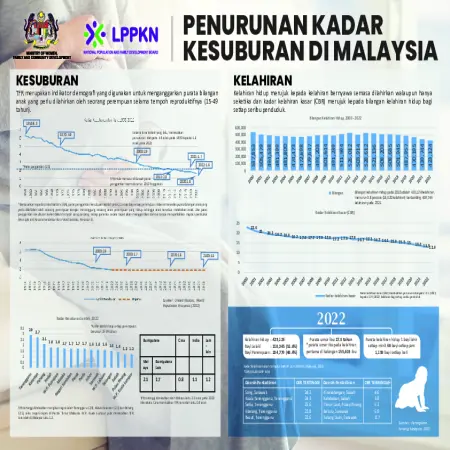
Abstract: The number of Malaysian families is increasing, but family size is getting smaller. Marriages are increasingly being delayed, especially as the divorce rate has doubled since 2010. The scenario of fertility rate changes in Malaysia shows a declining trend. The crude birth rate in Malaysia also shows a drastic decrease. The rapid decline in fertility rate (TFR) will accelerate the country's aging process. LPPKN services can be one of the effective strategies that can support Malaysia in facing the scenario of declining fertility.
|
|
|
|
|
|
Meniti usia, menunda jodoh: mengupas punca dan kesan kadar kesuburan rendah di Pulau Pinang
Item Type: Conference or Workshop Item
Editor:
Year: 00/08/2025
Abstract: Penang is currently facing persistently low fertility rates as well as rapid population aging. The main factor identified is the low marriage rate, especially among non-Muslims. Policy suggestions to address the low marriage rate include exposing the public to the importance of having more than two children; implementing affordable housing schemes specifically for young couples and newlyweds; and fostering the value of marriage through awareness and educational programs, educating young people about the benefits of marriage, as well as addressing misconceptions about marriage.
|
|
|
|
|
|
Perkhidmatan subfertiliti LPPKN
Item Type: Conference or Workshop Item
Editor:
Year: 00/08/2025
Abstract: LPPKN provides subfertility services to raise awareness and education on fertility and reproductive health; empower access to fertility treatments and reproductive health services; organize community engagement programs and support services focused on fertility issues and family well-being; establishment of the National Subfertility Center and others. The subfertility treatments provided are Intrauterine Insemination (IUI) and In Vitro Fertilisation (IVF)
|
|
|
|
|
|
Lelaki itu sebenarnya…?
Item Type: Conference or Workshop Item
Editor:
Year: 00/08/2025
Abstract: Unraveling the myths, realities, and science of men's health and fertility in Malaysia. Malaysia's fertility rate has dropped far below the replacement level (2.1) since 2013. In Malaysia, 1 in 10 men show poor-quality sperm. The causes of male fertility problems are obesity; lifestyle (smoking/alcohol/drugs); health and medical issues; age factors.
|
|
|
|