


TOPICS
Results for Topics : "Education"
|
Using games to stimulate and motivate Esl students in Malaysia
Item Type: Book Section
Editor:
Year: 00/12/2023
Abstract: Vocabulary is a vital part of English second language education. Unfortunately, the teaching and learning process is challenging for students as regular classroom activities have become tedious and boring, which does not motivate them to learn. Not only that, but this also discourages them from practising outside of the classroom. To help encourage students to become more motivated in learning and improving their English vocabulary, teachers need to consider more creative activities to be used in the classroom.
|
|
|
|
|
|
Usability of ‘Rancanglah’ for health education in family planning: the perspective from healthcare personnel
Item Type: Book Section
Editor:
Year: 00/12/2023
Abstract: Advancement of digital technology brings great potential to complement current method in promoting family planning. Traditionally, health education on family planning is routinely delivered through face-to-face counseling during postnatal follow up at 6 weeks post-delivery. The innovation of RancangLah, a mobile-based application aims to educate women to choose the best family planning method for them apart from having awareness on their pregnancy risk.
|
|
|
|
|
|
Melaporkan kualiti tinjauan sistematik amalan bersesuaian pendidikan untuk kanak-kanak bawah dua tahun: Pematuhan mengikut garis panduan Prisma
Item Type: Book Section
Editor:
Year: 00/12/2023
Abstract: The aim of this study was to assess the quality of the reporting of the systematic review of educationally appropriate practices for children under two years of age using the guidelines of the Item Pelaporan Pilihan for Systematic Review and Meta-analysis (PRISMA). Results of searches from Scopus, Web of Science (WoS), and Taylor & Francis online have obtained 42 journal articles of empirical report data that describe the education of children under two tears of age starting in 2019-2023
|
|
|
|
|
|
Kepentingan pendidikan keusahawanan bagi mengurangi jurang kemiskinan dalam mencapai matlamat pembangunan mampan negara: kerangka konseptual
Item Type: Book Section
Editor:
Year: 00/12/2023
Abstract: The study was conducted on the importance of entrepreneurship education in reducing the poverty gap between urban and rural population. This study aims to study the effectiveness of entrepreneurship education in changing the living standards of a family. Sustainable development requires an education that is effective in lifting students out of poverty. Poverty is a global problem not only faced by the country of Malaysia but the whole world is facing the same problem.
|
|
|
|
|
|
Population, education and sustainable developmet
Item Type: Newsletter
Editor:
Year: 00/06/2023
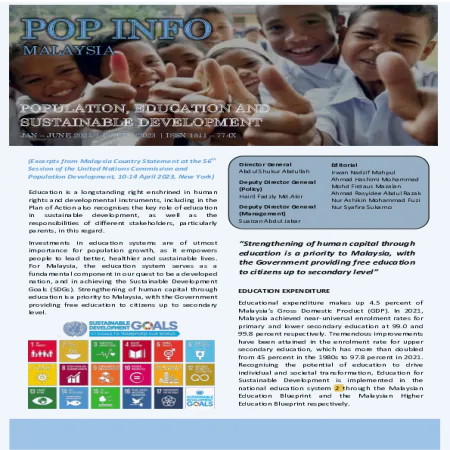
Abstract: Education is a longstanding right enshrined in human rights and developmental instruments, including in the Plan of Action also recognises the key role of education in sustainable development, as well as the responsibilities of different stakeholders, particularly parents, in this regard.
Strengthening of human capital through education is a priority to Malaysia, with the Government providing free education to citizens up to secondary level. Malaysia is also undertaking efforts to ensure that the education system is robust, resilient and fit for the future.
|
|
|
|
|
|
Population Policy Brief: Youth Sexual Education and Reproductive Health
Item Type: Act & Policy
Editor:
Year: 00/06/2023
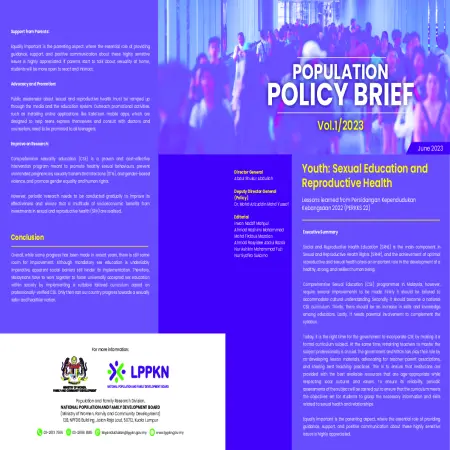
Abstract: Comprehensive sexuality education (CSE) is a proven and cost-effective intervention program meant to promote healthy sexual behaviours, prevent unintended pregnancies, sexually transmitted infections (STIs), and gender-based violence, and promote gender equality and human rights. Therefore Malaysian have to work together to foster universally accepted sex education within society by implementing a suitable tailored curriculum based on professionally-verified CSE.
|
|
|
|
|
|
The 56th Session of The Commission On Population And Development, United Nations New York, 10-14 April 2023
Item Type: Country Statement
Editor:
Year: 11/04/2023
Abstract: Education is a longstanding right enshrined in human rights and developmental instruments, including in the Plan of Action of the International Conference on Population and Development (ICPD). The ICPD Plan of Action also recognizes the key role of education in sustainable development, as well as the responsibilities of different stakeholders, particularly parents, in this regard. Investments in education systems are of utmost importance for population growth, as it empowers people to lead better, healthier and sustainable lives. For Malaysia, the education system serves as a fundamental component in our quest to be a developed nation, and in achieving the Sustainable Development Goals (SDGs). Strengthening of human capital through education is a priority to Malaysia, with the Government providing free education to citizens up to secondary level.
|
|
|
|
|

|
Modul My Therapeutic Family: Family Psychological First Aid
Item Type: Module
Editor:
Year: 00/01/2023
Abstract: INTRODUCTION:-
KASIH Keluarga Ceria Program is a comprehensive initiative aimed to bolster the family institution in Malaysia, which is a cornerstone of national well-being. This program comprises two modules, namely:
i. Psychoeducation Module
ii. Support Group "My Therapeutic Family" Module
These modules were based on the Family Psychological First Aid (F-PFA) model, jointly developed by NPFDB and Universiti Pendidikan Sultan Idris (UPSI). The model integrated fundamental family dynamics, functional family systems, and Psychological First Aid principles recognized by the World Health Organization (WHO).
The Support Group "My Therapeutic Family" Module complements the Psychoeducation Module by focusing on maintenance, particularly in the post-intervention phase, addressing crisis management within the family unit.
The objectives of this program are:
1. Enhance parents' awareness regarding mental health and adaptive skills;
2. Educate parents with knowledge of Family Psychological First Aid (F-PFA);
3. Empower parents with referral skills for psychological assistance;
4. Establish support groups platform for parents; and
5. Forge intelligent collaborative network between NGOs, agencies, and referral experts.
|
|
|
|
|
|
Modul Psiko-Pendidikan "Family Psychological First Aid"
Item Type: Module
Editor:
Year: 00/01/2023
Abstract: KASIH Keluarga Ceria Program is a comprehensive initiative aimed to bolster the family institution in Malaysia, which is a cornerstone of national well-being. This program comprises two modules, namely:
i. Psychoeducation Module
ii. Support Group "My Therapeutic Family" Module
These modules were based on the Family Psychological First Aid (F-PFA) model, jointly developed by LPPKN and Universiti Pendidikan Sultan Idris (UPSI). The model integrates fundamental family dynamics, functional family systems, and Psychological First Aid principles recognized by the World Health Organization (WHO).
The Psychoeducation Module serves to impart knowledge on F-PFA concepts and skills necessary during the preparation and intervention phases of managing crises within the family unit. The module encompasses mental health screening, psychosocial intervention, and referral skill. Families, armed with F-PFA knowledge and skills, gain the capacity to adeptly respond during family crisis.
The objectives of this program are:
1. Enhance parents' awareness regarding mental health and adaptive skills;
2. Educate parents with knowledge of Family Psychological First Aid (F-PFA);
3. Empower parents with referral skills for psychological assistance;
4. Establish support groups platform for parents; and
5. Forge intelligent collaborative network between NGOs, agencies, and referral experts.
|
|
|
|
|
|
Jangan Malu Ambil Tahu, Jangan Malu Bagi Tahu
Item Type: Video
Editor:
Year: 00/01/2023
Abstract: #AmbilTahuBagiTahu is a movement that supports the campaign "Don't be ashamed to learn and don't be ashamed to learn" which aims to raise awareness about the importance of reproductive and social health education in Malaysia.
This campaign is implemented by one of the agencies under the Ministry of Women, Family and Community Development which is the National Population and Family Development Board (NPFDB).
|
|
|
|
|

