Browse by Year
|
Motherhood in childhood: teenage pregnancy & MOH initiatives
Item Type: Conference or Workshop Item
Editor:
Year: 00/00/2016
Abstract: Teenage pregnancy in Malaysia is the result of either early marriages, consensual sex or the tragedy of rape. Although the age specific rate is showing a decline from 32 per 1000 women aged 1-19 years in 1980 to about 14 in the year 2010, the Ministry of Health (MOH) continue to focus on adolescent health with great concerns. Incidence of teenage pregnancies continue to be reported and in 2015 the highest is still those reported in Sabah dan Sarawak. The MOH has taken several measures in creating awareness and providing the facilities to address teenage pregnancy issues. They are given guidance and counselling, early identifications and intervention to help reduce the risk of serious morbidities during pregnancy or childbirth. This presentation discusses about teenage pregnancy problem in Malaysia.
|
|
|
|
|
|
Big data for measuring and achieving the 2030 agenda for sustainable development goals in Malaysia
Item Type: Conference or Workshop Item
Editor:
Year: 00/00/2016
Abstract: The Sustainable Development Goals (SDGs) have set 17 goals and 169 related targets to be achieved by 2030. In line to support SDGs indicators, Big Data plays a pivotal role to achieve the aspiration by providing real time information and evidence-based decision making through the predictive analytics. Thus, Big Data Analytics (BDA) has become a top priority for Malaysia’s government and one of the key pillars for national ICT development under the 11th Malaysia Plan. In becoming a leading statistical agency internationally by 2020, DOSM has taken efforts to utilise big data to improvise outcome and produce a more comprehensive and quality services. DOSM is vital to ensure the statistical products and services are able to fulfil users’ expectations. In tandem with DOSM's Transformation Plan 2015-2020 and aiming to make the most of the fast-growing volume of digital data, DOSM has initiated the implementation of Big Data Analytics under the project of StatsBDA. This presentation aims to highlight DOSM’s experiences in constructing official statistics by using big data which is aligned to the 2030 Agenda for SDGs. In addition, we will also share on the issues and challenges faced by DOSM pertinent to utilising the Big Data.
|
|
|
|
|
|
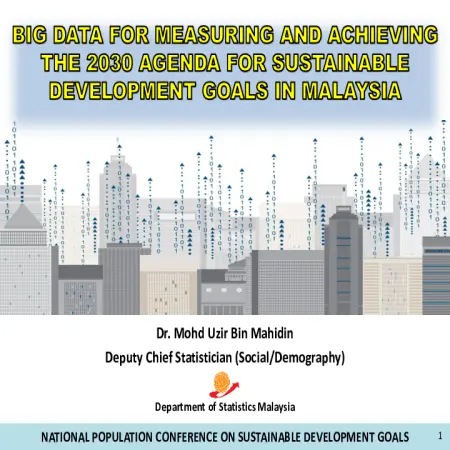
Pengenalan Kajian Penduduk dan Keluarga Malaysia Kelima 2014
Item Type: Conference or Workshop Item
Editor:
Year: 00/00/2016
Abstract: The objective of this study to provide time series data related to demographic and socioeconomic information and to be source of data for national socioeconomic planning. Tha last objective is to evaluate the efficiency and effectiveness of planning and implementation of policies, programs and activities. This slide presentation is about the introduction and key findings of the Malaysian Population and Family Survey-5, 2014.
|
|
|
|
|
|
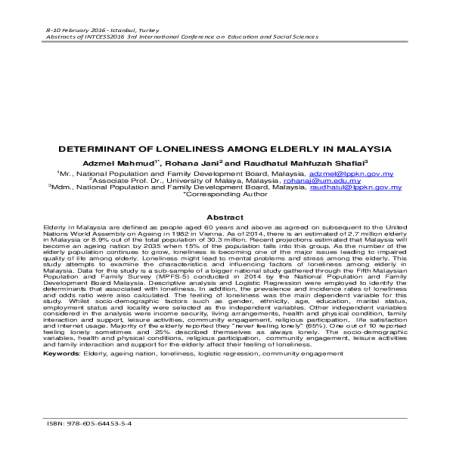
Determinants of loneliness among elderly in Malaysia
Item Type: Conference or Workshop Item
Editor:
Year: 00/00/2016
Abstract: As of 2014, there is an estimated of 2.7 million elderly in Malaysia or 8.9% out of the total population of 30.3 million. Recent projections estimated that Malaysia will become an ageing nation by 2035 when 15% of the population falls into this group. As the number of the elderly population continues to grow, loneliness is becoming one of the major issues leading to impaired quality of life among elderly. Loneliness might lead to mental problems and stress among the elderly. This study attempts to examine the characteristics and influencing factors of loneliness among elderly in Malaysia. Data for this study is a sub-sample of a bigger national study gathered through the Fifth Malaysian Population and Family Survey (MPFS-5) conducted in 2014 by the National Population and Family Development Board Malaysia.
|
|
|
|
|
 |
Living the 'reduce, reuse and recycle' lifestyle
Item Type: Conference or Workshop Item
Editor:
Year: 00/00/2016
Abstract: In this presentation, the author will emphasise the urgency for "living the ‘reduce, reuse & recycle’ lifestyle” because humanity is living well beyond the ecological limits of one planet. Based on ecological footprint analysis, a tool for measuring sustainability, the biocapacity for humanity to be sustainable in 2012 was 1.7 global hectares (gha) per person (Global Footprint Network 2016; EF&B in 2012). Yet, the actual footprint of 2.8gha per person in that year globally indicates we were consuming the resources of 1 ½ planets. When we note further that some countries only survived on the equivalent of 0.7gha per person while others consumed the resources of over four planets at more than 8gha per person, it highlights the inequity of consumption across the human population. If this trend continues without shifting to a ‘reduce, reduce, reduce’ lifestyle, we will not achieve the sustainable development goals or Agenda 2030. Further, we will be borrowing from the future generations and compromising on their ability to meet their own needs. With a footprint of 3.7gha per person, Malaysians are already consuming the resources of more than two planets. Next, consumption patterns in 550 urban households in Malaysia based on data from an EPSM survey will be presented. In order to make the sustainable shift to ‘reduce, reuse & recycle’ lifestyle, an institutional framework needs to be created to mainstream sustainable development, as advocated by EPSM’s ongoing Sustainable Living in Malaysia (SLiM) campaign. Serious efforts need to be made to reduce our consumption of energy (electricity and fuel), water, meat and waste generation, including unnecessary shopping. In conclusion, the author will highlight examples of living the ‘reduce, reuse and recycle’ lifestyles.
|
|
|
|
|
Investing in young people: matching education with employment needs
Item Type: Conference or Workshop Item
Editor:
Year: 00/00/2016
Abstract: Education has always been the engine of growth for Malaysia. Malaysia aspiration to become a high income nation by 2020. Multi-prong strategies which include access to education for all among the pillars to transforming the nation. Malaysia has always been embracing with the strategies and action plans of the sustainable development goals regardless of class, race, gender, age and creed.
|
|
|
|
|