Browse by Division/Agency
|
Predictor of successful Intra Uterine Insemination (IUI) treatment for infertile couples treated at a Malaysian clinic
Item Type: Conference or Workshop Item
Editor:
Year: 00/00/2012
Abstract: The purpose of the study was to determine prognostic factors that affect the success rate of Intrauterine Insemination (IUI) as well as association of prognostic factors with success rate of IUI treatment for infertile couples. A retrospective cohort study investigating the prognostic factors affecting success of IUI was done at National Infertility clinic. A total of 1585 couples involving 3249 IUI cycles with ovarian stimulation using clomiphene citrate and/or human menopausal gonadotrophin (HMG) were recruited from lst January 2000 till 3lst December 2006. The pregnancy rate per cycle and per couple was 3.7% and 7.4%, respectively. Logistic regression analysis had determined three prognostic variables as regards pregnancy namely as duration of infertility a = 0.002), interval of menstrual cycle a = 0.00025) and sperm count a = 0.016). The percentage of women successfully pregnant after cycle one till cycle 5 IUI were ranging from 3.4% to 4.8%. Results showed that no pregnancy occurred after the sixth cycle of IUI. The result suggests that duration of infertility is of utmost important determinants of an infertile couple in view of IUI success rate.
|
|
|
|
|
|
Perkongsian pengalaman tok ma tok pa
Item Type: Conference or Workshop Item
Editor:
Year: 00/00/2012
Abstract: This presentation shares experiences on how to empower family institutions as well as how these changes are impacting the current scenario such as increasing social or negative symptoms. A new culture that is not filtered to the family. The institution of the family is increasingly challenging, parents are unaware of the condition of the children. Parents, grandparents and the community are unprepared from the knowledge, mentality and awareness to cope with new scenarios. Actions that can be taken to cope with the transition of new scenarios are through continuous learning for parents, grandparents and the community, creating a mutually supportive growing environment, enabling grandparents to assist in parenting, more integrated, more knowledgeable and sustainable family governance and a more caring community.
|
|
|
|
|
|
Proses kaunseling keluarga di Malaysia
Item Type: Conference or Workshop Item
Editor:
Year: 00/00/2012
Abstract: Family counseling is one of the interventions in family services for built a healthy family in Malaysia. This is a qualitative case study of a variety of 'settings' aims to explore the phenomenon of family counseling process conducted by practitioners in Malaysia with an in-depth interview technique, observation and document analysis. Study participants in the study were 12 family counseling practitioners from three counseling service centers. This study has five research questions namely to (i) identify the type of cases handled, number of cases and causes of problems in the family counseling process (ii) identify the initial relationship in the family counseling process (iii) explore the family counseling process (iv) identify approaches and skills used in family counseling and (v) explore the impetus and challenges of the family counseling process among family counseling practitioners in various settings in Malaysia. Cross -case analysis method based on interviews, observations and document analysis on family counseling practitioners was implemented using Nvivo 8 software. In this study, 190 themes and sub -themes were produced from 12 study participants. The results show that there are some similarities and differences between the family counseling process in Malaysia and the process framework in Western countries. These similarities and differences occur at all levels of the counseling process, skills, use of techniques, application of theory, and challenges in practice. The results of the study also show that the family counseling process among practitioners in Malaysia is tied to the education and training received by the practitioner, the context of religion, culture, values and SES of the family and community in Malaysia. Therefore, this study contributes to the provision of family counseling process that is very necessary in strengthening the family institution and can be an intervention in building a generation of excellent Malaysian society.
|
|
|
|
|

|
Pengkelasan keberkesanan perancang keluarga menggunakan pepohon keputusan
Item Type: Conference or Workshop Item
Editor:
Year: 00/00/2012
Abstract: Awareness of the importance of family planning practices for a family institution in Malaysia began around the 1960s. In order to plan family size it is important to determine the appropriate and effective method of family planning. Therefore, this study was conducted to develop a best classification model and identify the factors of effectiveness of such methods and also for women who do not use any family planning method, factors that influence the effectiveness of non-use of methods are also identified. Classification techniques in data mining were used to obtain patterns of effectiveness of the family planning methods used. The classification techniques used are result trees J48, ID3, Random Tree, REPTree and Bayes classifier Naive Bayes. Secondary data from the fourth set of the Malaysian Population and Family Survey (MPFS) obtained from the National Population and Family Development Board (LPPKN) were used in this study. To obtain the best classification model, 10-fold cross validation method, Weka and Mynda applications were used. The test results found that the J48 result tree was selected as the best classification model because this model provides the highest accuracy values for both data sets of 87.83% and 80.42% compared to other techniques. The study has produced a decision tree that can generate a set of tips to identify the effectiveness of family planning methods used and a set of tips to identify the effectiveness of those who do not use family planning methods. In conclusion, this study does not cover women who are using family planning methods and it is hoped that future studies will cover the effectiveness of the method for women who are using family planning methods and make pattern comparisons based on MPFS 1, MPFS 2, MPFS 3 and MPFS 4 data sets.
|
|
|
|
|
|
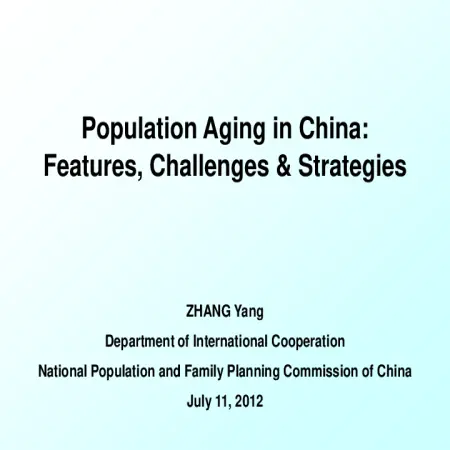
Population aging in China: features, challenges & strategies
Item Type: Conference or Workshop Item
Editor:
Year: 00/00/2012
Abstract: Global response to population aging is confronted by a series of severe challenges, for example retirement and medical/caring costs adds to fiscal burdens, population aging withers the labor force, development and aging problems intermingle as growth of the aged population mostly takes place in developing countries and poverty of the aged remains an acute problem. All these issues may only be addressed when national governments all over the world take the needs of the aged into full consideration in developing their social policies, establish specific strategies for responding to population aging and incorporate such strategies into long-term national development frameworks. Population aging also reflects the progress and achievement that the human society has made in extending life expectancy, improving mother and child health and helping women realize family planning. Seniors are more than just beneficiaries of social welfare. As producers, consumers, spreaders of traditional cultures, care-takers of children in their families and communities, seniors also play positive irreplaceable roles. A shared goal for us all therefore is to regard aging as an achievement, respond to age-related issues with a positive, optimistic and rational altitude, view skills, experiences and resources of the elderly as capital of the social development course, incorporate aging into our development agendas, promote positive aging and thereby construct a sharing society regardless of age.
|
|
|
|
|
|
Persepsi penduduk tempatan terhadap kehadiran pekerja Indonesia di Bahagian Tawau, Sabah
Item Type: Conference or Workshop Item
Editor:
Year: 00/00/2011
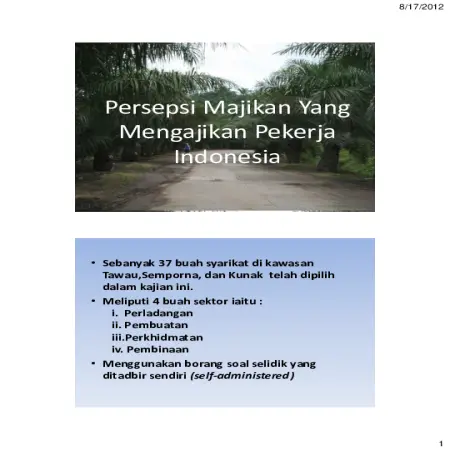
Abstract: A total of 37 companies in Tawau, Semporna and Kunak were selected in this study which covers 4 sectors namely plantation, manufacturing, services and construction. This study uses a self-administered questionnaire. The majority of employers in all sectors were found to provide facilities and welfare such as accommodation (employees only), health and medical treatment facilities and insurance to their Indonesian employees. More than 80.0 percent of employers in all sectors fully fund facilities and welfare such as workers' insurance (94.4%), treatment and health facilities for workers with family members (88.6%), and shelter for workers (82.4%). This presentation slide describes the perception of employers who employ Indonesian workers.
|
|
|
|
|
 |
Parenting@Work module
Item Type: Module
Editor:
Year: 00/00/2010
Abstract: The National Population and Family Development Board (NPFDB) has developed a Parenting@Work courses designed to help dual career families cope with the multiple demands of work and family life. Through the Parenting@Work courses, you will have the opportunity to learn the skills and techniques of balancing family and work, time management as well as gain valuable parenting knowledge and skills to make you a better parent. You are urged to utilize the opportunity provided by NPFDB to enhance your knowledge and skills in facing contemporary family challenges.
|
|
|
|
|
Profil keluarga di Malaysia & kesannya kepada masyarakat
Item Type: Conference or Workshop Item
Editor:
Year: 00/00/2009
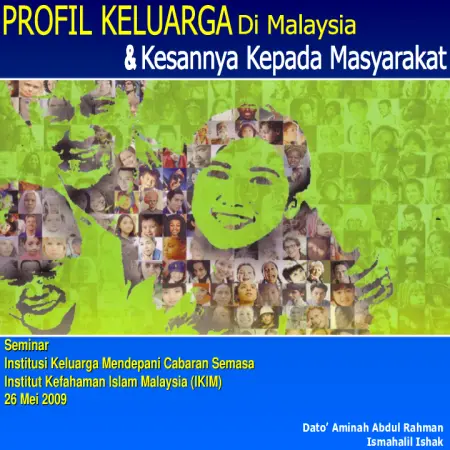
Abstract: Family institution in Malaysia is facing many changes and challenges. Functional families and the role of institutions is crucial to the development of human capital formation, human and potential development of each family members and influence the development and well-being of the people. Formation patterns and family relationships as well as family lifestyle can be seen in the demographic trends in Malaysia. Formation and family structure that encountered evolution has influenced some aspects of family life. Now family institutions are required to be more resilient in dealing with the challenges of life such as child care, dual-career couples, financial management, parenting teens and responsibilities to elderly parents.
|
|
|
|
|
|
Penduduk dan keluarga: penemuan Kajian Penduduk dan Keluarga Keempat
Item Type: Conference or Workshop Item
Editor:
Year: 00/00/2009
Abstract: This paper discusses the important findings of the Fourth Population and Family Survey conducted by NPFDB in 2004. This study is the fourth in a series of Malaysian Population and Family Survey (MPFS) conducted every ten years since 1974. In 2004, this study was for the first time conducted simultaneously for the whole of Malaysia. In contrast to the previous MPFS, MPFS-4 interviewed households consisting of five (5) categories, (a) Women aged 15 to 49 years, (b) Husbands of married women, (c) Adolescents aged 13 to 24 years, (d) Citizens aged 50 years and above, and (e) single residents aged 25 to 49 years. This study aims to provide time series data related to demographic and socio-economic information in particular the relationship between population, family and human reproduction with development. The results of the study are used to evaluate the effectiveness of existing development programs and also used as input in the preparation of the Ninth Malaysia Plan (9MP). In this study data analysis was performed for the three areas separately. Among the important findings include: 1) Age structure of the population, 2) burden of dependents, 3) Delayed marriages, 4) Fertility, 5) Family planning, 6) Health practices, 7) Household composition, 8) Female labor force participation, 9) Child care, 10) The elderly, and 11) Adolescent social and sexual behavior.
|
|
|
|
|