Browse by Author
|
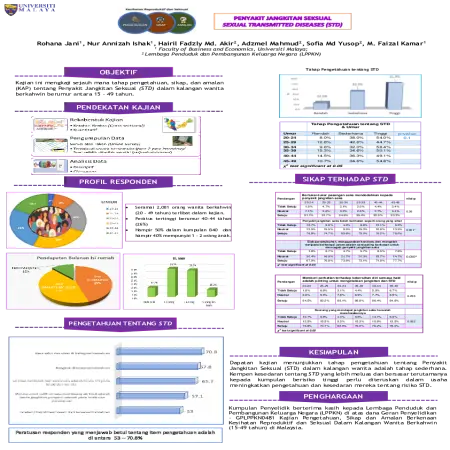
Penyakit Jangkitan Seksual= Sexual Transmitted Diseases (STD)
Item Type: Scientific Poster
Editor:
Year: 00/07/2024
Abstract: This study examines the extent of knowledge, attitudes, and practices (KAP) about Sexually Transmitted Diseases (STDs) among married women aged between 15-49 years. The findings of the study show that the level of knowledge about Sexually Transmitted Diseases (STDs) among women is moderate. Awareness campaigns about STDs that are more widespread and targeted especially at high-risk groups should be continued in an effort to increase their knowledge and awareness of the risks of STDs.
|
|
|
|
|
|
Project concept: a mixed method study of social psychological influences and affordability perception on fertility intentions in Malaysia
Item Type: Scientific Poster
Editor:
Year: 00/07/2024
Abstract: Malaysia, a culturally rich and economically strong Southeast Asian country, is experiencing a major demographic transition. In 1970, the Total Fertility Rate (TFR) was high at 4.9 children per woman, indicating a preference for larger families. By 2022, TFR has drastically reduced to 1.6 children per woman, below the replacement level of 2.1. Pronounced in urban areas especially Kuala Lumpur, with a TFR or just 1.2. The study aims to bridge gaps in understanding fertility intentions in urban Malaysia. Findings will inform public health policies and family planning programs, contributing to sustainable health systems.
|
|
|
|
|

|
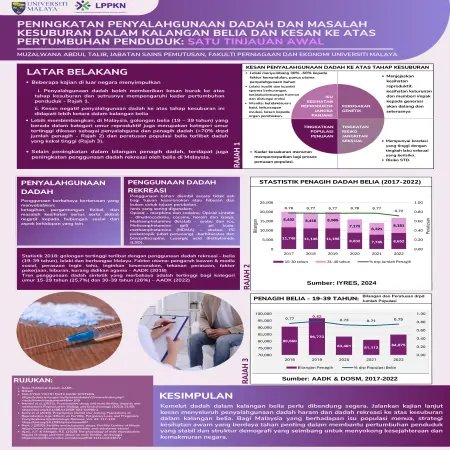
Peningkatan penyalahgunaan dadah dan masalah kesuburan dalam kalangan belia dan kesan ke atas pertumbuhan penduduk : satu tinjauan awal
Item Type: Scientific Poster
Editor:
Year: 00/07/2024
Abstract: Drug abuse can have an adverse effect on fertility levels and subsequently affect the rate of population growth. The negative effect of drug abuse on the level of fertility is found to be more significant among the youth. More worrying in Malaysia, the youth group (19-39 years) who are in the reproductive age category are also the highest age category detected as drug abusers and addicts (>70% of the total number of addicts) and the percentage of the youth population involved in drugs remains high.
|
|
|
|
|
|
Suara Keluarga, Masa Depan Negara: Kajian Penduduk dan Keluarga Malaysia Keenam (KPKM-6) 2024
Item Type: Video
Editor:
Year: 00/07/2024
Abstract: The Sixth Malaysian Population and Family Survey (MPFS-6) 2024 is the sixth study in a series of surveys conducted by the National Population and Family Development Board (NPFDB) since 1974. This study aims to provide up-to-date information and time-series data related to population, family, and reproductive health of the Malaysian population.
|
|
|
|
|

|
Video Promosi Kajian Penduduk dan Keluarga Malaysia Keenam (KPKM-6) 2024
Item Type: Video
Editor:
Year: 00/07/2024
Abstract: The Sixth Malaysian Population and Family Survey (MPFS-6) 2024 is the sixth study in a series of surveys conducted by the National Population and Family Development Board (NPFDB) since 1974. This study aims to provide up-to-date information and time-series data related to population, family, and reproductive health of the Malaysian population.
|
|
|
|
|

|
Assessing the status of implementation of the Programme of Action of the International Conference on Population and Development and its contribution to the follow-up and review of the 2030 Agenda for Sustainable Development during the decade of action and deliver for sustainable development
Item Type: Newsletter
Editor:
Year: 00/06/2024
Abstract: Despite facing numerous challenges, there is a significant progress has been made over the past 30 years since the implementation of the Programme of Action in Malaysia. This includes improvements such as increased life expectancies as well as better access to services and education on sexual and reproductive health.
|
|
|
|
|

|
The likelihood of self-perceived loneliness among older persons in Malaysia
Item Type: Article
Editor:
Year: 00/06/2024
Abstract: As people grow older, the risk of becoming lonely increases. Loneliness has a negative impact on both mental and physical health in older persons. Although research on loneliness among older persons is expanding, less is known about loneliness in Southeast Asia, particularly Malaysia. Therefore, this study’s purpose is to investigate the prevalence of loneliness and its associated factors among older persons in Malaysia using the most recent national survey data from the 2014 Malaysian Population and Family Survey. The sample was extracted to include ever-married Malays, other Bumiputera, and Chinese and Indian groups aged 60 and above who had children. Loneliness was measured using a single self-reported question about whether respondents had ever felt lonely, which was then categorized as a binary variable. A Chi-Square test was performed on feelings of loneliness across socio-demographic characteristics, mental health, physical health, family support, and social participation, followed by logistic regression analysis using significant variables as predictors. The prevalence of loneliness among older persons was 35.7%. The logistic regression showed that factors contributing to the likelihood of feeling lonely include being widowed, divorced, or separated, experiencing anxiety, physical limitations, and sharing problems with children. In contrast, residing in urban areas, having higher education levels, having more sources of income, having life satisfaction, perceiving life as meaningful, having fair and good self-rated health, co-residence with adult children, and participation in religious activities were associated with a lower likelihood of experiencing loneliness. Loneliness is a serious issue among older persons in Malaysia. The government, community, and family should immediately address this psychological problem. The study suggests the need for appropriate strategies for the prevention of loneliness should be developed in the near future.
|
|
|
|
|

|
The 57th Session of The Commission On Population And Development, United Nations New York, 29 April – 3 May 2024
Item Type: Country Statement
Editor:
Year: 00/05/2024
Abstract: Malaysia like many other countries is becoming an aging nation due to declining fertility and increasing life expectancy. As 10.7 per cent of its population aged above 60 in 2020, Malaysia is expected to reach aged nation status by 2030. In this regard, Malaysia has revised its National Policy for Older Persons to enhance the integration of the elderly into society and introduced measures to boost the number of geriatricians and aged care health professionals under the National Health Policy for Older Persons. Malaysia's commitment to adolescent healthcare is evident in the National Adolescent Health Plan of Action (2015-2020) and the revised National Policy and Plan of Action on Social and Reproductive Health Education (2022-2025). These initiatives emphasize sexual and reproductive health education rooted in religious and moral principles across different settings and age groups. The Government also provides comprehensive health care services which includes contraceptive and sexual and reproductive health services that are integrated into primary health-care facilities nationwide. Family planning services are also provided by the National Population and Family Development Board of the Ministry of Women, Family and Community Development, NGOs such as the Family Planning Associations as well as private practitioners.
|
|
|
|
|

|
SDGS and the impact of megatrends on Families: perspectives from Malaysia
Item Type: Conference or Workshop Item
Editor:
Year: 00/05/2024
Abstract: 57th Commissions on Population and Development (CPD57): Assessing the status of implementation of the Programmed of Action of the International Conference on Population and Development and its contribution to the follow-up and review of the 2030 Agenda for Sustainable Development during the decade of action and delivery for sustainable development. Strengthening Malaysian Families in era of megatrends, National Population and Family Development Board Malaysia (NPFBD) had LPPKN Family Centre, Nur Sejahtera Clinic Services, Population and Family Research, Training and education (family), Counseling service and program, online accessibility etc.
|
|
|
|
|

|
Bridging Boundaries: Empowering SRHE Through KafeTEEN Peer Educators
Item Type: Conference or Workshop Item
Editor:
Year: 00/05/2024
Abstract: There is increase in sexual activity prevalence among youth and high risk practice among youth who engaged in sexual activity. SRHE knowledge is known to be one of protective factors in preventing youth from engaging in high risk sexual activity. KafeTEEN YOUTH Centre Program is one of NPFBD initiative to lead SRH education dissemination for youth in Malaysia.
|
|
|
|
|