Browse by Type
|
Analisis situasi kependudukan dan kekeluargaan di Malaysia
Item Type: Research Report
Editor:
Year: 01/12/2018
Abstract: The evolution of population and family policy in this country has begun since the implementation of the National Family Planning Programme by the National Family Planning Board (NFPB) in 1966. The main purpose of the programme was to reduce the population growth rate from 3% to 2% by 1985. Apart from Malaysia, other Asian countries also introduced
a family planning programme to its population in the 1960s where the earliest country to introduce the programme was India around the 1950s. As a result of the introduction of the family planning programme in the 1960s, the country’s gross birth rate has decreased from 36.7 babies in 1966 to 31.5 babies per 1,000 population in 1985. This directly makes the average annual population growth rate of the country declined from 3.0% per annum in 1966 to 2.8% per annum in 1980.
|
|
|
|
|
|
Amalan perancangan keluarga di Malaysia: cabaran dan hala tuju
Item Type: Conference or Workshop Item
Editor:
Year: 00/00/2018
Abstract: Family planning allows people to attain their desired number of children and determine the spacing of pregnancies. It is achived through use of contraceptive method and the treatment of infertility. Proportion of women of reproductive aged 15-49 years who have their need for family planning satisfied with modern methods.
|
|
|
|
|
|
Ajar anak hargai ibu bapa
Item Type: Article
Editor:
Year: 00/07/2017
Abstract: Parents are the most important people in everyone's life. Their service to us is priceless. Ever since we were in the womb, the mother has carried us in her womb for 9 months and 10 days and it is the mother who gave birth to us. Not to be forgotten is also the role of the father who is the leader and takes care of us to the best of our ability. We can show love to our parents by respecting and obeying them. Our parents have instilled pure values in us and educated us since childhood to the best of our ability.
|
|
|
|
|

|
A Review of The National Population Policy : Strategic Action Plan for Sustainable Development Towards 2030.
Item Type: Report
Editor:
Year: 00/07/2017
Abstract: Globalization, technology, and the continuous strive for progress has changed the way people work, live, and build relationships with each other. Across the world, more people are traveling across borders for work, as the world becomes smaller and open markets continue to emerge; people are flocking to the largest cities, creating more pressure on infrastructure, housing and jobs, while also representing social challenges; the rise of the ‘me-culture’ versus the concern and responsibility for the collective ‘family’ is set to continue, while family formation is occurring later and trending towards small-sized norms. Technology, while it has made us all more connected, has made us lonelier as well.
Malaysia is not immune to these global trends. The world is evolving rapidly: new jobs that did not exist before are being created every day, giving rise to an unpredictable future. In order to prepare Malaysians to excel in such an unpredictable future, an effective population policy, updated to best meet the nation’s on-going and future population challenges, needs to be in place.
|
|
|
|
|
|
Ageing phenomenon: Malaysia towards 2030
Item Type: Newsletter
Editor:
Year: 00/00/2017
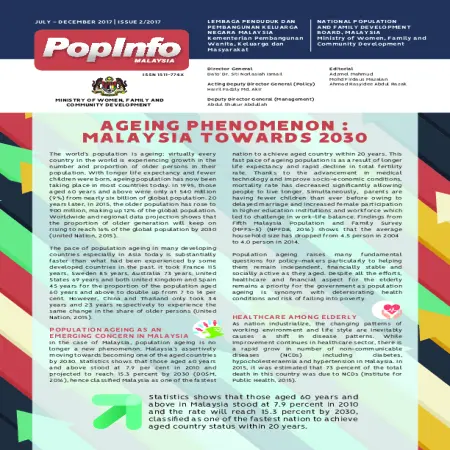
Abstract: Statistics shows that those aged 60 years and above in Malaysia stood at 7.9 % in 2010 and the rate will reach 15.3 % by 2030, classified as one of the fastest nation to achieve aged country status within 20 years. This fast pace of ageing population is as a result of longer life expectancy and rapid decline in total fertility rate.
|
|
|
|
|
|
Analisis strategi kelangsungan hidup migran pekerja Bugis Indonesia ke Sabah
Item Type: Conference or Workshop Item
Editor:
Year: 00/00/2016
Abstract: Bugis migration to Sabah especially the Tawau Division in the 19th Century not only had provided the workforce but also created the early Bugis community in Sabah. They had assimilated with local people and become Malaysian citizens after the formation of Malaysia in 1963. Bugis migration flow to Sabah still continues to date and it is difficult to control. This paper studies migration of Indonesian workers phenomenon, especially the Bugis who dominate a few districts in Tawau and Sandakan Divisions. In collaboration with the LPPKN, a study involving 896 Indonesian workers who responded to a survey was conducted using face-to-face interview, while 20 legal and illegal workers, respectively participated in the in-depth interview. This study focuses on survival strategies using the role of social network in assisting migration process in three phases namely pre, while and post migration. This study found that new migrants were assisted by social network to reduce migration cost to achieve successful migration. Based on the Push and Pull theory, the decision to migrate and the selection of migration destination was influenced by economic factors such as job opportunity and wages in the origin and destination which could be explained by Neo Classical Economy theory. What is more important was, this study found that, non-economic pull factors such as social network, historical links and geographical proximity; as well as culture, ethnicity, religion and language similarity strongly influenced new migrants in making the decision to migrate. In conclusion, survival strategies using trusted social network crosses political boundary has continued to assist flow of information and resources, and reduced the risk of unsuccessful migration. Ethnicity-based recruitment strategy assisted by Mandur was found to be beneficial and thus, maintaining the migration flow of Bugis to Sabah until today.
|
|
|
|
|