Browse by Type
|
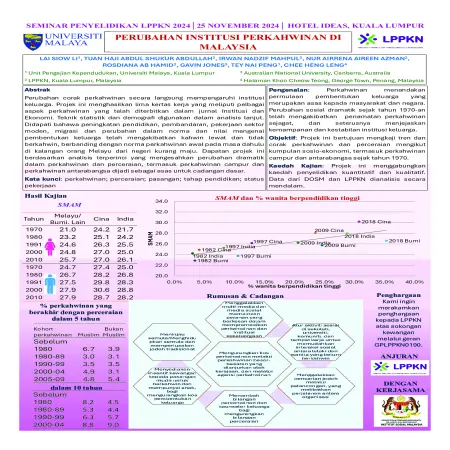
Kompilasi Hasil Geran Penyelidikan LPPKN 2021-2023
Item Type: Research Report
Editor:
Year: 00/03/2025
Abstract: To further enhance research in the fields of population, family, and reproductive health, the National Population and Family Development Board (LPPKN) took a proactive step by establishing the LPPKN Research Grant (GP LPPKN) in 2021. GP LPPKN serves as a platform and catalyst for local researchers to conduct studies in these areas. All findings and inputs obtained through GP LPPKN have been compiled into the Compilation of LPPKN Research Grant Findings 2021–2023.
The publication of the Compilation of LPPKN Research Grant Findings 2021–2023 focuses on population, family, and reproductive health. The main objective of implementing GP LPPKN is to strengthen research in these three areas by producing new theories, holistic policy recommendations, innovative ideas, and creative outputs to enhance the well-being of families and society. A total of 28 researchers from local universities were awarded GP LPPKN grants, consisting of 9 in the field of population, 12 in family, and 7 in reproductive health.
Through GP LPPKN, researchers have successfully produced various outputs such as journal articles, policy briefs, modules, guidebooks, mobile applications, and intellectual property creations. The publication of this report, which compiles the research findings of GP LPPKN recipients, can be utilized and referenced not only by LPPKN but also by policymakers, program planners, module developers, researchers, and the general public in efforts to improve family and population well-being in Malaysia.
|
|
|
|
|
|
Dapatan data subfertitli Kebangsaan bagi tahun 2023
Item Type: Infographic
Editor:
Year: 00/12/2024
Abstract: The collection of subfertility data involves all registered hospitals and clinics providing subfertility treatment services throughout Malaysia from January 1, 2023, to December 31, 2023. The collected subfertility data has been approved by NPFDB (LPPKN), including information on the profiles of new female and male clients (husbands) in the current year, as well as details of subfertility treatments carried out at the participating facilities during the same period.
|
|
|
|
|

|
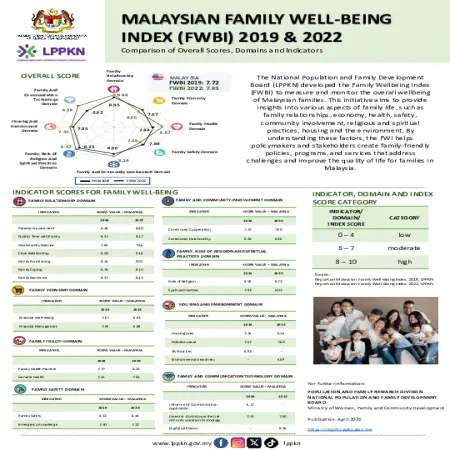
Malaysian Family Well-Being Index (FWBI) 2019 & 2022: Comparison of Overall Scores, Domains and Indicators
Item Type: Infographic
Editor:
Year: 00/12/2024
Abstract: The National Population and Family Development Board (LPPKN) developed the Family Wellbeing Index (FWBI) to measure and monitor the overall wellbeing of Malaysian families. This initiative aims to provide insights into various aspects of family life, such as family relationships, economy, health, safety, community involvement, religious and spiritual practices, housing and the environment. By understanding these factors, the FWI helps policymakers and stakeholders create family-friendly policies, programs, and services that address challenges and improve the quality of life for families in Malaysia. Overall scores Malaysia FWBI is 7.72 (2019) while Malaysia FWBI is 7.93 (2022)
|
|
|
|
|
|
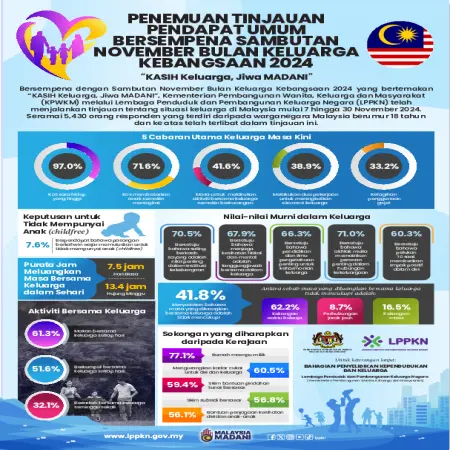
Penemuan tinjauan pendapat umum bersempena Sambutan November Bulan Keluarga Kebangsaan 2024
Item Type: Infographic
Editor:
Year: 00/11/2024
Abstract: In conjunction with the National Family Month celebration in November 2024, themed “KASIH Keluarga, Jiwa MADANI”, the Ministry of Women, Family and Community Development (KPWKM) through the National Population and Family Development Board (NPFBD) conducted a survey on the family situation in Malaysia from November 7 to 30, 2024. A total of 5,430 respondents, consisting of Malaysian citizens aged 18 and above, participated in this survey. The purpose of the survey was to gain a deeper understanding of the well-being, challenges, and perspectives of families in Malaysia, as well as to gain further insight into the social dynamics of families in the current context.
|
|
|
|
|
|
Coronavirus diseases (COVID-19) and psychological distress among urban-living older Malaysians
Item Type: Scientific Poster
Editor:
Year: 00/11/2024
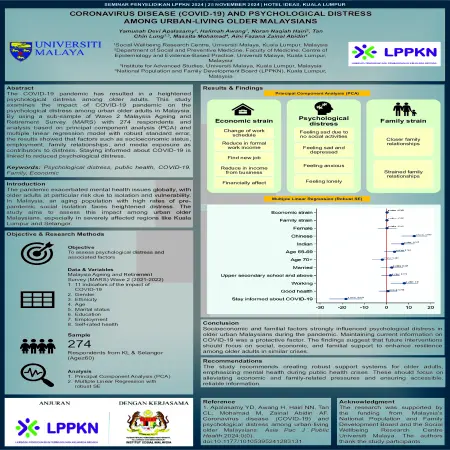
Abstract: The COVID-19 pandemic has resulted in a heightened psychological distress among older adults. This study examines the impact of COVID-19 pandemic on the psychological distress among urban older adults in Malaysia. By using a sub-sample of Wave 2 Malaysia Ageing and Retirement Survey (MARS) witg 274 respondents and analysis based on principal component Analysis (PCA) and multiple linear regression model with robust standard error, the results showed that factors such as socioeconomics status, employment, family relationship and media exposure as contributors to distress. Staying informed about COVID-19 is linked to reduced psychological distress.
|
|
|
|
|
|
Keberkesanan modul intervensi sexting untuk mengurangkan niat dan kesediaan sexting bagi pelajar Institusi Pengajian Tinggi
Item Type: Scientific Poster
Editor:
Year: 00/11/2024
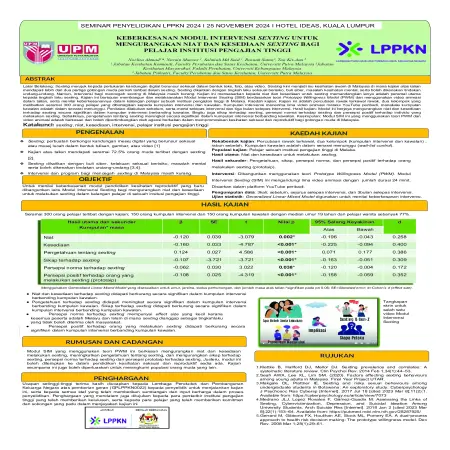
Abstract: Sexting refers to the exchange of sexually explicit content in the form of texts, photos, or videos. Sexting has become a public health issue in Malaysia, where online studies show that more than two-thirds of young people have engaged in sexting. Sexting is associated with risky sexual behavior, cyberbullying, mental health issues, and may lead to legal consequences. However, interventions to prevent sexting in Malaysia are still lacking. This study targets the intention and willingness to sext as these are key predictors of sexting behavior. The aim of this study is to develop and implement a Sexting Intervention Module (SIM) based on the Prototype Willingness Model (PWM) theory, using online animated videos, and to evaluate its effectiveness among students at a higher education institution in Melaka.
Study Method: This study is a randomized controlled trial involving 300 students divided into intervention and control groups. The intervention group received five animated videos via a private YouTube link, while the control group was placed on a waiting list. Assessments were made before, immediately after, and three months after the intervention.
Study Results: The module successfully reduced the intention and willingness to sext significantly in the intervention group compared to the control group. Similarly, attitudes towards sexting, perceived norms about sexting, and positive perceptions towards individuals engaging in sexting were also significantly reduced. On the other hand, knowledge about sexting increased significantly in the intervention group compared to the control group. Conclusion: The SIM module, which uses PWM theory and animated videos, is effective and can be considered by relevant agencies to promote sexual and reproductive health among young people in Malaysia.
|
|
|
|
|
|
Pembangunan Modul Psikopendidikan untuk memperkasa resiliensi belia B40 dan kefungsian keluarga dalam era Covid-19
Item Type: Scientific Poster
Editor:
Year: 00/11/2024
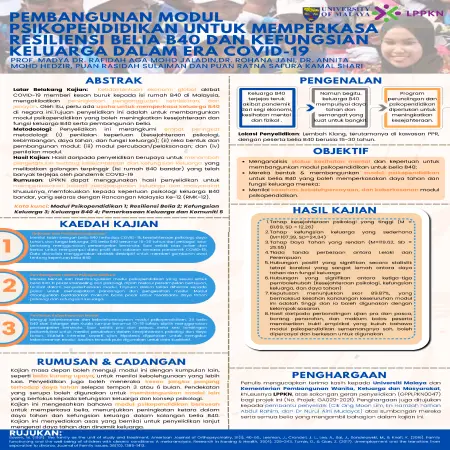
Abstract: The global economic uncertainty caused by COVID-19 has had a negative impact on B40 households in Malaysia, resulting in increased unemployment, poverty, and crime. Therefore, efforts are needed to empower the B40 families in the country. The aim of this research is to develop a psychoeducational module that can improve the well-being and functioning of B40 families as well as the development of youth.
Methodology: This research includes four methodological stages: (i) needs assessment (psychological well-being, concerns, resilience, and family functioning); (ii) design and development of the module; (iii) trial/implementation of the module; and (iv) module evaluation.
Study Findings: The results of the research are expected to increase knowledge on the well-being and functioning of families, particularly marginalized groups (urban B40 households) that have been significantly affected by the COVID-19 pandemic.
Conclusion: LPPKN can utilize the results of this research to strengthen family and community development initiatives, particularly focusing on the psychological needs of urban B40 families, in line with the 12th Malaysia Plan (RMK-12).
|
|
|
|
|
|
Digital parenting module to help Malaysian parents nurture digitally resilient children
Item Type: Scientific Poster
Editor:
Year: 00/11/2024
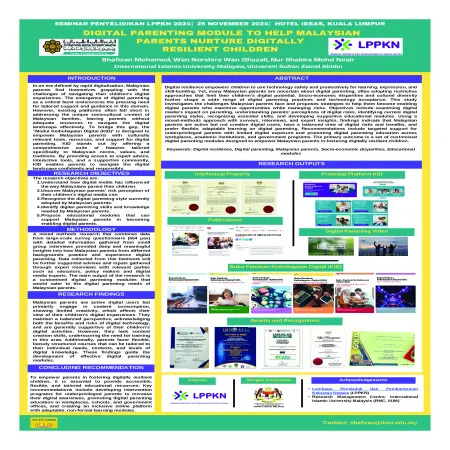
Abstract: Digital resilience empowers children to use technology safely and productively for learning, expression, and skill-building. Yet, many Malaysian parents are uncertain about digital parenting, often adopting restrictive approaches that limit their children’s digital potential. Socio-economic disparities and cultural diversity further shape a wide range of digital parenting practices and technology acceptance. This study investigates the challenges Malaysian parents face and proposes strategies to help them become enabling digital parents who maximize opportunities while managing risks. Objectives include examining digital media’s impact on parenting, understanding parents' perceptions of digital risks, identifying current digital parenting styles, recognizing essential skills, and developing supportive educational modules. Using a mixed-methods approach with surveys, interviews, and expert insights, findings indicate that Malaysian parents are active but not creative digital users, have a balanced view of digital risks and benefits, and prefer flexible, adaptable learning on digital parenting. Recommendations include targeted support for underprivileged parents with limited digital exposure and promoting digital parenting education across workplaces, academic institutions, and government programs. The primary outcome is a set of customized digital parenting modules designed to empower Malaysian parents in fostering digitally resilient children.
|
|
|
|
|
|
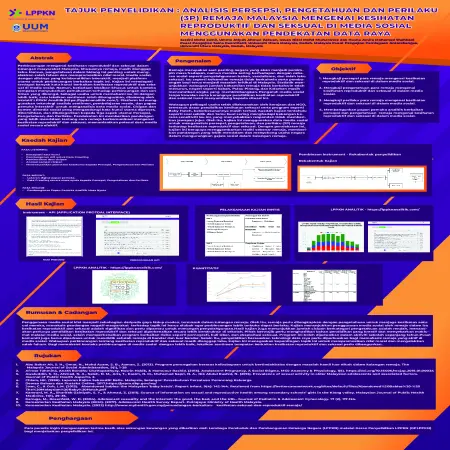
Analisis persepsi, pengetahuan dan perilaku (3P) remaja Malaysia mengenai kesihatan reproduktif dan seksual di media sosial menggunakan pendekatan data raya
Item Type: Scientific Poster
Editor:
Year: 00/11/2024
Abstract: Discussion on reproductive and sexual health among Malaysians, particularly adolescents, is still considered taboo. However, knowledge in this area is crucial to avoid misunderstandings and promote moral values. Social media, with its collaborative and interactive nature, has become the main platform for discussions on these topics. This study found that there are many keywords related to reproductive and sexual health on social media. However, the lack of a specific lexicon for the local context makes it difficult to understand the discussions and sentiments shared.
To better understand this issue, a sentiment lexicon has been developed, supported by the LPPKN Analytics initiative (https://lppknanalitik.com/). This platform uses sentiment analysis technology, machine learning, and interactive dashboards to analyze social media data. Tweets and comments on social media that contain key keywords are processed, cleaned, and categorized into three main aspects: Perception, Knowledge, and Behavior. This approach provides deeper insights into how adolescents communicate about reproductive and sexual health, effectively utilizing the potential of social media data.
|
|
|
|
|
|
Perubahan institusi perkahwinan di Malaysia
Item Type: Scientific Poster
Editor:
Year: 00/11/2024
Abstract: The changing patterns of marriage directly affect the family institution. This project produced five papers covering various aspects of marriage, which have been published in the Journal of Institutions and Economics. Statistical and demographic techniques were used in further analysis. It was found that increased education, urbanization, employment in the modern sector, migration and changes in norms and values regarding family formation have led to later marriages and unmarried individuals, compared to the earlier marriage norms among Malays in less developed states. The findings of this project, based on detailed analysis, confirm dramatic changes in marriage and divorce trends, including mixed marriages and international marriages, which serve as the basis for policy recommendations.
|
|
|
|
|