Browse by Type
|
Resilient families coping with sudden demise husband: an exploratory and empirical study of 50 nuclear urban middle class families in North India
Item Type: Conference or Workshop Item
Editor:
Year: 00/00/2009
Abstract: The paper offers research based Resilient Indian Family Template' culled from the coping practices adopted by 50 Nuclear Urban Middle Class Families in North India in the eventuality of sudden loss of husband. Convenient random sampling technique of data collection was employed for choosing the 50 families in question. Further interview and narrative methodology was used to elicit information from the families. Sudden loss of husband was accompanied by emotional and health problems for the surviving spouse, acute feeling of loneliness, decreased standard of living for the family, increased moral support from close relatives, children especially grown ups showing more restraint and responsibility in their habits and one member (in most cases it was wife) taking up income generating activity. Coping practices adopted by these families helped them rebound from crisis.
|
|
|
|
|
|
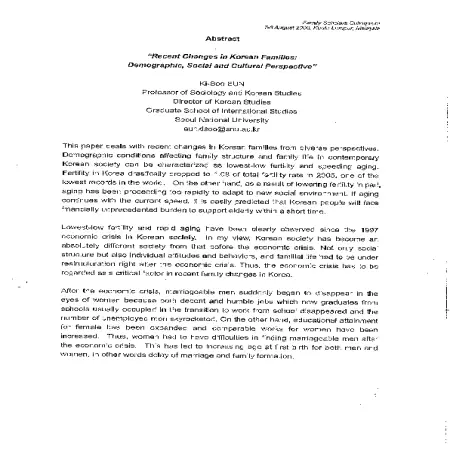
Recent changes in Korean families: demographic, social and cultural perspective
Item Type: Conference or Workshop Item
Editor:
Year: 00/00/2006
Abstract: This paper deals with recent changes in Korean families from diverse perspectives. Demographic conditions affecting family structure and family life in contemporary Korean society can be characterized as lowest-low fertility and speeding aging. Fertility in Korea drastically dropped to 1.08 of total fertility rate in 2005, one of the lowest records in the world. On the other hand, as a result of lowering fertility in part, aging has been proceeding too rapidly to adapt to new social environment. If aging continues with the current speed, it is easily predicted that Korean people will face financially unprecedented burden to support elderly within a short time. Lowest-low fertility and rapid aging have been clearly observed since the 1997 economic crisis in Korean society. In my view, Korean society has become an absolutely different society from that before the economic crisis. Not only social structure but also individual attitudes and behaviors and familial life had to be under restructuration right after the economic crisis. Thus, the economic crisis has to be regarded as a critical factor in recent family changes in Korea. Educational attainment for female has been expanded and comparable works for women have been increased. Thus, women had to have difficulties in finding marriageable men after the economic crisis. This has led to increasing age at first birth for both men and women, in other word delay marriage and family formation. Korean family has shown several new features in the late 1990s and early 2000s. One is the decreasing family formation. Another is increasing remarriage in Korea. Remarriage, in particular women's remarriage was negatively stigmatized according to a Confucian legacy to prohibit women's remarriage in traditional times. This custom has been remained for a long time. However, increasing divorce not only at younger ages but at middle and older ages has widened the possibility of remarriage for both men and women. Tolerance toward remarriage at the societal level has also greatly increased according to various family surveys. Even first-time marriage by men has been made with divorced or bereaved women. Another feature in contemporary marriage in Korea is a soaring international or interracial marriage, especially for Korean men. Single men in rural area have had so many difficulties in finding marriage partner because Korean women would not like to marry farmers or men residing in rural area. Under the shortage of marriageable women, rural men began to seek foreign bride, firstly from China and then Vietnam these day. Thus, more than one to ten marriages are now an interracial marriage in Korea. Changing demographic and familial conditions results in small size of family in Korea. The average number of household members is now less than three. On the other hand, one-person household is remarkably increasing in both urban and rural areas because of increasing divorce, deepening aging and increasing number of the female bereaved, and wide pursuit of independent life by younger generation. Also, with this trend, the proportion of female head of household is steadily increasing. However, female household heads are more suffering from poverty than male counterparts because of sex-discriminatory labor market, lack of women-friendly welfare policy and dual burden by the traditional patriarchal family system.
|
|
|
|
|
|
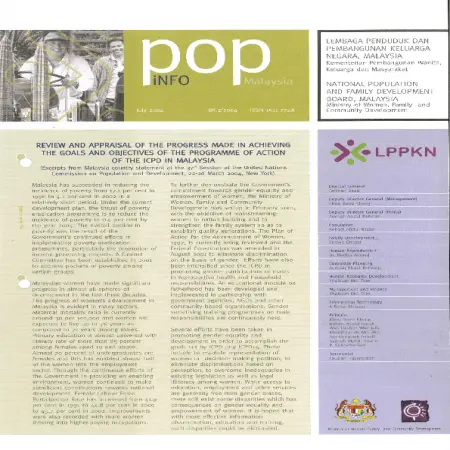
Review and appraisal of the progress made in achieving the goals and objectives of the programme of action of the ICPD in Malaysia
Item Type: Newsletter
Editor:
Year: 00/07/2004
Abstract: The role of the civil society organisations and non-government organisations as partners in the implementation of population programmes has been recognised and supported in Malaysia. Their involvement, participation, sharing resources and consultation have been pivotal to the sucess of the population related programmes.Since ICPD, annual dialogues between Government and NGOs have been conducted to facilitate greater smart partnership. Recognizing their role, grants are made available by the Government to NGOs to enable them to play more effective role in grassroot programmes and activities.
|
|
|
|
|
|
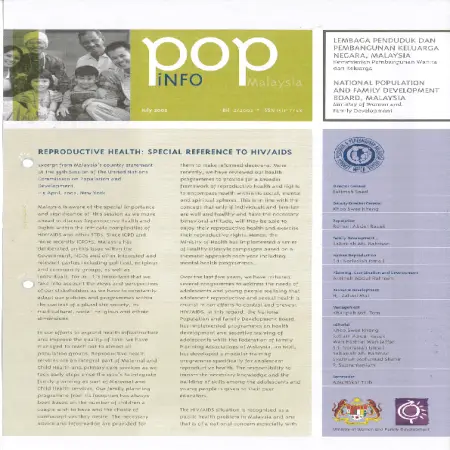
Reproductive health: special reference to HIV/AIDS
Item Type: Newsletter
Editor:
Year: 00/07/2002
Abstract: The HIV/AIDS situation is recognised as a public health problem in Malaysia and one that is of a national concern especially with regard to the spread of HIV / AIDS among young people and to newborns through mother-to-child transmission. Since the first case of AIDS was reported in Disember 1986, there has been a geometric increase in the number of HIV infections. Over the last seven years (1995-2001), the average number of new cases reported annually was 4,716. By 2001, the cumulative number of HIV infections was 44,208 with 1,258 cases of AIDS and 934 deaths.
|
|
|
|
|
|
Report of the Malaysian Family Life Survey-II 1988
Item Type: Research Report
Editor:
Year: 00/00/1992
Abstract: MFLS-2 was, in part, a follow-up to the original Malaysian Family Life Survey, fielded in 1976-1977, reinterviewing original respondents and their adult children, plus interviewing a new group of women age 18-49 in 1988. The information that is collected are household-level retrospective and current data from women and their husbands, covering such topics as fertility, nuptiality, migration, mortality, employment, household composition, transfers, and income as well as social, economic, and community-level factors affecting family decision making. MFLS-2 added a sample of older Malaysians to support research on their living standards, health, and intergenerational transfers.
|
|
|
|
|
|
Report of the Population and Family Survey in Sarawak - 1989
Item Type: Research Report
Editor:
Year: 00/00/1992
Abstract: The main objective of the Population and Family Survey in Sarawak was to provide necessary data for the formulation, implementation and evaluation of population and family development programmes, in line with national objectives. Specifically, the survey was conducted to collect information on socio-cultural determinants of fertility and maternity patterns, fertility preferences and behaviour, female labour force participation, childcare arrangement, family life, family planning practices, socio-economic status of subgroups, as well as population profiles and migratory patterns.
|
|
|
|
|
|
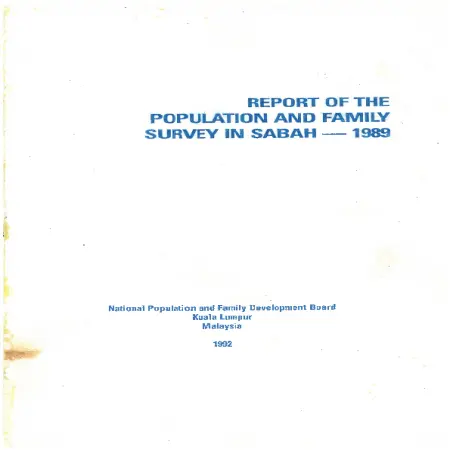
Report of The Population and Family Survey in Sabah - 1989
Item Type: Research Report
Editor:
Year: 00/00/1992
Abstract: The main objective of the survey was to provide necessary data for the formulation, implementation and evaluation of population and family development programmes, in line with national objectives. Specifically, the survey was conducted to collect information on socio-cultural determinants of fertility and maternity patterns, fertility preferences and behaviour, female labour force participation, childcare arrangement, family life, family planning practices, socio-economic status of subgroups, as well as population profiles and migration patterns.
|
|
|
|
|