Browse by Type
|
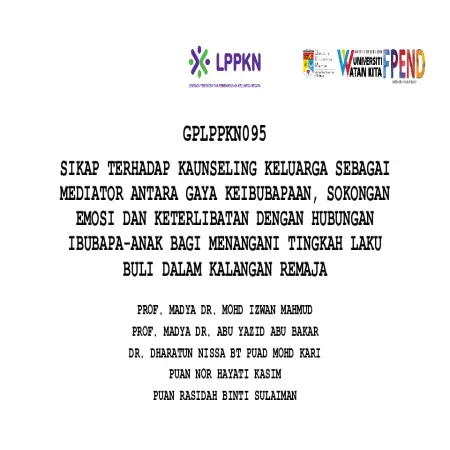
Sikap Terhadap Kaunseling Keluarga Sebagai Mediator Antara Gaya Keibubapaan, Sokongan Emosi dan Keterlibatan Dengan Hubungan Ibubapa-Anak Bagi Menangani Tingkah Laku Buli Dalam Kalangan Remaja
Item Type: Conference or Workshop Item
Editor:
Year: 00/07/2026
Abstract: This study aims to examine the influence of family dynamics on bullying behavior among teenagers, focusing on parenting styles, emotional support, and parental involvement. It also looks at the role of parent-child relationships and attitudes toward family counseling as mediating factors. The study emphasizes that family dynamics play an important role in shaping teenage behavior, with positive family relationships and an openness to counseling being key mechanisms in reducing bullying behavior.
|
|
|
|
|
|
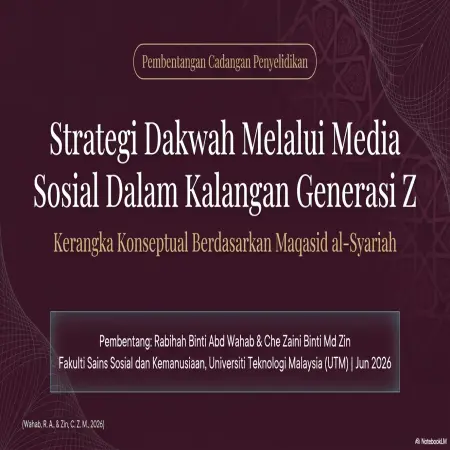
Strategi Dakwah Melalui Media Sosial Dalam Kalangan Generasi Z: Kerangka Konseptual Berdasarkan Maqasid Al-Syariah
Item Type: Conference or Workshop Item
Editor:
Year: 00/07/2026
Abstract: Conceptual and practical contribution: integrating the 3 main dimensions (Gen Z, Social Media, Maqasid) into a complete da'wah ecosystem and shifting from just popularity metrics (likes/views) to metrics of blessing and ethics. The suggestion for the next study is to test this conceptual framework empirically through field analysis (quantitative/qualitative) to measure actual changes in attitudes and religious behaviors of Generation Z.
|
|
|
|
|
|
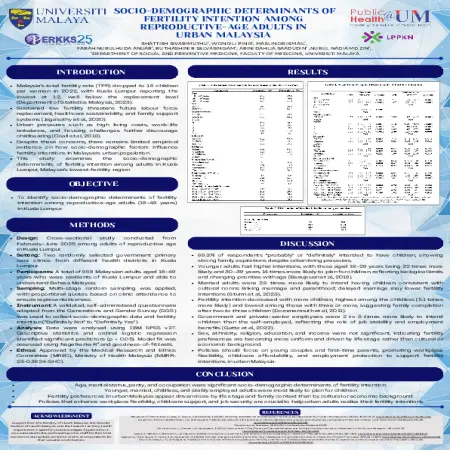
Socio-demographic determinants of fertility intention among reproductive-age adults in urban Malaysia
Item Type: Scientific Poster
Editor:
Year: 00/11/2025
Abstract: Malaysia’s total fertility rate (TFR) dropped to 1.6 children per woman in 2022, with Kuala Lumpur reporting the lowest at 1.2, well below the replacement level. Sustained low fertility threatens future labour force replacement, healthcare sustainability, and family support sustems. Urban pressures such as high living costs, work-life imbalance, and housing challenges further discourage childbearing. Despite these concerns, there remains limited empirical evidence on how socio-demographic factors influence fertility intentions in Malaysia’s Urban population. This study examines the socio-demographic determinants of fertility intention among adults in Kuala Lumpur, Malaysia’s lowest-fertility region.
|
|
|
|
|
|
Situasi kemiskinan dan peranan Kerajaan dalam menanganinya
Item Type: Conference or Workshop Item
Editor:
Year: 00/08/2025
Abstract: Malaysia's poverty statistics show a total of 295,706 households, consisting of 295,256 poor households and 450 hardcore poor households. The government plays a role in terms of policy formulation, provision of aid, social protection, job offerings, income improvement, education/human capital, and infrastructure/housing. Sejahtera MADANI is one of the initiatives for public welfare.
|
|
|
|
|

|
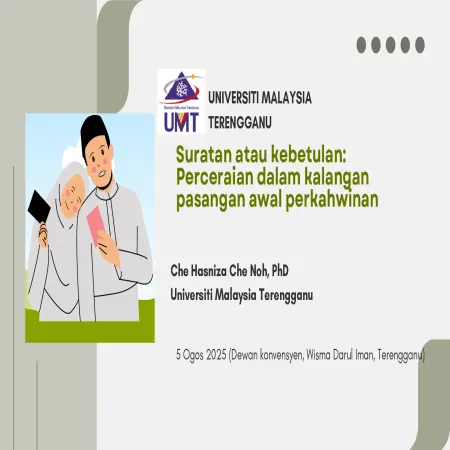
Suratan atau kebetulan: perceraian dalam kalangan pasangan awal perkahwinan
Item Type: Conference or Workshop Item
Editor:
Year: 00/08/2025
Abstract: Divorce among Muslim couples increased by 45.8% in 2022, with 46,138 cases compared to 31,650 cases in 2021. This divorce rate is more pronounced among young couples (ages 30-34). An analysis of 50 sampled divorce cases based on Divorce Certificates from 2020 to 2023 in Terengganu showed that the highest divorce rate was for marriages lasting between 1 to 5 years. In summary for the years 2020 (27 cases), 2021 (18 cases), 2022 (17 cases) and 2023 (21 cases).
|
|
|
|
|
|
Suara Keluarga, Masa Depan Negara: Kajian Penduduk dan Keluarga Malaysia Keenam (KPKM-6) 2024
Item Type: Video
Editor:
Year: 00/07/2024
Abstract: The Sixth Malaysian Population and Family Survey (MPFS-6) 2024 is the sixth study in a series of surveys conducted by the National Population and Family Development Board (NPFDB) since 1974. This study aims to provide up-to-date information and time-series data related to population, family, and reproductive health of the Malaysian population.
|
|
|
|
|

|
SDGS and the impact of megatrends on Families: perspectives from Malaysia
Item Type: Conference or Workshop Item
Editor:
Year: 00/05/2024
Abstract: 57th Commissions on Population and Development (CPD57): Assessing the status of implementation of the Programmed of Action of the International Conference on Population and Development and its contribution to the follow-up and review of the 2030 Agenda for Sustainable Development during the decade of action and delivery for sustainable development. Strengthening Malaysian Families in era of megatrends, National Population and Family Development Board Malaysia (NPFBD) had LPPKN Family Centre, Nur Sejahtera Clinic Services, Population and Family Research, Training and education (family), Counseling service and program, online accessibility etc.
|
|
|
|
|

|
Stress dan tahap kesejahteraan sosial pasca pandemik covid19: Satu tinjauan
Item Type: Book Section
Editor:
Year: 01/12/2022
Abstract: Since the start of the Coronavirus Disease 19 (COVID-19) pandemic in late 2019, the highest daily deaths recorded in Malaysia were 408 and until the end of the pandemic period, on 30 March 2022, the cumulative death toll was over 35,800 deaths. Throughout the pandemic phase, every Malaysian individual of all ages, races and economic social backgrounds received the impact of the phased implementation of the Phased Movement Control Order policy implemented by the government. This paper aims to identify the factors that influence the level of stress of parents during the post COVID-19 pandemic in Malaysia.
|
|
|
|
|
|
Socio demographics determinants of contraceptive use among women in Malaysia: logistic regression model
Item Type: Book Section
Editor:
Year: 00/06/2022
Abstract: Family planning could be defined as the ability of individuals and couples to anticipate and achieve their births. There are many types of contraceptive methods that can be used in family planning that could divided into two categories; namely modern and non-modern contraceptives methods. The choice whether to use modern or non-modern methods is said to be related to the socio demographic determinants of contraceptive use among ever married women aged 15-49 in Malaysia. Data used in this study was obtained from a national survey called Fifth Malaysia Population and Family Survey (MPFS-5) which was conducted by the National Population and Family Development Board in 2014. Multi-stage stratified random sampling method was used across all states in Malaysia. A total of 2736 ever married women who use contraception aged 15-49 years old were subjected to a face-to-face interview. The information was obtained on socio demographic characteristics and family planning practise. Data was analysed by using descriptive analysis, Chi-Square analysis and binary logistic regression. Findings of the analysis revealed that amongst five socio-demographic characteristics under study which are stratum, ethnicity, education level, age and income, only three socio-demographic characteristics known as stratum, ethnicity and education level present a significant association to the modern and non-modern contraceptive use among ever married women in Malaysia. In conclusion, the stratum or the location which either from urban or rural areas, the ethnicity which either Malay, other Bumiputera, Chinese or Indian, and the education level which either no education, primary school, secondary school or tertiary school, are the determinants of modern and non-modern contraceptive use among ever married women aged 15-49 in Malaysia
|
|
|
|
|