Browse by Type
|
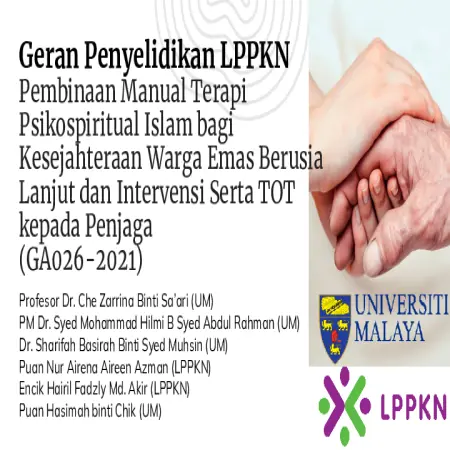
Evaluating digital and financial well-being of urban low-income families: insights into government assistance programs and post-COVID-19 resilience
Item Type: Scientific Poster
Editor:
Year: 00/11/2024
Abstract: This study examines the impact of government assistance programs on the digital and financial well-being of urban B40 families during the Covid-19 pandemic. Based on survey data from 417 Kuala Lumpur residents, findings show significant positive effects of government aid on digital and financial well-being. However, digital and financial well-being are not directly related. Importance-Performance Analysis (IPA) suggests a stronger need for digital assistance initiatives, highlighting areas for policy reform to improve resilience among vulnerable households in future crises.
|
|
|
|
|
|
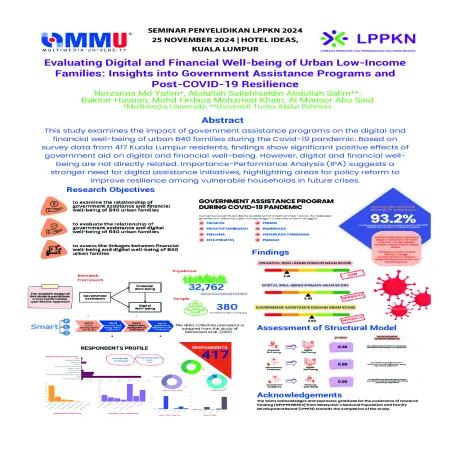
Modelling a comprehensive Long-Term Care Insurance (LTCI) plan for societal well-being in Malaysia
Item Type: Scientific Poster
Editor:
Year: 00/11/2024
Abstract: Malaysia is currently going through a demographic transition as an aging country that is affected by two main factors, namely the decline in the overall fertility rate, as well as the increase in average life expectancy. The elderly are often associated with a decline in physical and cognitive abilities, which requires them to seek long-term care. This poses a major challenge for a country facing the phenomenon of population aging, as it impacts society and the government, particularly in economic and social aspects. Accordingly, it is important for Malaysia to immediately formulate a comprehensive strategy to deal with issues related to the aging of the population, particularly in the aspect of long-term care, to ensure the well-being of the people, as well as the sustainability of the country's fiscal management. Data collection for this study was conducted through seven focus group discussion sessions from March to August 2022, where the focus was on the four main aspects of long-term care insurance (LTCI), namely benefits, financing, eligibility, and supply. Taking into account policy makers' targets as well as the country's fiscal and economic situation, this study presents three main recommendations which are i) the implementation of a social insurance plan as a post-retirement benefit; ii) development of care economy; iii) increasing the retirement age limit. These measures are believed to help the country to meet the needs of the Malaysian community in facing the aging population transition.
|
|
|
|
|
|
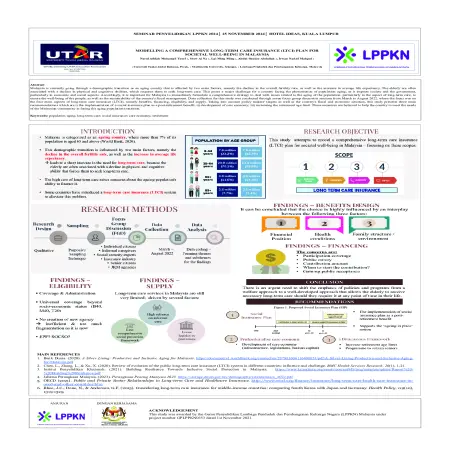
Penyakit jangkitan seksual (Std)
Item Type: Scientific Poster
Editor:
Year: 00/11/2024
Abstract: Reproductive and sexual health (SRH) is a key element in women's well-being and profoundly affects their quality of life. This study aims to assess the knowledge, attitude, and practices (KAP) regarding sexually transmitted diseases (STDs) among married women aged 15 to 49 years in Malaysia. A quantitative approach with a cross-sectional survey design was used in this study. A total of 2,081 respondents were involved, and data was collected through face-to-face interviews as well as self-administered, anonymous online questionnaires.
The results of the study indicate that women in Malaysia have a moderately high level of knowledge about STDs. Women from the Northern region, aged between 30 and 34 years, with 1-2 children, employed, educated, and with a B40 income category, showed significant knowledge about STDs (51.9%). Additionally, the majority of respondents (more than 90%) correctly understood that having multiple sexual partners increases the risk of exposure to STDs. The study also found that around 75 to 86% of respondents agreed that one should keep their STD status confidential.
These findings highlight that cultural norms and societal attitudes play an important role in shaping perceptions about STDs, which may influence behaviors and awareness of their prevention.
|
|
|
|
|
|
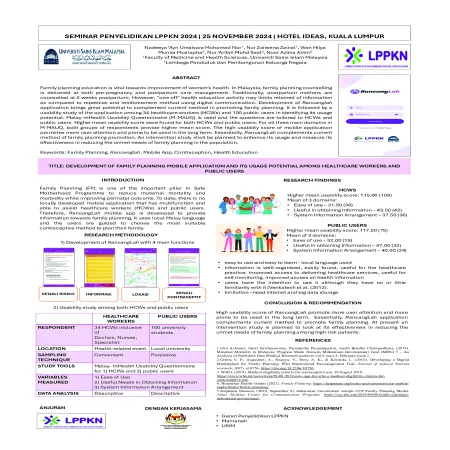
Development of family planning mobile application and its usage potential among healthcare workers and public users
Item Type: Scientific Poster
Editor:
Year: 00/11/2024
Abstract: Family planning education is vital towards improvement of women’s health. In Malaysia, family planning counselling is delivered at both pre-pregnancy and postpartum care management. Traditionally, postpartum mothers are counselled at 6 weeks postpartum. However, “one off” health education activity may limits retained of information as compared to repetitive and reinforcement method using digital communication. Development of Rancanglah application brings great potential to complement current method in promoting family planning. It is followed by a usability study of the application among 34 healthcare workers (HCWs) and 100 public users in identifying its usage potential. Malay-mHealth Usability Questionnaire (M-MAUQ) is used and the questions are tailored to HCWs and public users. Higher mean usability score were found for both HCWs and public users. For all three main domains in M-MAUQ, both groups of respondents provide higher mean score. The high usability score of mobile application promotes more user attention and prone to be used in the long term. Essentially, RancangLah complements current method of family planning promotion. An intervention study shall be planned to enhance its usage and measure its effectiveness in reducing the unmet needs of family planning in the population.
|
|
|
|
|
|
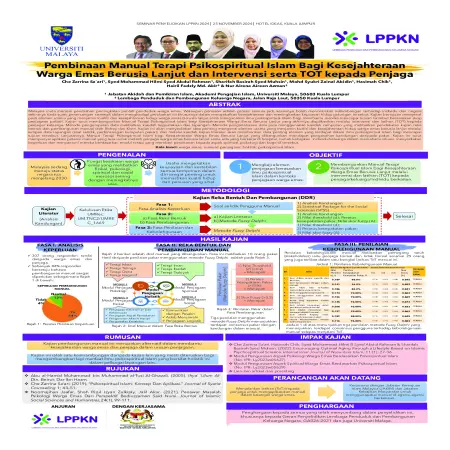
Pembinaan manual terapi psikospiritual Islam bagi kesejahteraan warga emas berusia lanjut dan intervensi serta TOT kepada penjaga
Item Type: Scientific Poster
Editor:
Year: 00/11/2024
Abstract: The aging population in Malaysia is increasingly becoming a concern. Although aging is a natural process, its effects can cause anxiety among individuals and the country if there is no strategic planning to address it, particularly in maintaining the well-being and improving the quality of life for the elderly. This study aims to identify key elements that ensure the quality of life and well-being of the elderly and analyze Islamic psychospiritual knowledge to help achieve these goals based on palliative care. The study also develops an Islamic Psychospiritual Therapy Manual for Elderly Well-being, which is applied through intervention and training (TOT) for caregivers/families. Data collection methods include literature review and fieldwork, while data analysis uses a mixed-method approach involving Richey and Klein's design and development study. This research will provide important data on the key elements that guarantee the quality of life for the elderly through field data collection (surveys, expert group discussions), and literature research will give valuable insights into psychospiritual elements in Islam that can help achieve this. Additionally, the developed manual for elderly well-being was content-validated by experts. This study also has the potential for widespread application, such as training elderly caregivers, whether working in hospitals, welfare homes, or within families, to better understand, meet the needs, and care for elderly individuals based on the therapeutic module focusing on spiritual, psychological, and cognitive aspects.
|
|
|
|
|
|
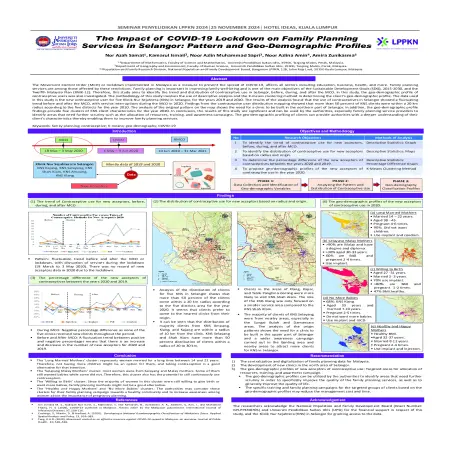
The impact of covid-19 lockdown on family planning services in Selangor: pattern and geo-demographic profiles
Item Type: Scientific Poster
Editor:
Year: 00/11/2024
Abstract: The Movement Control Order (MCO) or lockdown implemented in Malaysia as a measure to prevent the spread of COVID-19, affects all sectors including education, business, health, and more. Family planning services are among those affected by these restrictions. Family planning is important in improving family well-being and is one of the main objectives of the Sustainable Development Goals (SDG), 2015-2030, and the Twelfth Malaysia Plan (RMK-12). Therefore, this study aims to identify the trend and distribution of contraceptive use in Selangor, before, during, and after the MCO. In this study, the geo-demographic profile of contraceptive users was also investigated. The methodology of this study involves the use of descriptive analysis and the K-means clustering method in determining the client's geo-demographic profile. The data used in this study is the new contraceptive user for five Klinik Nur Sejahtera (KNS) in Selangor, for the years 2019 and 2020. The results of the analysis found that the use of contraceptives in Selangor showed a fluctuating trend before and after the MCO, with service interruptions during the MCO in 2020. Findings from the contraceptive user distribution mapping showed that more than 50 percent of KNS clients were within a 20 km radius according to the five districts for the year 2020. The analysis of the original pattern on the map shows the need for a clinic to be built in the northern part of Selangor. In addition, the geo-demographic profile findings provide five clusters of KNS client characteristics for the year 2020. In conclusion, the results of this study are significant and can be used by the authorities, especially family planning service providers to identify areas that need further scrutiny such as the allocation of resources, training, and awareness campaigns. The geo-demographic profiling of clients can provide authorities with a deeper understanding of their client's characteristics thereby enabling them to improve family planning services.
|
|
|
|
|
|
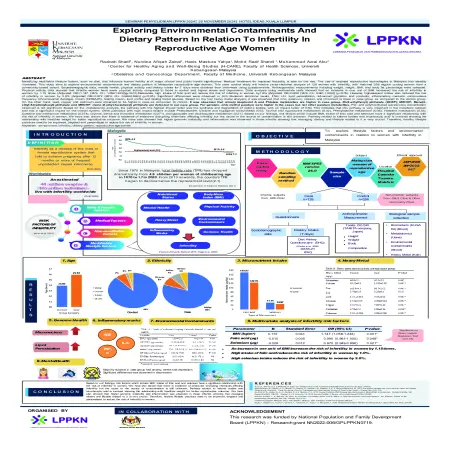
Exploring environmental contaminants and dietary pattern in relation to infertility in reproductive age women
Item Type: Scientific Poster
Editor:
Year: 00/11/2024
Abstract: Identifying modifiable lifestyle factors, such as diet, that influence human fertility is of major clinical and public health significance. Medical treatment for impaired fecundity is also on the rise. The use of assisted reproductive technologies in Malaysia has steadily increased. This study aims to explore environmental contaminants and dietary pattern in Malaysian reproductive age women. This case control study will involve cross-sectional analysis of 128 women with infertility, with matched 256 regular cycling women from a community-based cohort. Sociodemographic data, mental health, physical activity and dietary intake for 7 days were obtained from interviews using questionnaires. Anthropometric measurements including weight, height, BMI, and body fat percentage were collected. Physical activity data showed that infertile women have lower physical activity compared to those in control and higher stress and depression. Data analysis using multivariate tests showed that an increase in one unit of BMI increased the risk of infertility in women by 1.15 times [Adjusted OR=1.147 (95% CI= 1.059-1.243)])(p<0.01).Meanwhile, high intake of folic acid will reduce the risk of infertility in women by1.0% [Adjusted OR=0.990 (95% CI= 0.981-1.000)] (p<0.05). Likewise, highselenium intake also reduced the risk of infertility in women by 3.0% [Adjusted OR=0.972 (95% CI= 0.949-0.996)] (p<0.05). Significant differences were observed in Anti Mullerian Hormone levels, FSH, LH, lipid peroxidation, advanced glycation end products, inflammatory markers, micronucleus frequency (chromosomal damage), insulin (HOMA-IR), fasting insulin, lipid profile and fasting blood glucose. Based on the hair heavy metal analysis, it was observed that zinc, selenium, calcium and chromium is lower in case group as compared to the control group. On the other hand, lead, copper and cadmium were observed to be higher in case as compared to control. It was observed that urinary bisphenol A and Phtalate metabolites are higher in case group. Di-(2-ethylhexyl) phthalate (DHEP), MEHHP, Mono (2-ethyl-5-hydroxyhexyl) phthalate and MEOHP, mono (2-ethyl-5-oxohexyl) phthalate are detected in our case group. For paraben, only methyl paraben were higher in the cases but not other paraben metabolites. Per- and polyfluorinated substances) concentration observed is not significant. Based on the metabolomic analysis, the pathway with the highest impact factor was the synthesis and degradation of ketone bodies, with an impact factor of 0.60. This indicates that this pathway is very important in the metabolic network and has a significant impact on the overall system. Other pathways with high impact factors include Phenylalanine, tyrosine and tryptophan biosynthesis (0.5), Taurine and hypotaurine metabolism (0.42), Phenylalanine metabolism (0.35), Histidine metabolism (0.32), Cysteine and methionine metabolism (0.274), Glycine, serine and threonine metabolism (0.271), and glyoxylate and dicarboxylate metabolism (0.21). Based on our findings, risk factors which include BMI, intake of folic acid and selenium have a significant relationship with the risk of infertility in women. We have also shown that there is existence of endocrine disrupting chemicals affecting infertility but the cause or the source of contamination is still unknown. Pathway related to ketone bodies and tricarboxylic acid is involved showing the relationship with healthier weight for better reproductive outcome. We have also showed that higher genomic instability and inflammation was observed in those infertile showing that managing dietary and lifestyle related to it is very crucial. Therefore, healthy lifestyle practices need to be improved, targeted and personalized to reduce the risk of infertility in women.
|
|
|
|
|
|
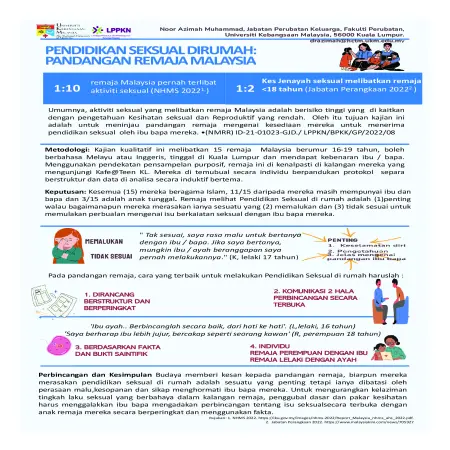
Pendidikan seksual di rumah : pandangan remaja Malaysia
Item Type: Scientific Poster
Editor:
Year: 00/11/2024
Abstract: Culture influences the views of adolescents, even though they believe that sexual education at home is important, it is often restricted by feelings of shame, modesty, and respect for their parents. To reduce the prevalence of risky sexual behaviors among adolescents, policymakers and health experts should encourage parents to have open discussions about sexual issues with their teenage children in a gradual manner, using factual information.
|
|
|
|
|
|
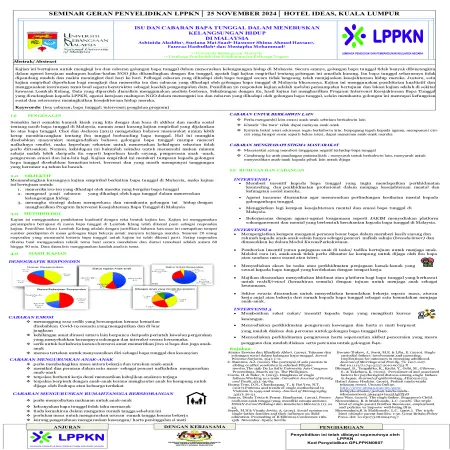
Isu dan cabaran bapa tunggal dalam meneruskan kelangsungan hidup di Malaysia
Item Type: Scientific Poster
Editor:
Year: 00/11/2024
Abstract: This study aims to examine the issues and challenges faced by single fathers in Malaysia in sustaining their livelihoods. Generally, single fathers are not discussed as much by government agencies or NGOs when compared to single mothers, and empirical research on this group is also quite limited. The issue of single fathers should not be taken lightly, as it is increasing day by day. The various challenges faced by single fathers have indirectly affected their overall well-being. Therefore, an empirical study is needed to investigate and explore the issues and challenges encountered by single fathers in Malaysia. This study uses a qualitative approach with semi-structured interviews as the data collection method. A total of 20 respondents were selected through purposive sampling, and the study was conducted in the Klang Valley area. The data obtained was analyzed using thematic analysis. The findings of this study resulted in the proposal of an Intervention Program for the Well-being of Single Fathers, which can be suggested to LPPKN, government agencies, or NGOs to address the issues and challenges faced by single fathers, while also helping this group achieve social functionality and ultimately improve their quality of life.
|
|
|
|
|
|
Pembinaan manual terapi psikospiritual Islam bagi kesejahteraan warga emas berusia lanjut dan intervensi serta TOT kepada penjaga
Item Type: Conference or Workshop Item
Editor:
Year: 00/11/2024
Abstract: It is projected that by 2050, the elderly population will be significantly larger than the number of children under the age of five, reaching two billion within the next 50 years. This growth wave also affects Malaysia, where the elderly population increased to 9.9% in 2020. Some elderly individuals experience spiritual distress due to the awareness that their lifespan is limited. The application of religious elements is considered the most effective method to address life's challenges, as it helps individuals achieve mental well-being. As a result, the research has developed a manual, namely the Islamic Psychospiritual Therapy Manual for the Well-being of Elderly Individuals, along with interventions and a Training of Trainers (TOT) program for caregivers.
|
|
|
|
|